

Horror Movies You Probably Haven’t Seen
A horror movie you probably haven’t seen isn’t just an obscure one. It is a film mainstream audiences missed because of a limited release, weak marketing, streaming burial, a language barrier, or because it was overshadowed by a louder hit from the same era, even though horror fans and critics have been recommending it for years.
This page is a discovery guide, not just a ranking. The 50 films below are tagged by fear type, by decade, by why they got buried, and rated on dread, visceral intensity, and re-watch value. Each entry includes where to stream it and what mainstream horror it pairs with, so a reader can pick a film by how they want to be scared and why they missed it.
The page uses two proprietary frameworks: the Six Buried-Movie Patterns, which identify the structural reasons each film got overlooked, and the Dread Rating, which scores films on three independent scales. Both are explained in full below.
Find Your Entry Point
Just finished Hereditary and want something harder? Start at #9. Love The Conjuring, but want something nobody has heard of? Start at #37. Enjoy slow-burn atmospheric horror? Go straight to #19. Ready for the most disturbing film on this list? Jump to #27 and read the warning first. If you want a fuller match based on specific films you already love, there is a complete pairing table further down in the If You Liked X section.
Dread Leaderboard
Highest Dread score (5/5): Lake Mungo (#1), Session 9 (#2), Possum (#3), They Look Like People (#4), Resurrection (#6), Saint Maud (#7), The Dark and the Wicked (#12), Hagazussa (#22), Relic (#23), Martyrs (#27), Kill List (#28), The Coffee Table (#31), Noroi: The Curse (#17), The Wailing (#18), Carnival of Souls (#25), Event Horizon (#35), Angst (#47)
Highest Visceral score (5/5): Martyrs (#27), Inside (#29), Baskin (#30), The Coffee Table (#31), Angst (#47)
Highest Re-watch score (5/5): Lake Mungo (#1), Cure (#36), The House of the Devil (#20), The Empty Man (#40), Trick r Treat (#41)
What Counts as a Horror Movie You Probably Haven’t Seen?
A horror movie qualifies as “probably haven’t seen” when it is under-watched relative to its quality, not when it is unknown to everyone. A film can be a familiar title in horror communities and still be invisible to mainstream audiences. That gap is what this page maps.
What is the difference between an underrated and an underseen horror movie?
An underrated horror movie is one that critics or audiences judged too harshly when it came out. An underseen horror movie is one that not enough people watched in the first place. Most films on this page are both.
What does “hidden gem” mean in horror?
A hidden gem is a horror film that delivers more than its public reputation suggests: better scares, better filmmaking, or more lasting impact. The defining trait is the gap between quality and visibility.
What is the difference between a cult horror movie and a hidden horror movie?
A cult horror movie has a devoted following that recommends it consistently. A hidden horror movie may have a cult following inside the genre community, but mainstream audiences still haven’t reached it. Lake Mungo is both. Most films on this list have cult status inside horror circles and remain invisible outside them.
Can a famous director still make an overlooked horror movie?
Yes, and frequently. Cure (1997) is by Kiyoshi Kurosawa. The Empty Man (2020) was a major studio release. Jennifer’s Body (2009) had a major-star lead. Talent does not guarantee visibility. Marketing, timing, and platform decisions do.
How We Chose These 50 Hidden Horror Movies
Every film on this list meets four criteria: a strong critical or fan reputation among horror specialists, lower visibility than mainstream horror canon, real scare value rather than just curiosity-shop weirdness, and a clear reason it got missed. The last one is the most important.
The Six Buried-Movie Patterns
A horror movie usually gets buried for one of six structural reasons. We call these the Six Buried-Movie Patterns, and every film on this page is tagged with the one that best explains why mainstream audiences missed it.
Streaming burial (BMP-1): Released straight to a platform and lost in algorithm churn. Example: His House, Cam, The Dark and the Wicked.
Release shadow (BMP-2): Arrived next to a louder hit and got eclipsed. Example: Session 9 (opened the same weekend as The Others), The Blackcoat’s Daughter, Trick r Treat.
Language barrier (BMP-3): Non-English-language horror that never crossed into mainstream Western markets. Example: Cure, Terrified, The Wailing, Noroi: The Curse.
Festival ceiling (BMP-4): Strong festival buzz that never converted to general-audience reach. Example: A Dark Song, They Look Like People, Saint Maud, Resurrection.
Genre ambiguity (BMP-5): Too horror for drama audiences, too literary for horror audiences. Example: Possum, Kill List.
Critical misfire (BMP-6): Panned or dismissed on release, reappraised later. Example: The Thing, Event Horizon, Jennifer’s Body, The Empty Man.
The Dread Rating
Three 1-5 scales per film, applied independently.
Dread (1-5): Lingering atmospheric unease. How much does the film sit with you after watching? Calibration anchor: Lake Mungo = 5, His House = 4.
Visceral (1-5): Body horror, gore, and on-screen brutality. How physically hard is the film to watch? Calibration anchor: Martyrs = 5, Lake Mungo = 1.
Re-watch (1-5): How rewarding the film is on a second viewing. Calibration anchor: Lake Mungo and The House of the Devil = 5, most extreme cinema = 2.
What we deliberately left off the list
We did not include films already considered horror canon: The Shining, Rosemary’s Baby, The Exorcist, Halloween, Hereditary, The Witch, and Get Out. We also did not include films that are obscure for the wrong reason. Bad films do not qualify as hidden gems just because nobody watched them.
Where to Start: A Hidden Horror Progression by Intensity
Hidden horror covers an enormous range of intensity, from atmospheric slow-burns that work for casual viewers to extreme films most audiences should not watch. The progression below maps the genre by intensity, not by quality. Every film here is worth seeing, but they are not all for everyone.
Tier 1: Gateway
For viewers whose horror baseline is The Conjuring, Insidious, or A Quiet Place. These films have genuine scares without requiring specialist tolerance for extreme content. The Invitation (#37), His House (#10), The Autopsy of Jane Doe (#38), Oddity (#14), Trick r Treat (#41).
Tier 2: Intermediate
For viewers who have already loved Hereditary, The Witch, or Get Out. These films demand patience and reward it. Lake Mungo (#1), A Dark Song (#9), The Blackcoat’s Daughter (#19), Session 9 (#2), The Night House (#5).
Tier 3: Deep Cuts
For viewers who have already loved Midsommar, Mandy, or It Follows. These films are formally demanding, psychologically intense, or both. Possum (#3), Resurrection (#6), Saint Maud (#7), Cure (#36), Kill List (#28).
Tier 4: Extreme
Only if you know what you are getting into. Every film in this tier scores 4 or 5 on the Visceral scale. Re-watch scores are typically 2 or lower. Martyrs (#23), Inside (#25), Baskin (#26), The Coffee Table (#27), Angst (#47).
Psychological Horror Movies You Probably Haven’t Seen
Psychological horror generates fear from inside the mind: paranoia, grief, unstable identity, mental collapse. These films build dread through perception breakdown more than through monsters. You are never certain what is real. That uncertainty is the scare.
#1. Lake Mungo (2008)
The scariest film nobody has seen. Fifteen years of recommendations. Still underseen.
Director: Joel Anderson
Starring: Rosie Traynor, David Pledger, Martin Sharpe, Talia Zucker
Country: Australia | Fear type: Supernatural | Buried-Movie Pattern: Festival ceiling
Dread: 5 / Visceral: 1 / Re-watch: 5
Runtime: 87 mins | Rating: R | IMDb: 6.7
Where to Watch: Prime Video (free with ads), Tubi (free), Plex (free), Kanopy (free), Hoopla (free), Netflix, Fandango at Home (rent/buy) — verify via JustWatch before publishing
If you liked: The Sixth Sense, Hereditary, The Ring
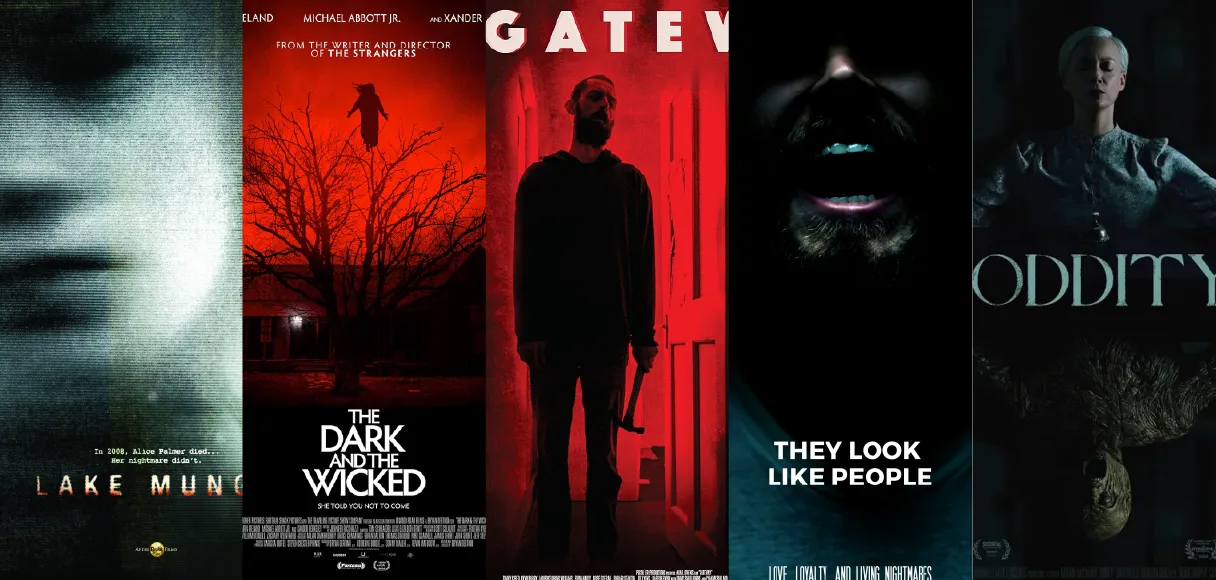
Lake Mungo is an Australian mockumentary about a family unravelling after their teenage daughter Alice drowns in a local dam. It has spent fifteen years being recommended in horror circles without ever quite breaking through to mainstream audiences. The Buried-Movie Pattern is festival ceiling: strong critical response at niche horror festivals, no meaningful theatrical push, no marketing budget, no name cast to anchor a campaign.
The film builds dread through grief, grainy home video, and structural layers that reveal themselves only on a second viewing. Joel Anderson, working in his feature directorial debut and to date his only film, constructs the dread from accumulation rather than incident. There are no jump scares. The fear comes from what the footage reveals about Alice’s life, and what Alice’s life reveals about how little her family knew her.
The Screendollars Take
Lake Mungo is not a ghost story. It is a film about all the things a person carries that no one else can see.
The final image, a single frame that has been in the film the entire time, recontextualises everything that preceded it. Anderson plants it early and trusts that the audience will not notice. On a second viewing, the frame is visible from the first minutes. It changes the film’s entire emotional register: from grief to something closer to guilt. The mockumentary format is not a stylistic choice. It is the mechanism that makes the revelation possible.
This is the film The Ring would have been if The Ring had been about mourning.
#2. Session 9 (2001)
A film about an abandoned asylum that uses architecture as its horror engine.
Director: Brad Anderson
Starring: Peter Mullan, David Caruso, Stephen Gevedon, Josh Lucas
Country: USA | Fear type: Psychological | Buried-Movie Pattern: Release shadow
Dread: 5 / Visceral: 2 / Re-watch: 4
Runtime: 100 mins | Rating: R | IMDb: 6.7
Where to Watch: Prime Video (rent/buy), Apple TV (rent/buy), Fandango at Home (rent/buy). No free streaming is currently available. Verify via JustWatch before publishing.
If you liked: The Shining, The Haunting of Hill House, Compliance
Session 9 follows an asbestos removal crew working at the Danvers State Mental Hospital in Massachusetts, an actually decommissioned asylum with a documented history of institutional abuse. Director Brad Anderson was permitted to film inside the actual building. The release shadow that buried it was severe: it opened the same weekend as The Others and was lost in the chaos of the post-9/11 theatrical market a month later, two films that dominated the psychological horror conversation for years.
The film’s mechanism is the building itself. Anderson uses the hospital’s actual corridors, actual operating theatres, and actual session recordings from former patients to generate an atmosphere of place-as-trauma that no set construction could replicate. Gordon Fleming, the crew foreman played by Peter Mullan, is deteriorating from the opening scene. The film is about whether the building is responsible for what happens, or whether it is simply the room where Gordon’s own collapse reaches its conclusion.
The Screendollars Take
Session 9 is a film about a man becoming something he already was, in a place that simply permitted him.
Anderson never explains what the ninth session recording contains. You hear the voice describe what happened. The camera stays on the faces of the people listening. The restraint is everything. The film earns its horror not from what it shows but from the specific quality of the silence that follows what it plays.
Danvers State Hospital was demolished in 2006 to make way for condominiums. The film is the building’s most complete record.
#3. Possum (2018)
A British children’s puppeteer and a spider puppet. The most unpleasant film on this list to sit with.
Director: Matthew Holness
Starring: Sean Harris, Alun Armstrong
Country: UK | Fear type: Psychological | Buried-Movie Pattern: Genre ambiguity
Dread: 5 / Visceral: 3 / Re-watch: 4
Runtime: 85 mins | Rating: NR | IMDb: 5.7
Where to Watch: Prime Video (free with ads), Philo, Plex (free), Hoopla (free), Fandango at Home Free — verify via JustWatch before publishing
If you liked: Hereditary, Eraserhead, The Wicker Man
Possum is Matthew Holness’s debut feature, adapted from his own short story. Philip, a disgraced children’s puppeteer played by Sean Harris, returns to his childhood home to confront his abusive stepfather. He carries a black bag containing a spider puppet with a human face that he cannot destroy. The film’s Buried-Movie Pattern is genre ambiguity: too formally strange for mainstream horror audiences, too viscerally disturbing for arthouse audiences, too specifically psychological for casual viewers.
Harris’s performance is built entirely from physical containment. He is a man holding something in for the entirety of the film, and the film is about what happens when he stops. Holness shoots the Norfolk landscape as hostile and flat, a geography that offers nowhere to hide. The puppet does not move on its own. The horror is in Philip’s relationship to it: his inability to destroy it, his inability to leave it behind, his inability to articulate what it represents. The film provides the answer eventually. It is not a comfortable one.
The Screendollars Take
Possum is a film about trauma that refuses to let the horror metaphor remain metaphorical.
The puppet is not a symbol. By the film’s end, it is a literal thing that exists in the real world of the story. Holness collapses the distance between the psychological and the physical that most horror films maintain as a safety valve for the audience. There is no safety valve in Possum. What Philip carries in the black bag is what Philip carries.
The lowest IMDb score on this list. The most completely realised vision. Both things are true.
#4. They Look Like People (2015)
A micro-budget film that delivers more dread per dollar than anything else on this list.
Director: Perry Blackshear
Starring: MacLeod Andrews, Evan Dumouchel
Country: USA | Fear type: Psychological | Buried-Movie Pattern: Festival ceiling
Dread: 5 / Visceral: 2 / Re-watch: 4
Runtime: 80 mins | Rating: NR | IMDb: 6.4
Where to Watch: Fandango at Home Free, Pluto TV (free), Prime Video Free with Ads, Plex (free), Hoopla (free) — verify via JustWatch before publishing.
If you liked: It Follows, Take Shelter, The Invitation.
They Look Like People was made on a micro-budget by director Perry Blackshear with a cast of two primary actors who are also his friends. Wyatt, recently broken up with his girlfriend and increasingly convinced that the people around him are being replaced by monsters, reconnects with his old friend Christian. The film is about whether Wyatt is right or unwell. It is also about male friendship and the particular difficulty of admitting need.
Blackshear’s formal restraint is extraordinary for a first-time feature at this budget. He shoots almost entirely in apartments and streets, uses silence more effectively than most horror directors use sound design, and constructs the ambiguity between Wyatt’s paranoia and the possibility that he is simply correct so precisely that the film sustains its tension for its entire runtime without revealing which interpretation is true. The answer it finally provides is stranger than either option.
The Screendollars Take
They Look Like People is a film about what it costs two men to say they need each other. The horror is almost incidental.
The scene in which Wyatt calls Christian from his girlfriend’s apartment at 3 am and simply says he is scared, and Christian drives across the city to sit with him, is the emotional centre of the film. Blackshear frames it as an ordinary act. It is not ordinary. Most films about male friendship require an external crisis to justify this level of need. This film suggests the need was always there.
Micro-budget. A 96% critical approval rating. The arithmetic of what horror actually requires.
#5. The Night House (2020)
Rebecca Hall holds a film about grief and negative space on her face alone.
Director: David Bruckner
Starring: Rebecca Hall, Sarah Goldberg, Vondie Curtis-Hall, Evan Jonigkeit
Country: USA | Fear type: Psychological | Buried-Movie Pattern: Streaming burial
Dread: 4 / Visceral: 2 / Re-watch: 3
Runtime: 110 mins | Rating: R | IMDb: 6.5
Where to Watch: fuboTV, YouTube TV, FXNow (free) — verify via JustWatch before publishing.
If you liked: Hereditary, The Haunting of Hill House, Annihilation
The Night House follows Beth, a teacher whose husband has recently died by suicide, as she discovers secrets hidden in the lakeside house he built for her. David Bruckner directs with a formalist’s eye for negative space: there are things in the corners of rooms that should not be there, and the film trains the viewer to look for them before deploying the technique fully. The Buried-Movie Pattern is streaming burial: it premiered at Sundance 2020 and sat on a shelf for eighteen months before Searchlight released it, losing the awards-season momentum that its Sundance response had generated.
Rebecca Hall plays Beth with a sustained, specific exhaustion: the particular posture of a person who has not slept properly in weeks and has decided that is acceptable. The film is about grief, and it takes that seriously in a way that most horror films about grief do not. Beth is not recovering. She is not processing. She is performing the motions of continuing while the question of whether her husband’s actions were what they appeared to be consumes everything.
The Screendollars Take
The Night House is more interested in what grief does to a person’s relationship with their own mind than in what the house is actually doing.
Bruckner’s most precise formal decision is to have Beth never quite focus on the things the film shows in the corners of the frame. She looks through them rather than at them. The audience sees them. She does not. The gap between what the viewer sees and what Beth can process is where the horror lives. It is a film about denial constructed entirely from visual evidence.
The ending will divide viewers. That division is the correct response.
#6. Resurrection (2022)
Rebecca Hall again. A performance so complete it makes the film’s extreme premise feel mundane.
Director: Andrew Semans
Starring: Rebecca Hall, Tim Roth, Grace Kaufman, Michael Esper
Country: USA | Fear type: Psychological | Buried-Movie Pattern: Festival ceiling
Dread: 5 / Visceral: 3 / Re-watch: 3
Runtime: 103 mins | Rating: R | IMDb: 6.3
Where to Watch: Shudder, AMC+, Philo, Prime Video (rent/buy) — verify via JustWatch before publishing.
If you liked: Hereditary, Compliance, Under the Skin
Resurrection follows Margaret, a composed and successful businesswoman living in Albany, New York, whose carefully constructed life begins to destabilise when a man from her past reappears in her vicinity. Tim Roth plays David. The film does not rush to explain its history. It is specific and disturbing, and when the explanation comes, it is delivered in a single unbroken monologue by Hall that runs for several minutes and is one of the most technically demanding pieces of acting in recent horror.
Andrew Semans’s directorial control is most visible in what he withholds and when. The Buried-Movie Pattern is festival ceiling: strong Sundance response, limited IFC Films release, no commercial marketing weight. It is the most disproportionately underseen film on this list relative to the quality of its lead performance.
The Screendollars Take
Resurrection is a film about the specific way trauma reorganises a person’s logic until the logic feels completely coherent.
Hall’s sustained monologue explaining what David did and what he took is not played for shock. It is played with the flat precision of a person reciting events they have organised into a narrative they can survive. The matter-of-factness is the horror. Semans holds on to her face throughout. He trusts the performance to do what a lesser director would supplement with score and editing.
The ending is not a metaphor. That is the most disturbing thing about it.
#7. Saint Maud (2019)
A devout hospice nurse in a seaside town. Rose Glass’s debut film is suffocating in the best possible way.
Director: Rose Glass
Starring: Morfydd Clark, Jennifer Ehle
Country: UK | Fear type: Psychological | Buried-Movie Pattern: Festival ceiling
Dread: 5 / Visceral: 2 / Re-watch: 4
Runtime: 84 mins | Rating: R | IMDb: 6.6
Where to Watch: Prime Video, fuboTV, MGM+, Philo. No free streaming is currently available. Verify via JustWatch before publishing.
If you liked: Hereditary, Black Swan, First Reformed
Saint Maud follows Maud, a newly devout hospice nurse working in a quiet English seaside town, who becomes obsessed with saving the soul of her patient, Amanda, a former dancer now dying of terminal illness. Rose Glass’s debut feature premiered at TIFF 2019 before A24 acquired US distribution rights. The Buried-Movie Pattern is festival ceiling: the pandemic delayed its US release until 2021, by which time the awards cycle that would have capitalised on its critical momentum had passed.
Glass’s formal control is extraordinary for a debut. She shoots Maud’s religious experiences as genuine ecstasy and genuine horror simultaneously, never resolving the ambiguity about whether Maud’s faith is real or delusional. The distinction matters to Maud. Glass refuses to let it matter to the viewer. Morfydd Clark plays Maud with a specific brand of certainty that is more unsettling than doubt: a woman who has replaced one dangerous thing with another and calls the replacement God.
The Screendollars Take
Saint Maud is a film about the intoxication of certainty in a world that offers very little to be certain about.
Glass’s final image is both the most extreme thing in the film and its most honest statement. It has been prepared from the first scene. Maud’s relationship to her own body throughout, the pins, the pain, the particular posture of someone who has learned to convert suffering into something that feels like transcendence, makes the ending not a surprise but an arrival.
Rose Glass subsequently directed Love Lies Bleeding. The two films together constitute the most assured debut-and-follow-up in recent British horror.
#8. Cam (2018)
A psychological horror about identity, the internet, and a camera that refuses to stop watching.
Director: Daniel Goldhaber
Starring: Madeline Brewer, Patch Darragh, Melora Walters
Country: USA | Fear type: Psychological | Buried-Movie Pattern: Streaming burial
Dread: 4 / Visceral: 2 / Re-watch: 3
Runtime: 94 mins | Rating: NR | IMDb: 6.2
Where to Watch: Netflix — verify via JustWatch before publishing
If you liked: Black Mirror, Unfriended, Ingrid Goes West
Cam follows Alice, a camgirl working to build her ranking on an adult streaming platform, who discovers one day that someone who looks exactly like her is performing as her on the platform, and she has been locked out of her own account. Isa Mazzei wrote the screenplay from her own experience as a sex worker. The Buried-Movie Pattern is a clean case of streaming burial: Netflix acquired it after a modest festival run, gave it a single week of promotional support, and it disappeared into the algorithm.
Goldhaber and Mazzei are interested in identity and performance and the specific vulnerability of building a public self that becomes more real than the private one. The horror is not supernatural. The double is doing exactly what Alice would do. The film is about what it means to have your own performance stolen from you, and what it reveals about the self when a copy of you functions identically to the original.
The Screendollars Take
Cam is the only horror film on this list that is also a precise account of labour conditions in the creator economy.
The ranking system that drives Alice’s decisions, the way she calibrates her performances to audience engagement metrics, the way a single bad day can cascade into a drop in standing that costs her rent: Mazzei writes this from the inside. The horror is not grafted onto the world of the film. It grows out of it. The double is not the threat. The platform is.
Netflix buried the most original horror film they acquired that year. That is also a kind of genre commentary.
Supernatural Horror Hidden Gems
Supernatural horror works through ghosts, possessions, hauntings, occult ritual, and cursed objects. The hidden gems below favour atmosphere and lingering unease over jump scares. The scares arrive, but they arrive because the films have earned them.
#9. A Dark Song (2016)
A grieving mother and a damaged occultist spend nine months in a rented house performing a ritual. Neither of them is prepared for what it costs.
Director: Liam Gavin
Starring: Catherine Walker, Steve Oram
Country: Ireland/UK | Fear type: Supernatural | Buried-Movie Pattern: Festival ceiling
Dread: 4 / Visceral: 1 / Re-watch: 4
Runtime: 99 mins | Rating: NR | IMDb: 6.6
Where to Watch: AMC+, Netflix, Plex (free), Prime Video (rent/buy) — verify via JustWatch before publishing
If you liked: Hereditary, The Witch, Midsommar
A Dark Song is Liam Gavin’s debut feature, a film that takes occult ritual seriously as a formal and emotional subject rather than as horror dressing. Sophia hires occultist Joseph to help her perform the Abramelin ritual, an extended magical working from an 18th-century grimoire, to speak to her murdered son. The film is set almost entirely inside a single rented house. The ritual takes nine months. So does the film, roughly.
The Buried-Movie Pattern is festival ceiling: A Dark Song played festivals to sustained critical enthusiasm and was acquired for streaming without the theatrical push that its word-of-mouth potential warranted. Gavin’s restraint is unusual for a debut: the film trusts the process rather than rushing to the horror. The two characters are together for months before anything overtly supernatural occurs. By the time it does, the relationship has accumulated enough weight that the stakes are personal rather than generic.
The Screendollars Take
A Dark Song is the only film on this list where the horror is a form of grief therapy taken to its logical extreme.
Gavin understands that the Abramelin ritual’s actual difficulty is not supernatural. It is the sustained, deliberate exposure to one’s own worst impulses over months of enforced isolation. The ritual requires this. Joseph knows it. Sophia discovers it. The film is about what a person is willing to destroy in themselves to speak to someone they have lost.
The most quietly devastating horror film of its decade. Festival horror does not get much more precise than this.
#10. His House (2020)
A refugee couple flees South Sudan and arrives in a UK council estate haunted by something they brought with them.
Director: Remi Weekes
Starring: Sope Dirisu, Wunmi Mosaku, Matt Smith
Country: UK | Fear type: Supernatural | Buried-Movie Pattern: Streaming burial
Dread: 4 / Visceral: 2 / Re-watch: 3
Runtime: 93 mins | Rating: TV-MA | IMDb: 6.9
Where to Watch: Netflix — verify via JustWatch before publishing
If you liked: Hereditary, The Babadook, Under the Shadow
His House follows Bol and Rial, a South Sudanese couple granted provisional asylum in Britain, as they attempt to build a new life in a crumbling council house while being haunted by an entity that followed them from Sudan. Remi Weekes’s debut feature was Netflix-commissioned and Netflix-released, which is the textbook Buried-Movie Pattern BMP-1: strong initial promotion, algorithm-buried within a fortnight, found primarily by word of mouth in the years since.
Weekes uses the haunting to do something more ambitious than most supernatural horror attempts. The ghost that follows Bol and Rial is not simply malevolent. It is specific to what they did and what they survived to reach Britain. The film understands that refugee experience involves guilt as well as trauma, and it refuses to flatten any of that into a simple moral position. The horror is earned because the characters are earned.
The Screendollars Take
His House is the best horror film about the specific cost of survival rather than the threat to it.
Weekes’s formal decision to show the entity early, clearly, and repeatedly is a deliberate refusal of the ambiguity-as-horror convention. The entity is real. The question is not whether Bol and Rial are imagining it. The question is what they owe it, and what they owe each other. That reframing converts a haunted house film into a film about complicity, and complicity is harder to watch than monsters.
Netflix buried this. Horror communities found it anyway. That is its own kind of testament.
#11. Terrified (2017)
An Argentine film that deploys more genuine horror in ninety minutes than most American franchises manage across a decade.
Director: Demian Rugna
Starring: Maxi Ghione, Norberto Gonzalo, Elvira Onetto
Country: Argentina | Fear type: Supernatural | Buried-Movie Pattern: Language barrier
Dread: 4 / Visceral: 3 / Re-watch: 4
Runtime: 87 mins | Rating: NR | IMDb: 6.8
Where to Watch: Shudder, AMC+ — verify via JustWatch before publishing
If you liked: The Conjuring, Sinister, Insidious
Terrified follows three investigators examining a Buenos Aires suburb where supernatural events are occurring simultaneously in adjacent houses. Director Demian Rugna structures the film as an anthology of horrors connected by location: a child’s body, a voice in the kitchen drain, something under the bed, a figure that stands motionless in a corner. The Buried-Movie Pattern is a language barrier: Terrified was released in Argentina in 2017 and acquired by Shudder in the United States the following year, but subtitled horror from Argentina does not reach mainstream audiences without a significant push.
Rugna’s formal generosity is unusual: he shows you things fully. There is no straining-to-see-in-the-dark ambiguity. The film presents its horrors in clear light and trusts that they are frightening enough without concealment. They are. Rugna went on to direct When Evil Lurks (2023), which received significantly more attention. Terrified is the better film.
The Screendollars Take
Terrified is what happens when a director takes the Conjuring universe’s genre conventions and strips them of the franchise safety net.
The sequence involving the child’s body at the kitchen table is the most purely frightening set-piece in Argentine horror. Rugna shoots it simply and holds on to it. The horror is not in what the camera does. It is in the specific quality of wrongness that the image contains: the posture, the position, the patience of it. He gives you the full image and trusts it to do its work.
Demian Rugna made two of the best horror films of their respective decades. The first one remains a secret.
#12. The Dark and the Wicked (2020)
A farm in rural Texas. A dying father. Something in the fields that has been waiting.
Director: Bryan Bertino
Starring: Marin Ireland, Michael Abbott Jr., Xander Berkeley
Country: USA | Fear type: Supernatural | Buried-Movie Pattern: Streaming burial
Dread: 5 / Visceral: 3 / Re-watch: 3
Runtime: 95 mins | Rating: NR | IMDb: 6.1
Where to Watch: Shudder, AMC+ — verify via JustWatch before publishing
If you liked: Hereditary, The Witch, Midsommar
The Dark and the Wicked follows Louise and Michael, two adult siblings who return to their family farm in rural Texas as their father lies dying. Their mother has already broken under something she will not name. Something in the surrounding landscape is systematically dismantling the family’s capacity to believe in safety. Bryan Bertino directed The Strangers (2008) and has spent the subsequent years making progressively quieter and more atmospheric horror. This is his finest work.
The Buried-Movie Pattern is streaming burial. The Dark and the Wicked opened in limited theatres and simultaneously on digital in November 2020, a Covid-era release that gave it almost no theatrical footprint. Shudder acquired it, and it has circulated through horror communities with the specific word-of-mouth quality of a film people find and immediately want to press on someone else. Marin Ireland’s performance is the film’s centre of gravity: a woman watching her family destroyed and unable to locate the geometry of the threat.
The Screendollars Take
The Dark and the Wicked is a film about evil that does not negotiate and cannot be reasoned with. That refusal to provide a mechanism is what makes it frightening.
Bertino’s most significant formal decision is to withhold the rules. There is no lore, no history, no explanation of what is doing this or why. Most supernatural horror provides a framework that converts the threat into something the characters can at least attempt to counter. This film denies them that. The evil is simply present, persistent, and patient. The absence of a mechanism is the horror.
A 91% the critical aggregate score on a film most horror fans have not heard of. That gap is the entire argument for this list.
#13. Host (2020)
Fifty-six minutes. Shot entirely on Zoom during the first Covid lockdown. The most efficient horror film of the decade.
Director: Rob Savage
Starring: Haley Bishop, Jemma Moore, Emma Louise Webb, Radina Drandova
Country: UK | Fear type: Supernatural | Buried-Movie Pattern: Streaming burial
Dread: 4 / Visceral: 2 / Re-watch: 4
Runtime: 56 mins | Rating: NR | IMDb: 6.7
Where to Watch: Shudder, AMC+ — verify via JustWatch before publishing
If you liked: Unfriended, REC, Paranormal Activity
Host was made during the first COVID-19 lockdown of 2020. Rob Savage shot it remotely over Zoom with a cast of six friends, each filming themselves on their own home equipment, over a period of twelve weeks. It runs 56 minutes. It has a 100% critical approval rating. The Buried-Movie Pattern is streaming burial: Shudder released it with a one-week promotional push, and it has been recommended largely through horror-community word of mouth since.
Savage’s formal achievement is making the constraints the film’s primary asset. The Zoom call format is not a limitation being worked around. It is the horror’s delivery mechanism. The audience knows these people cannot leave their screens. The isolation of the lockdown format, each person alone in their home, is the emotional subtext made structural. Savage went on to direct Barbarian (2022). Host remains his most formally accomplished work.
The Screendollars Take
The host made the most of a global tragedy by making a film whose form is inseparable from the conditions of its production. That coherence is rare.
The sequence involving the hanging in the attic is the film’s formal summit. Savage achieves it without cutting, using only the Zoom call’s own visual grammar. The viewer sees it the same way the other characters see it: through a small rectangle in the corner of a screen, at low resolution, in the dark. The limitation is the scare.
Fifty-six minutes. Zero budget. The most formally complete horror film of 2020.
#14. Oddity (2024)
Damian McCarthy’s follow-up to Caveat is more confident, stranger, and scarier. It arrived next to louder horror and got buried.
Director: Damian McCarthy
Starring: Carolyn Bracken, Gwilym Lee, Tadhg Murphy
Country: Ireland | Fear type: Supernatural | Buried-Movie Pattern: Release shadow
Dread: 4 / Visceral: 3 / Re-watch: 4
Runtime: 97 mins | Rating: NR | IMDb: 6.4
Where to Watch: Shudder — verify via JustWatch before publishing
If you liked: The Autopsy of Jane Doe, The Wicker Man, Caveat
Oddity is Irish director Damian McCarthy’s second feature, following Caveat (2020). A blind psychic medium investigates her twin sister’s murder by arriving at the remote house where it occurred, bringing with her a large wooden mannequin. The film is structured as a slow-burning supernatural mystery and is considerably more formally assured than Caveat. The Buried-Movie Pattern is released in shadow: Oddity arrived on Shudder in late 2024 alongside a louder slate of genre releases and received minimal promotional support.
McCarthy’s understanding of the mechanics of dread is precise. He knows when to show and when to withhold. The wooden mannequin accumulates menace through its positioning rather than through any overt action. Carolyn Bracken plays the blind psychic medium with a stillness that is either serene or predatory, depending on the moment. The film earns a 91% critical approval rating on its debut, which most horror audiences have not yet found.
The Screendollars Take
Oddity is the most controlled horror film Shudder has released that Shudder did not properly release.
McCarthy’s formal confidence is most visible in the film’s management of the mannequin. It does not move when you are watching. The horror is in the moments when the viewer, not a character, has lost track of where it is. That distinction is deliberate and technically demanding to maintain across a feature. McCarthy maintains it.
Two films into his career, Damian McCarthy is the most consistently overlooked horror director working in English-language cinema.
#15. Under the Shadow (2016)
Tehran, 1988. A missile lands in a building and does not detonate. Something else arrives with it.
Director: Babak Anvari
Starring: Narges Rashidi, Avin Manshadi
Country: UK/Iran | Fear type: Supernatural | Buried-Movie Pattern: Language barrier
Dread: 4 / Visceral: 2 / Re-watch: 3
Runtime: 84 mins | Rating: PG-13 | IMDb: 6.8
Where to Watch: Netflix, Hoopla (free) — verify via JustWatch before publishing.
If you liked: His House, The Babadook, A Quiet Place
Under the Shadow is set in Tehran during the Iran-Iraq War of 1988. Shideh, a former medical student whose application to resume her studies has been denied due to her political activities before the revolution, remains in the city with her daughter Dorsa while her husband deploys as a doctor to the front. A missile lands in their building and does not explode. Dorsa’s doll goes missing. A neighbour tells Shideh about djinn. Babak Anvari’s debut feature uses the supernatural to map the specific terror of a woman living under a system designed to erase her.
The Buried-Movie Pattern is a language barrier: the film is in Farsi with English subtitles, acquired by Netflix UK after a strong festival run. Under the Shadow was nominated for the Academy Award for Best Foreign Language Film in 2017. That recognition reached critics. It did not reach mainstream horror audiences at scale.
The Screendollars Take
Under the Shadow is a film about two kinds of fear: the political kind that can be named, and the supernatural kind that cannot. Anvari understands that they are the same fear.
The djinn in Under the Shadow operates through theft. It takes the things that anchor Shideh to her sense of safety and self, her daughter, her exercise tape, her ordinary domestic objects, and substitutes absence. Anvari shoots the absence the way most horror directors shoot the monster: with sustained attention, with implication, with the understanding that what is not there is more frightening than what is.
Babak Anvari made one of the best political horror films of the decade, and it is currently available on Netflix. The algorithm buried it. It should not stay buried.
#16. The Medium (2021)
A Thai documentary crew follows a village shaman, and the film becomes something the crew did not consent to making.
Director: Banjong Pisanthanakun
Starring: Narilya Gulmongkolpech, Sawanee Utoomma, Sirani Yankittikan
Country: Thailand | Fear type: Supernatural | Buried-Movie Pattern: Language barrier
Dread: 4 / Visceral: 3 / Re-watch: 3
Runtime: 130 mins | Rating: NR | IMDb: 6.5
Where to Watch: Shudder, AMC+, Hoopla (free), Plex (free) — verify via JustWatch before publishing.
If you liked: REC, The Wailing, Hereditary
The Medium follows a documentary film crew in rural Thailand as they document Nim, a woman believed to be possessed by a local deity. Co-produced by Na Hong-jin, who directed The Wailing, the film is structured as found footage but shot with a visual sophistication that exceeds the found-footage convention. As the documentary progresses, the subject mutates: what is happening to Nim is not what the crew came to document. The Buried-Movie Pattern is a language barrier: Thai horror with English subtitles does not receive mainstream theatrical distribution in Western markets, regardless of its festival profile.
Banjong Pisanthanakun’s formal gambit is to use the documentary format not for plausibility but for duration. The film is two hours and ten minutes. It earns its length. The escalation is patient, methodical, and when it arrives, it is overwhelming. The final act is among the most extreme sustained sequences in Thai cinema.
The Screendollars Take
The Medium is a film about what happens when a documentary crew decides to keep filming something they should stop filming. The camera is the moral problem.
Pisanthanakun understands that the found-footage format’s horror potential is not in what the camera captures but in the decision to keep it running. Each scene where the crew continues filming is also a scene about complicity. By the time they stop, it is too late.
Na Hong-jin produced it. That alone should be enough. It was not. It should have been.
#17. Noroi: The Curse (2005)
The definitive Japanese found-footage horror film. Two hours of accumulating dread with one of the most disturbing final images in the genre.
Director: Koji Shiraishi
Starring: Jin Muraki, Rio Kanno, Marika Matsumoto
Country: Japan | Fear type: Supernatural | Buried-Movie Pattern: Language barrier
Dread: 5 / Visceral: 2 / Re-watch: 4
Runtime: 115 mins | Rating: NR | IMDb: 7.1
Where to Watch: Shudder, AMC+, Philo, Hoopla (free) — verify via JustWatch before publishing.
If you liked: Ringu, Sinister, Lake Mungo
Noroi: The Curse presents itself as a documentary about paranormal journalist Masafumi Kobayashi, who disappeared after completing a film about a series of seemingly unrelated supernatural incidents. The film we are watching is that film. Koji Shiraishi constructs the narrative from interview footage, home video, television broadcast clips, and surveillance recordings that slowly converge on an ancient demon called Kagutaba. The Buried-Movie Pattern is a language barrier: Noroi received a limited Japanese theatrical release in 2005 and has been a Shudder exclusive in Western markets.
The film’s formal achievement is patience. At 115 minutes, it is among the longer found-footage horror films in existence, and Shiraishi earns every minute. The connections between the initial incidents are obscure, the conspiracy builds slowly, and the final twenty minutes reward the attention the preceding ninety have asked for. The last image of the film is among the most purely disturbing in Japanese horror.
The Screendollars Take
Noroi is the film that proves found-footage horror’s ceiling is determined by the screenplay, not the format.
Shiraishi’s script constructs five apparently unrelated storylines and connects them with the patience of a detective novel. The horror accumulates not from incident but from implication: the growing certainty that everything was connected before the film began. The found-footage format means we watch someone else’s investigation. The film’s power comes from the moment we realise the investigation was never going to end well.
Twenty years of horror community recommendations and still underseen. Noroi is the test case for why this list exists.
#18. The Wailing (2016)
A South Korean village. A mysterious stranger. One hundred and fifty-six minutes that will not let you go.
Director: Na Hong-jin
Starring: Kwak Do-won, Hwang Jung-min, Chun Woo-hee, Jun Kunimura
Country: South Korea | Fear type: Supernatural | Buried-Movie Pattern: Language barrier
Dread: 5 / Visceral: 4 / Re-watch: 4
Runtime: 156 mins | Rating: NR | IMDb: 7.4
Where to Watch: fuboTV, Philo, Roku Channel (free), Hi-YAH — verify via JustWatch before publishing
If you liked: Parasite, The Medium, Hereditary
The Wailing follows Jong-goo, a police officer in a remote South Korean village, as a series of violent deaths coincides with the arrival of a mysterious Japanese stranger. Jong-goo’s daughter begins exhibiting symptoms similar to those of the other victims. Na Hong-jin’s film is two hours and thirty-six minutes, and it earns the runtime: the mystery deepens, and shifts throughout, moral certainty is constructed and destroyed multiple times, and the film’s final hour is a sustained ratcheting of tension that has no American equivalent in recent horror.
The Buried-Movie Pattern is a language barrier: The Wailing received limited Western theatrical distribution despite a Cannes premiere and domestic box office of $51 million in South Korea. Na Hong-jin has said the film took six years to write and shoot. The investment is visible in every scene.
The Screendollars Take
The Wailing is a film about the specific horror of not knowing whom to trust when the people who might tell you the truth are also the people who might be lying.
Na Hong-jin constructs his film around a series of reversals, each of which destroys the interpretive framework the viewer has just established. The shaman sequence in the film’s second half is among the most technically and emotionally overwhelming sequences in Korean horror: two simultaneous rituals, intercut, each claiming to be the correct one. The audience cannot know which is true. Jong-goo cannot know.
One hundred and fifty-six minutes. If you give it that time, it earns everyone.
Best Slow-Burn Horror Movies You Probably Haven’t Seen
Slow-burn horror earns its scares by withholding them. These films build through mood, isolation, and patient escalation toward final acts that hit harder for the wait. The dread arrives before anything happens. That gap between the feeling and the event is where these films live.
#19. The Blackcoat’s Daughter (2015)
Two girls were left at a boarding school over winter break. A third woman on a road at night. The connection between them is the film’s entire horror.
Director: Oz Perkins
Starring: Kiernan Shipka, Lucy Boynton, Emma Roberts, James Remar
Country: USA/Canada | Fear type: Slow-burn | Buried-Movie Pattern: Release shadow
Dread: 5 / Visceral: 2 / Re-watch: 4
Runtime: 93 mins | Rating: R | IMDb: 6.3
Where to Watch: Tubi (free), HBO Max, Prime Video (rent/buy) — verify via JustWatch before publishing
If you liked: Hereditary, Black Swan, The Witch
The Blackcoat’s Daughter, Oz Perkins’s debut feature, follows three women across two timelines: Kat and Rose, two students left at a Catholic boarding school when their parents fail to collect them for winter break, and Joan, a young woman being driven by a couple on a winter road toward an unnamed destination. The connection between the timelines is the film’s central architecture. Perkins does not rush to make the connection explicit.
The Buried-Movie Pattern is release shadow: the film premiered at TIFF in 2015 under the title February, sat without a US distributor for over a year, and received a limited theatrical release from A24 in March 2017, five weeks after Get Out opened. It never had a promotional moment. Elvis Perkins composed the score for his brother’s film. The music is among the most effectively unsettling in recent horror.
The Screendollars Take
The Blackcoat’s Daughter is about the specific kind of loneliness that makes a person ready to accept something they should refuse.
Perkins’s most precise formal decision is to give Kat the film’s emotional centre without ever explaining her. Kiernan Shipka plays a girl receiving something: through the furnace room, through the school’s empty corridors, through the particular quality of attention she pays to the boiler. What she is receiving is never named. The film trusts the viewer to understand that naming it would diminish it.
Oz Perkins has become one of the more visible horror directors of his generation. The Blackcoat’s Daughter remains his most formally controlled work.
#20. The House of the Devil (2009)
A babysitting job in the early 1980s. Ti West spent ninety minutes proving that nothing needs to happen for everything to be terrifying.
Director: Ti West
Starring: Jocelin Donahue, Tom Noonan, Mary Woronov, Greta Gerwig
Country: USA | Fear type: Slow-burn | Buried-Movie Pattern: Festival ceiling
Dread: 4 / Visceral: 2 / Re-watch: 5
Runtime: 95 mins | Rating: R | IMDb: 6.5
Where to Watch: Kanopy (free), Prime Video (rent/buy) — verify via JustWatch before publishing.
If you liked: Hereditary, Rosemary’s Baby, It Follows
The House of the Devil is Ti West’s period horror exercise set in the early 1980s, shot on 16mm with period-appropriate equipment, costumes, and hair, and structured almost entirely as sustained atmospheric dread with minimal incident. Samantha accepts a babysitting job at a remote house from a strange couple. Nothing happens for most of the film. The nothing is the point. West shot The House of the Devil in fifteen days. It looks like it took six months.
The Buried-Movie Pattern is festival ceiling: the movie played at the Tribeca 2009 to a strong critical response and received a hybrid theatrical/DVD release that generated no theatrical momentum. It is available on Kanopy, the library streaming service, which is where most of its audience has found it. Greta Gerwig appears in a supporting role, a fact that has generated retrospective interest without generating retrospective visibility for the film itself.
The Screendollars Take
The House of the Devil is the definitive argument that slow-burn horror’s mechanism is atmosphere as environment, not atmosphere as decoration.
West’s most significant formal achievement is the pizza scene. Samantha is alone in the house, everything is strange, and she orders a pizza and eats it while watching television. The scene is eight minutes long. Nothing in it is overtly threatening. But the preceding forty minutes have established a frequency of unease that makes the mundane act of eating pizza feel like the most dangerous thing in the film. That recalibration is the skill.
Ti West has since made the X trilogy. The House of the Devil remains the film that proves what he can do when he removes everything except patience and dread.
#21. Caveat (2020)
An Irish horror film about a man who agrees to look after a disturbed woman on an isolated island. He is also wearing a leather harness and chain.
Director: Damian McCarthy
Starring: Jonathan French, Leila Sykes, Ben Caplan
Country: Ireland | Fear type: Slow-burn | Buried-Movie Pattern: Streaming burial
Dread: 4 / Visceral: 2 / Re-watch: 4
Runtime: 88 mins | Rating: NR | IMDb: 5.9
Where to Watch: Shudder, AMC+, Philo, Fandango at Home Free, Hoopla (free) — verify via JustWatch before publishing
If you liked: The Witch, Hereditary, Misery
Caveat follows Isaac, a drifter suffering from partial memory loss, who accepts a cash payment to look after a landlord’s niece on an isolated island. There is a condition: he must wear a leather harness and chain that restricts his movement to certain rooms of the derelict house. Olga, the niece, is psychologically unstable. Isaac cannot leave. Damian McCarthy’s debut feature is a film about constraint in the most literal possible sense.
The Buried-Movie Pattern is streaming burial: Caveat was acquired by Shudder and released with a one-week promotional push. It found its audience through horror community word of mouth over the subsequent two years. McCarthy’s management of the central tension, the harness, the island, Olga’s unpredictability, and the drum that ticks in the night is precise enough to generate genuine dread from very limited material.
The Screendollars Take
Caveat is a film about what a person will accept in exchange for money and how quickly the terms of that exchange become impossible to renegotiate.
The drum that Olga moves through the house is the film’s formal spine. McCarthy uses sound with more sophistication than his budget would suggest: the drum’s ticking, its position in the house, and its relationship to Olga’s state function as both a scare mechanism and a metric of Isaac’s confinement. Where the drum is tells you how much danger Isaac is in.
McCarthy made Oddity after this. Both are worth your time. Start here.
#22. Hagazussa (2017)
An Austrian witch film from 1350 that moves like a hallucination and sounds like the inside of a disturbed mind.
Director: Lukas Feigelfeld
Starring: Aleksandra Cwen, Claudia Martini
Country: Austria | Fear type: Slow-burn | Buried-Movie Pattern: Language barrier
Dread: 5 / Visceral: 3 / Re-watch: 3
Runtime: 102 mins | Rating: NR | IMDb: 5.8
Where to Watch: Shudder, AMC+, Tubi (free), Plex (free), Kanopy (free), Hoopla (free) — verify via JustWatch before publishing.
If you liked: The Witch, Hereditary, Midsommar
Hagazussa is Lukas Feigelfeld’s debut feature, set in the Austrian Alps in the 15th century, following Albrun, a young woman who has grown up isolated in the mountains and is accused of being a witch by the village below. The film is German-language and dialogue-sparse: much of it is landscape, body, and the particular quality of light in the Alps in winter and summer. The Buried-Movie Pattern is a language barrier: Hagazussa received a limited festival release and was acquired by Shudder for the English-language market, where subtitled Austrian folk horror does not generate mainstream attention regardless of quality.
The film is structurally closer to Andrei Tarkovsky than to The Witch, which it superficially resembles. Its horror is experiential rather than narrative. Albrun’s isolation, her grief, and her relationship to the landscape build until the final act breaks disturbingly
The Screendollars Take
Hagazussa is the only film on this list that works primarily as a sensory experience. The horror is tonal rather than event-driven.
Feigelfeld’s soundtrack, composed in collaboration with the band MMMD, is among the most effective horror scores of the decade. It does not score events. It creates a frequency of psychological unease that persists across scenes, transitions, and silences. The sound design and score are indistinguishable. That indistinguishability is the formal achievement: the film sounds like the inside of Albrun’s deteriorating mind.
The lowest audience score on this list for a film with a 5/5 Dread rating. That combination is exactly what this page exists to identify.
#23. Relic (2020)
A woman returns to her childhood home to find her mother missing and something wearing her mother’s face when she returns.
Director: Natalie Erika James
Starring: Emily Mortimer, Robyn Nevin, Bella Heathcote
Country: Australia | Fear type: Slow-burn | Buried-Movie Pattern: Release shadow
Dread: 5 / Visceral: 2 / Re-watch: 4
Runtime: 89 mins | Rating: R | IMDb: 5.9
Where to Watch: Shudder, AMC+, Philo, Sundance Now, Kanopy (free) — verify via JustWatch before publishing.
If you liked: Hereditary, The Babadook, Annihilation
Relic follows Kay and her daughter Sam, who travel to rural Victoria, Australia, after Kay’s elderly mother Edna goes missing. When Edna returns, something is different about her. Natalie Erika James’s debut feature uses dementia as the architecture of its horror: the horror of watching a person become someone you do not recognise, the guilt of not knowing how much is illness and how much is something else. The Buried-Movie Pattern is release shadow: Relic premiered at Sundance 2020 alongside a stronger promotional slate and was overshadowed by both Midsommar’s cultural afterglow and the Covid-impacted theatrical landscape.
James’s formal restraint is extraordinary for a first-time feature. She shoots Edna’s deterioration with a physical specificity: the bruise on her back, the pattern spreading through the house’s walls, the way she sits in certain rooms at certain times. The horror accumulates through detail rather than event. The final act literalises the film’s central metaphor in a way that is either too much or exactly right, depending on the viewer. The film is unequivocally on the side of exactly right.
The Screendollars Take
Relic is the most precise horror film about dementia ever made because James understands that the horror is not in what the illness takes but in what remains.
The film’s central formal gamble is the third act, which converts the realist horror of the preceding sixty minutes into something close to body horror. James earns the shift because she has spent the film’s first two acts establishing the specific texture of Edna’s diminishment. This is not a sudden supernatural rupture. It is the same thing, made visible.
Natalie Erika James made one of the best dementia horror films of all time as her debut feature. The industry has been slow to notice.
#24. The Lodge (2019)
A woman with a traumatic religious past is left alone with her partner’s children in a snowbound house. Things go wrong in a direction nobody expects.
Director: Veronika Franz and Severin Fiala
Starring: Riley Keough, Jaeden Martell, Lia McHugh, Richard Armitage
Country: USA | Fear type: Slow-burn | Buried-Movie Pattern: Release shadow
Dread: 4 / Visceral: 2 / Re-watch: 3
Runtime: 108 mins | Rating: R | IMDb: 6.0
Where to Watch: Kanopy (free), Prime Video (rent/buy) — verify via JustWatch before publishing.
If you liked: Hereditary, The Witch, Goodnight Mommy
The Lodge follows Grace, a survivor of a religious cult whose family was killed in a mass suicide, who is left alone at a snowbound holiday house with her partner’s two children over the Christmas break. The children resent her. The radio and television stopped working. Supplies begin disappearing. Veronika Franz and Severin Fiala previously made Goodnight Mommy, a slow-burning Austrian horror film that received significantly more attention. The Lodge is their more accomplished work.
The Buried-Movie Pattern is release shadow: The Lodge received a limited theatrical release from Neon in 2020 and was overshadowed by both the Covid theatre closures and the critical consensus that elevated Goodnight Mommy as the directors’ definitive work. Riley Keough plays Grace with a sustained, specific fragility that refuses to become sympathy. The film refuses to provide a stable moral position, which is its most unsettling quality.
The Screendollars Take
The Lodge is a film about religious trauma as an environmental condition: something that follows a person, modifies her perception, and cannot be reasoned with.
Franz and Fiala’s formal signature is a specific kind of still, wide framing that holds on spaces after characters have left them. The snowbound house, the frozen lake, and the bare trees are shot with the same attention as the characters. The landscape is a participant in what the film is doing to Grace. The ending is the logical conclusion of everything the film has established.
Goodnight Mommy got the attention. The Lodge deserved it more.
#25. Carnival of Souls (1962)
A church organist survives a car accident and is haunted by a spectral figure. Made for $33,000 in 1962. Still working.
Director: Herk Harvey
Starring: Candace Hilligoss, Frances Feist, Sidney Berger
Country: USA | Fear type: Slow-burn | Buried-Movie Pattern: Critical misfire
Dread: 5 / Visceral: 1 / Re-watch: 4
Runtime: 78 mins | Rating: NR | IMDb: 7.2
Where to Watch: Netflix, Prime Video, Plex (free), Hulu, HBO Max — verify via JustWatch before publishing
If you liked: The Sixth Sense, Lake Mungo, The Others
Carnival of Souls was made for approximately $33,000 in Lawrence, Kansas, in 1961, directed by industrial film director Herk Harvey in his only narrative feature. Mary Henry survives a car crash in which her companions are killed, relocates to Salt Lake City to take a job as a church organist, and finds herself drawn compulsively toward an abandoned amusement park while being haunted by a spectral male figure. The Buried-Movie Pattern is a critical misfire: on its 1962 release, the film was dismissed broadly. It took decades and the home video era to establish its reputation.
Harvey shot the film at the Saltair resort on the shore of the Great Salt Lake, an actually abandoned structure whose desolation required no art direction. The film’s formal achievement is atmosphere generated from limitation: the low budget forces Harvey into a sparse visual language that, sixty years later, reads as formal sophistication. The final sequence at the carnival remains one of the most purely effective horror set-pieces in American cinema.
The Screendollars Take
Carnival of Souls invented the structural conceit that The Sixth Sense made famous. It did it in 1962. It cost thirty-three thousand dollars.
Harvey’s restriction, no budget for conventional horror production, produces the film’s most distinctive quality: the shots of Mary walking through Salt Lake City in which no one acknowledges her presence. Harvey could not afford extras. The empty streets are not a stylistic choice. They became one. The city’s indifference to Mary is the film’s central horror before the film knows it is.
In the public domain. Available everywhere. Still, the most atmospheric American horror film of the 1960s.
#26. The Changeling (1980)
George C. Scott rents a house in Seattle. It has been empty for a reason.
Director: Peter Medak
Starring: George C. Scott, Trish Van Devere, Melvyn Douglas
Country: Canada | Fear type: Supernatural | Buried-Movie Pattern: Release shadow
Dread: 4 / Visceral: 1 / Re-watch: 4
Runtime: 107 mins | Rating: R | IMDb: 7.2
Where to Watch: Philo, Pluto TV (free), Roku Channel (free), Plex (free) — verify via JustWatch before publishing.
If you liked: The Shining, The Others, The Sixth Sense
The Changeling follows John Russell, a composer who relocates to Seattle after the deaths of his wife and daughter in a road accident, and rents a large Victorian house that has been unoccupied for twelve years. Peter Medak’s film belongs to the classical haunted-house tradition: the ghost here is specific, the mystery is historical, and the horror is in the revelation of what was done rather than in supernatural violence. George C. Scott plays Russell with a grief that is present in his physicality from the first scene.
The Buried-Movie Pattern is release shadow: The Changeling was released in 1980 in the shadow of The Shining, which dominated the haunted-house conversation for the decade. It was nominated for eight Genie Awards in Canada, where it was shot, and won four. The séance sequence remains one of the most formally inventive horror set-pieces of its era.
The Screendollars Take
The Changeling is the definitive example of the haunted-house film as historical investigation: the ghost is a witness, not a threat.
Medak understands that the most disturbing ghosts are the ones who need something specific rather than the ones who want to harm. John Russell’s investigation into the house’s history is not a horror narrative convention. It is the structural logic of a film about what happens to truth when the people who witnessed it are killed. The wheelchair sequence is simple, unhurried, and frightening.
The Shining got the decade. The Changeling deserved some of it.
Most Disturbing Horror Movies You Probably Haven’t Seen
The films below are extreme: visceral, emotionally upsetting, hard to shake. Each scores 4 or 5 on the Visceral scale. These are not films that will unsettle you. They will disturb you. Know what you are choosing before you start any of them.
#27. Martyrs (2008)
The New French Extremity at its most complete. Not recommended lightly. Cannot be unrecommended once seen.
Director: Pascal Laugier
Starring: Morjana Alaoui, Mylene Jampanoi, Catherine Begin
Country: France/Canada | Fear type: Disturbing | Buried-Movie Pattern: Language barrier
Dread: 5 / Visceral: 5 / Re-watch: 2
Runtime: 99 mins | Rating: NR | IMDb: 7.1
Where to Watch: AMC+, Shudder, Philo, Plex (free), Tubi (free), Prime Video (rent/buy) — verify via JustWatch before publishing
If you liked: Hereditary, The Thing, Raw
Martyrs is Pascal Laugier’s 2008 film about two women, Lucie and Anna, who are connected by a childhood of captivity and abuse, and the organisation responsible for it. Laugier wrote the screenplay during a period of clinical depression and suicidal ideation, and the film carries the specific quality of something made by a person in extremis: it is not interested in providing safety or distance. The Buried-Movie Pattern is a language barrier: Martyrs received a limited French theatrical release in 2008 and was acquired for Western markets through speciality distributors without mainstream theatrical support.
Laugier structures the film as two distinct halves that function under different genre conventions, and the transition between them is the film’s most significant formal act. The first half is a revenge thriller with supernatural elements. The second half is something else. Audiences at FrightFest 2008, the film’s UK premiere, reported physical illness. The film earned a 98% critical approval rating on a 2021 re-release. Those two facts, together, describe the film accurately.
The Screendollars Take
Martyrs is a film about the search for transcendence through suffering, and Laugier refuses to decide whether the search is delusional or the only honest response to existence.
The film’s final act is not gratuitous. It is the film’s argument made physical. Laugier is asking what it would require to actually know what lies beyond consciousness. The organisation in the film believes it knows the answer. The film is about the cost of trying to find out. The final whispered line is the most disturbing conclusion in French horror, and also the most honest.
Watch it once. You will spend considerable time afterwards deciding whether you are glad you did. That deliberation is the film working.
#28. Kill List (2011)
A British film that begins as a kitchen-sink drama, becomes a hitman thriller, and ends somewhere else entirely.
Director: Ben Wheatley
Starring: Neil Maskell, Michael Smiley, MyAnna Buring
Country: UK | Fear type: Disturbing | Buried-Movie Pattern: Genre ambiguity
Dread: 5 / Visceral: 4 / Re-watch: 4
Runtime: 95 mins | Rating: NR | IMDb: 6.7
Where to Watch: Shudder, AMC+, Philo, Sundance Now, Kanopy (free) — verify via JustWatch before publishing.
If you liked: Hereditary, Midsommar, No Country for Old Men
Kill List is Ben Wheatley’s second feature. Jay, a former soldier struggling with unemployment and a difficult marriage, takes a contract killing job with his partner, Gal, after eight months of inactivity. The first third of the film is a British domestic drama with genuine emotional specificity: the couple’s arguments, the financial pressure, the particular dynamic of two men who have worked together in violent situations trying to maintain normal domestic lives. The genre shift that follows is among the most disorienting in recent horror.
The Buried-Movie Pattern is genre ambiguity: Kill List is too realist for horror audiences entering without preparation and too horrifying for crime thriller audiences. It does not fit a marketing category. Ben Wheatley has since become a more prominent genre figure. Kill List remains his most formally and emotionally complete work. Neil Maskell’s performance as Jay is among the best in British horror.
The Screendollars Take
Kill List is the horror film that least resembles a horror film until the moment it becomes the only thing it could have been.
Wheatley and Amy Jump’s screenplay withholds the film’s genre identity until the viewer is too invested in Jay and Gal as people to exit. The horror, when it arrives, is more devastating because the preceding forty minutes have established what is at stake. The final sequence in the cave does not make sense in rational terms. It makes complete sense in emotional terms.
The most formally constructed genre subversion in British horror. The ending is not ambiguous. It is precise. Watch it again.
#29. Inside (2007)
The most viscerally extreme film on this list. Not for everyone. For the people, it is essential.
Director: Alexandre Bustillo and Julien Maury
Starring: Alysson Paradis, Beatrice Dalle
Country: France | Fear type: Disturbing | Buried-Movie Pattern: Language barrier
Dread: 4 / Visceral: 5 / Re-watch: 2
Runtime: 82 mins | Rating: NR | IMDb: 6.7
Where to Watch: Prime Video (rent/buy), Apple TV (rent/buy), Fandango at Home (rent/buy). No free streaming is currently available. Verify via JustWatch before publishing.
If you liked: Martyrs, Hereditary, Suspiria
Inside is the debut feature of Alexandre Bustillo and Julien Maury. Sarah, a photographer who is nine months pregnant and recovering from a car accident that killed her partner four months earlier, spends Christmas Eve alone in her house. A woman arrives at the door. The ensuing film is 82 minutes and constitutes one of the most sustained sequences of horror violence in French cinema. The Buried-Movie Pattern is a language barrier: Inside was a key text in the New French Extremity movement, but received virtually no mainstream theatrical distribution outside France.
Bustillo and Maury operate with a formal confidence that makes the film’s extreme content bearable as a viewing experience even when it is not comfortable: the cinematography is precise, the editing is controlled, and the performances, particularly Beatrice Dalle as the woman, are committed to the film’s internal logic. Inside is the film most likely to stop viewers partway through on this list. It is also the film with the clearest formal vision among the extreme cinema entries.
The Screendollars Take
Inside earns its extremity because Bustillo and Maury never lose control of the camera. The violence is not chaos. It is a composition.
The film’s most significant formal achievement is Beatrice Dalle’s stillness. She is never panicked. She is never hurried. She moves through Sarah’s house with the patience of someone performing a task they have planned carefully. That calm is more frightening than anything the film’s violence produces. Horror that is out of control scares. Horror that is perfectly controlled disturbs.
Not recommended lightly. Recommended with complete conviction.
#30. Baskin (2015)
Five Turkish police officers answer a call for backup and descend into a building that does not obey normal spatial logic.
Director: Can Evrenol
Starring: Gorkem Kasal, Muharrem Bayrak, Ergun Kuyucu
Country: Turkey | Fear type: Disturbing | Buried-Movie Pattern: Language barrier
Dread: 4 / Visceral: 5 / Re-watch: 2
Runtime: 97 mins | Rating: NR | IMDb: 6.0
Where to Watch: Shudder, AMC+, YouTube TV, Philo, Kanopy (free) — verify via JustWatch before publishing.
If you liked: Event Horizon, Martyrs, Hellraiser
Baskin is Can Evrenol’s debut feature, expanded from his 2013 short film. Five police officers driving through rural Turkey answer a call for backup that leads them to an abandoned building where something is happening. What is happening inside the building is the film’s entire second half, and it constitutes one of the most relentlessly extreme horror sequences made outside of France or Japan. The Buried-Movie Pattern is a language barrier: Turkish horror with English subtitles does not reach mainstream Western audiences regardless of quality.
Evrenol is interested in the intersection of police corruption and supernatural punishment, and the film’s politics are embedded in its horror: the officers are not innocent bystanders. The building has been expecting them. Mehmet Cerrahoglu plays Baba, the figure at the building’s centre, with a physical presence that is among the most unsettling in recent horror. He is not performing menace. He simply has it.
The Screendollars Take
Baskin is a film about men who have done terrible things, discovering that the universe keeps records.
Evrenol’s most significant formal decision is the dream sequence that opens the film: a child watches something happen in a bathroom that is never explained and never returned to. The dream recurs. By the time the film explains what the child was watching, the viewer has been primed for the revelation without knowing it. That preparation, concealed inside what appears to be a nightmare prologue, is the film’s structure.
Turkish horror’s most formally assured debut. Not its most famous film. This list exists to fix that.
#31. The Coffee Table (2022)
A couple buys a coffee table. What happens next is the reason the film exists in the Tier 4 warning list.
Director: Caye Casas
Starring: David Pareja, Estefanía de los Santos, Josep Maria Riera
Country: Spain | Fear type: Disturbing | Buried-Movie Pattern: Language barrier
Dread: 5 / Visceral: 5 / Re-watch: 2
Runtime: 91 mins | Rating: NR | IMDb: 6.7
Where to Watch: Shudder, AMC+, Philo, Kanopy (free), Tubi (free) — verify via JustWatch before publishing.
If you liked: Martyrs, Hereditary, Funny Games
The Coffee Table follows Jesus and Maria, a couple in a difficult relationship who have recently become parents, as they disagree over the purchase of an expensive and ugly coffee table. Jesus buys it. What happens next is the event the film has been building toward, and it occurs early enough in the film that the rest of the running time is spent watching Jesus and Maria navigate their new reality. Caye Casas’s film is classified under Tier 4 for specific reasons.
The Buried-Movie Pattern is a language barrier: The Coffee Table is a Spanish film that premiered at festivals in late 2022 and received international distribution through Shudder in 2024. It is a technically accomplished, formally controlled film that generates its horror from a single premise and sustains it with absolute commitment. That commitment is the source of both its power and its difficulty.
The Screendollars Take
The Coffee Table is a film about the specific hell of knowing something that cannot be shared, and the marriage that must accommodate that knowledge.
Casas shoots the film almost entirely in the apartment, in close-up, with the patient attention of a director who understands that the horror is not in any single moment but in the accumulation of ordinary domestic moments that follow it. Jesus carries the knowledge of what is in the apartment. Maria does not. The film is about that gap, and what it does to a person to maintain it in real time, in their own home, in front of their partner.
The most disturbing film on this list by the specific metric of what it asks the viewer to sit with rather than what it shows. Watch at your own considered discretion.
#32. The Platform (2019)
A vertical prison. People at the top eat. People at the bottom do not. The allegory is not subtle. The horror is still real.
Director: Galder Gaztelu-Urrutia
Starring: Ivan Massague, Zorion Eguileor, Antonia San Juan
Country: Spain | Fear type: Disturbing | Buried-Movie Pattern: Streaming burial
Dread: 3 / Visceral: 4 / Re-watch: 3
Runtime: 94 mins | Rating: NR | IMDb: 7.0
Where to Watch: Netflix — verify via JustWatch before publishing
If you liked: Parasite, Cube, Snowpiercer
The Platform is set in a vertical prison called the Hole, where inmates live in two-person cells stacked hundreds of floors deep. A platform of food descends each day from the top. Inmates at higher levels eat well. Inmates at lower levels receive whatever remains, which is often nothing. Galder Gaztelu-Urrutia’s film is a direct allegory for economic inequality, and it does not disguise this. The Buried-Movie Pattern is streaming burial: Netflix acquired it after festival play in 2019, gave it a strong promotional push during the first Covid lockdown, and it promptly disappeared into the catalogue.
The film’s horror is in the depiction of the logic by which people at higher levels justify not leaving food for those below, and the clarity with which it shows that the violence is structural rather than individual. The Platform is not optimistic. It is honest.
The Screendollars Take
The Platform is the only film on this list where the premise is also the thesis and the thesis is also the horror.
Gaztelu-Urrutia’s most significant formal decision is the ending, which resolves the film’s action without resolving its argument. The gesture Goreng makes in the final section is beautiful and futile, and the film knows both things simultaneously. It does not let the beauty cancel the futility. That refusal to comfort is the film’s strongest quality.
The allegory is crude. The execution is not. Both things can be true.
#33. Eyes Without a Face (1960)
A French surgeon and his daughter. A film that invented the face-transplant horror subgenre in 1960 and is still the genre’s best entry.
Director: Georges Franju
Starring: Pierre Brasseur, Alida Valli, Edith Scob
Country: France | Fear type: Disturbing | Buried-Movie Pattern: Language barrier
Dread: 4 / Visceral: 3 / Re-watch: 4
Runtime: 84 mins | Rating: NR | IMDb: 7.6
Where to Watch: HBO Max, Criterion Channel, Shout! Factory TV (free), Plex (free) — verify via JustWatch before publishing
If you liked: The Skin I Live In, Suspiria, May.
Eyes Without a Face follows Dr Genessier, a brilliant Parisian surgeon who disfigured his daughter Christiane in a car accident and is attempting to restore her face through a series of secret surgeries that require harvesting faces from kidnapped young women. Georges Franju shot the film in 1960. British censors condemned it, the US release was subjected to cuts, and contemporary reviews called it nauseating. The Buried-Movie Pattern is a language barrier: subtitled French horror from 1960 does not naturally cross into mainstream audiences without institutional support, and Eyes Without a Face received none until the Criterion Collection edition restored its reputation.
Franju’s formal achievement is the film’s tonal control: it is simultaneously a Gothic horror film, a medical procedural, a fairy tale about a father’s guilt, and a film about female incarceration. Edith Scob plays Christiane with her face obscured behind a white mask for most of the film. Her performance is entirely in posture and movement. It is among the great physical performances in horror cinema.
The Screendollars Take
Eyes Without a Face is the film that established the surgeon-as-monster archetype and then complicated it immediately by making the surgeon’s grief comprehensible.
Franju shoots the face transplant surgery with an objective camera and natural lighting. It looks like a documentary of a medical procedure. The horror is not in the editing or the score: it is in the fact that what is being done is being done with surgical precision and professional calm. The normalcy of the execution is what makes it disturbing. Franju understands that the most frightening violence is the kind that looks like work.
The most important horror film most people have not seen. This is a strong claim. It is accurate.
#34. The Thing (1982)
John Carpenter’s masterpiece was savaged on release. The people who savaged it were wrong.
Director: John Carpenter
Starring: Kurt Russell, Keith David, Wilford Brimley, T.K. Carter
Country: USA | Fear type: Disturbing | Buried-Movie Pattern: Critical misfire
Dread: 4 / Visceral: 4 / Re-watch: 5
Runtime: 109 mins | Rating: R | IMDb: 8.2
Where to Watch: Criterion Channel, Prime Video (rent/buy), Apple TV (rent/buy). No free streaming is currently available. Verify via JustWatch before publishing.
If you liked: Alien, Annihilation, The Fly
The Thing was released in June 1982, two weeks after E.T. the Extra-Terrestrial, to critical dismissal and commercial underperformance. Vincent Canby called it ‘foolish, depressing’ and ‘instant junk’ in The New York Times. The film lost money in its theatrical run. It is now in the Criterion Collection, holds an 8.2 IMDb rating from over 500,000 votes, and is routinely cited as one of the greatest horror films ever made. The Buried-Movie Pattern is a critical misfire.
Carpenter’s film follows a group of researchers at an Antarctic base who discover that a shape-shifting alien organism can perfectly replicate any organism it comes into contact with. Rob Bottin’s practical effects work is the most ambitious in genre history. Dean Cundey’s cinematography isolates each character in blue-white Antarctic light. The paranoia the film generates is structural: the threat is indistinguishable from safety.
The Screendollars Take
The Thing is the definitive paranoia horror film because Carpenter refuses to tell the audience who the Thing is. The uncertainty is the infection.
The blood-test scene, in which MacReady attempts to identify the Thing, is the film’s formal summit: a scene in which the viewer and the characters have access to the same information and reach the same conclusions at the same time. Carpenter does not cheat. The audience is as uncertain as the people in the room. That parity is rare in horror, and it is what makes The Thing endure.
The critics were wrong in 1982. That is also a kind of horror story.
#35. Event Horizon (1997)
A rescue crew investigates a spaceship that travelled to hell and came back with something from it. Dismissed in 1997. Found by horror audiences in the years since.
Director: Paul W.S. Anderson
Starring: Laurence Fishburne, Sam Neill, Kathleen Quinlan, Joely Richardson
Country: USA | Fear type: Disturbing | Buried-Movie Pattern: Critical misfire
Dread: 5 / Visceral: 4 / Re-watch: 4
Runtime: 96 mins | Rating: R | IMDb: 6.7
Where to Watch: fuboTV, MGM+ Amazon Channel, Philo, Kanopy (free) — verify via JustWatch before publishing
If you liked: Alien, Hellraiser, Sunshine
Event Horizon was released in August 1997 to critical contempt and a $47 million domestic gross on a $60 million budget. The film was cut by thirty minutes by Paramount following disastrous test screenings, and the cut footage is believed to have been destroyed or lost. The remaining version is the one that has been reconsidered by horror audiences since the mid-2000s as one of the most effectively disturbing science-fiction horror films ever made. The Buried-Movie Pattern is a critical misfire.
Paul W.S. Anderson’s film follows a rescue crew sent to investigate the reappearance of an experimental spacecraft that disappeared on its maiden voyage to Neptune seven years earlier. The ship was equipped with a gravity drive intended to fold space. Where the drive took the ship is the film’s central question. Sam Neill plays Dr Weir, the ship’s designer, with a controlled mania that becomes the film’s most disturbing element: a man who wanted to go back to where the ship went, and got his wish.
The Screendollars Take
Event Horizon understands that the most disturbing version of hell is the one that knows you specifically.
Anderson’s most significant formal achievement is the footage from the ship’s logs that the rescue crew recovers. It is brief, partially degraded, and looks like evidence. What it shows is specific to the people watching it, not generic horror. The ship did not come back from a generic hell. It came back from the individual hells of the people who will encounter it. That is a more frightening premise than anything a conventional haunting offers.
The lost thirty minutes might have been the film Paramount was afraid of. The ninety-six minutes that survived are already frightening enough.
Best Hidden Horror Movies With Big Final Reveals
Reveal-driven horror reframes the entire film in its final act. The films below all turn on a third-act recontextualisation that changes the meaning of everything before it. None of the writeups below name the reveal. Anything in the final 20 minutes is spoiler territory.
#36. Cure (1997)
A Japanese detective investigates a series of murders by unconnected people who cannot explain what they did. Kiyoshi Kurosawa’s most formally perfect film.
Director: Kiyoshi Kurosawa
Starring: Koji Yakusho, Masato Hagiwara, Anna Nakagawa
Country: Japan | Fear type: Psychological/Reveal-driven | Buried-Movie Pattern: Language barrier
Dread: 5 / Visceral: 2 / Re-watch: 5
Runtime: 111 mins | Rating: NR | IMDb: 7.7
Where to Watch: Criterion Channel, Prime Video (rent/buy). No free streaming is currently available. Verify via JustWatch before publishing.
If you liked: Se7en, Zodiac, The Silence of the Lambs
Cure follows Detective Takabe, who is investigating a series of murders in Tokyo where unconnected perpetrators have committed similar acts of violence that they cannot explain or remember. The connection is Mamiya, a young man with severe amnesia whom the detective eventually locates. Kiyoshi Kurosawa’s film was released in Japan in 1997 and received its Western critical reputation largely through repertory screenings and the Criterion Collection, which released it in 2020. The Buried-Movie Pattern is a language barrier: Japanese art-horror does not reach mainstream Western audiences without institutional support.
Kurosawa’s formal influence on horror is substantial: Park Chan-wook, Bong Joon-ho, and numerous other Asian directors have cited Cure as foundational. The film operates through implication rather than event: the horror is in what Mamiya does to the people he encounters, and what that reveals about the nature of will and suggestion. Koji Yakusho plays Takabe with a sustained, specific weariness. The detective is not solving the case. The case is solving him.
The Screendollars Take
Cure is the film that reveals its horror only after you have understood that the investigation itself was the mechanism of infection.
Kurosawa shoots the encounters between Mamiya and his victims with an unnerving stillness. The camera does not react to what happens. It simply records. That objectivity is deliberate: Kurosawa is showing you a process, not an event. The horror is in the recognition that what Mamiya does is possible, that the process he uses is real, and that the detective who has spent the film observing it is not immune.
Available on Criterion Channel. Has been available for years. Still underseen. This is why this list exists.
#37. The Invitation (2015)
A dinner party at a house in the Los Angeles hills. Something is wrong. The film takes its time proving it.
Director: Karyn Kusama
Starring: Logan Marshall-Green, Tammy Blanchard, Michiel Huisman, Emayatzy Corinealdi
Country: USA | Fear type: Reveal-driven | Buried-Movie Pattern: Release shadow
Dread: 4 / Visceral: 2 / Re-watch: 3
Runtime: 100 mins | Rating: NR | IMDb: 6.6
Where to Watch: Peacock Premium, Pluto TV (free), Kanopy (free), Hoopla (free), Fandango at Home Free — verify via JustWatch before publishing.
If you liked: Get Out, Midsommar, You’re Next.
The Invitation follows Will, who attends a dinner party at his former home hosted by his ex-wife, Eden and her new partner, David. Will is grieving the death of their son. David and Eden have found something in Los Angeles: a grief support group called The Invitation with beliefs and practices that Will finds disturbing. The film is structured around the question of whether Will’s unease is paranoia generated by his unprocessed grief or a correct assessment of a genuine threat. Karyn Kusama keeps this question suspended for most of the film’s runtime.
The Buried-Movie Pattern is release shadow: The Invitation premiered at SXSW 2015 and received its limited theatrical release in April 2016 from Drafthouse Films, the same week several larger horror releases dominated the cultural conversation. It has built its audience entirely through horror community recommendations. Logan Marshall-Green’s performance as Will is the film’s engine: a man at whom every other character directs a version of ‘you are imagining this,’ who may be correct that he is not.
The Screendollars Take
The Invitation is a masterclass in sustained ambiguity: the film keeps two possible realities in play simultaneously without cheating for either.
Kusama’s formal control is most visible in the dinner table conversations, which carry two simultaneous registers: the socially awkward but explicable surface, and the potentially sinister interpretation that Will’s POV generates. The viewer watches the same scene as the other guests and as Will at the same time. That double-vision is the film’s primary scare mechanism.
The reveal is not a twist. It is a confirmation. The film earns it because it never tells you which reality is true.
#38. The Autopsy of Jane Doe (2016)
A father and son coroner team. A single body. A building that does not want them to leave.
Director: Andre Ovredal
Starring: Brian Cox, Emile Hirsch, Ophelia Lovibond, Olwen Catherine Kelly
Country: UK/USA | Fear type: Reveal-driven | Buried-Movie Pattern: Release shadow
Dread: 4 / Visceral: 3 / Re-watch: 3
Runtime: 86 mins | Rating: R | IMDb: 6.8
Where to Watch: Shudder, AMC+, Philo, fuboTV, Paramount+, Tubi (free), Kanopy (free) — verify via JustWatch before publishing.
If you liked: The Thing, Pontypool, Hereditary
The Autopsy of Jane Doe follows Tommy and Austin Tilden, a father-and-son coroner team working in their basement mortuary, who receive an unidentified female body and are asked to produce a cause of death by morning. What the autopsy reveals contradicts itself: each finding suggests a different cause, and together they suggest something that should not be possible. Andre Ovredal directs with formal precision: the film is almost entirely confined to the mortuary, and each discovery in the autopsy corresponds to an escalation of what is happening in the building.
The Buried-Movie Pattern is release shadow: The Autopsy of Jane Doe opened in limited theatrical release in December 2016 from IFC Midnight, the same month as several major genre releases that dominated the horror conversation. Brian Cox and Emile Hirsch play the Tildens with genuine warmth, which is the film’s most important structural choice: the relationship between the two men gives the horror stakes that a cast of strangers could not provide.
The Screendollars Take
The Autopsy of Jane Doe is a film that uses the forensic procedure as a narrative structure: each cut reveals another layer, and the last layer changes everything before it.
Ovredal’s formal control of the single location is the film’s primary achievement. He does not leave the mortuary. He does not need to. The space accumulates menace through what is revealed about it rather than through what happens in it: the radio, the tarp, the token found in Jane Doe’s stomach. Each discovery is a step deeper into something the building has been waiting to show them.
The film ends before it explains everything. That restraint is correct.
#39. The Orphanage (2007)
A woman returns to the orphanage where she grew up to find something waiting for her. J.A. Bayona’s debut feature is the most emotionally devastating horror film on this list.
Director: J.A. Bayona
Starring: Belen Rueda, Fernando Cayo, Roger Princep
Country: Spain | Fear type: Reveal-driven | Buried-Movie Pattern: Language barrier
Dread: 4 / Visceral: 2 / Re-watch: 4
Runtime: 105 mins | Rating: R | IMDb: 7.4
Where to Watch: Netflix — verify via JustWatch before publishing
If you liked: The Others, The Sixth Sense, Pan’s Labyrinth
The Orphanage follows Laura, who returns with her family to the orphanage where she grew up to establish a care home for disabled children. Her son Simon begins communicating with an invisible friend called Tomas. Then Simon disappears. J.A. Bayona’s debut feature was produced by Guillermo del Toro and premiered at the Cannes Film Festival in 2007. The Buried-Movie Pattern is a language barrier: subtitled Spanish horror does not reach mainstream Western audiences without a theatrical push, and The Orphanage’s modest IFC Films release did not provide one.
Bayona has since directed The Impossible, Jurassic World: Fallen Kingdom, and A Monster Calls. The Orphanage remains his best film by a significant distance. Belen Rueda plays Laura with a sustained physical intelligence: a woman whose search for her son converts, over the course of the film, into something that the horror has been preparing from the beginning. The film’s final sequence is among the most emotionally complete in the genre.
The Screendollars Take
The Orphanage is a horror film that turns out to be a love story. The horror is the mechanism. Love is the point.
Bayona’s formal control of the reveal, which recontextualises the entire film’s timeline in a single sustained scene, is the most technically accomplished piece of horror storytelling in Spanish cinema. The viewer has had access to all the information required. The film withholds the connection until the moment that will produce maximum emotional impact. That calculation is cold. The result is not.
Available on Netflix. Among the most underseen films on a major streaming platform. If you see one film from this list, see this one first.
#40. The Empty Man (2020)
A 20th Century Studios film that received no marketing, opened to nothing, and has been slowly recognised as one of the strangest mainstream horror films ever made.
Director: David Prior
Starring: James Badge Dale, Marin Ireland, Stephen Root
Country: USA | Fear type: Reveal-driven | Buried-Movie Pattern: Critical misfire
Dread: 5 / Visceral: 3 / Re-watch: 5
Runtime: 137 mins | Rating: R | IMDb: 6.4
Where to Watch: fuboTV, YouTube TV, FXNow (free), Prime Video (rent/buy) — verify via JustWatch before publishing
If you liked: Annihilation, True Detective Season 1, The Thing
The Empty Man was acquired by 20th Century Fox before Disney purchased the studio’s assets and released it in October 2020 during the COVID-19 pandemic with zero promotional support and a global theatrical gross of approximately $4.8 million on a $16 million budget. David Prior’s film opens with a twenty-minute prologue set in the mountains of Bhutan that is formally complete in itself, and then shifts to a Missouri storyline about a former detective investigating the disappearance of a teenage girl connected to a cult. The two storylines converge in the final act in a way that recontextualises both.
Prior’s formal ambition is extraordinary for a wide-release studio horror film: the film is 137 minutes, structurally fragmented, philosophically committed to a specific theory of consciousness and will that most viewers will not have encountered in genre cinema, and refuses conventional horror scaffolding. The Buried-Movie Pattern is a critical misfire in the most extreme documented case: the film’s studio abandoned it during production, and its theatrical release was a catastrophe. Its Letterboxd reputation has grown every year since 2020.
The Screendollars Take
The Empty Man is what happens when a director is given a studio budget and uses it to make a film that the studio does not know how to release.
Prior’s central formal gamble is the 20-minute Bhutan prologue, which establishes the film’s philosophical and emotional stakes before introducing any of the characters who will carry the main narrative. Most studios would have cut it. Prior kept it. Without it, The Empty Man is a competent cult horror film. With it, it is something considerably stranger.
Zero marketing. Three-point-eight million dollars at the box office. A growing reputation as one of the most singular studio horror films of the decade. The Empty Man is the Buried-Movie Pattern made literal.
#41. Trick r Treat (2007)
An anthology horror film shelved by Warner Bros. for two years. It became a Halloween institution through home video alone.
Director: Michael Dougherty
Starring: Dylan Baker, Anna Paquin, Brian Cox, Quinn Lord
Country: USA | Fear type: Anthology | Buried-Movie Pattern: Release shadow
Dread: 3 / Visceral: 3 / Re-watch: 5
Runtime: 82 mins | Rating: R | IMDb: 6.7
Where to Watch: Tubi (free), Kanopy (free), Prime Video (rent/buy) — verify via JustWatch before publishing
If you liked: Creepshow, Halloween, Hocus Pocus
Trick r Treat was completed in 2007 and shelved by Warner Bros. due to concerns about the anthology format’s commercial viability. It received its US release directly to DVD in 2009, two years after its premiere at the Butt-Numb-A-Thon festival. Michael Dougherty’s film interweaves five Halloween stories connected by the recurring figure of Sam, a trick-or-treating demon in orange footie pyjamas who appears when Halloween traditions are violated. The Buried-Movie Pattern is a release shadow in the sense that Warner Bros. chose the shadow over the light.
The film has become one of the most consistently recommended Halloween horror films through home video and streaming. Its construction is formally sophisticated: the five stories are not sequential but spatially overlapping, and the connections between them reward re-watching. Sam is among the most successful original horror icons of his decade. Dougherty has made one sequel and continues to develop further Trick r Treat projects.
The Screendollars Take
Trick r Treat invented a new Halloween mythology that the market did not know it needed, which is why the market shelved it for two years.
Dougherty’s formal achievement is the web of connections between the five stories: characters who appear in backgrounds of other stories, actions whose consequences ripple across timelines, moments that are revealed to be simultaneous. The re-watch score of 5/5 is earned through this structure. The first viewing is a Halloween anthology. The second is an investigation.
Warner Bros. shelved it. Horror fans found it anyway. Sam has been appearing on Halloween merchandise ever since.
#42. Jennifer’s Body (2009)
Written by Diablo Cody, directed by Karyn Kusama, and marketed to the wrong audience. Spent fifteen years being rediscovered by the right one.
Director: Karyn Kusama
Starring: Megan Fox, Amanda Seyfried, Adam Brody, Johnny Simmons
Country: USA | Fear type: Reveal-driven | Buried-Movie Pattern: Critical misfire
Dread: 3 / Visceral: 3 / Re-watch: 4
Runtime: 102 mins | Rating: R | IMDb: 5.3
Where to Watch: Netflix, Peacock Premium, Starz — verify via JustWatch before publishing
If you liked: Heathers, Mean Girls, Ginger Snaps
Jennifer’s Body was written by Diablo Cody following her Academy Award win for Juno’s screenplay, directed by Karyn Kusama, and marketed by Fox Searchlight as a Megan Fox vehicle for teenage male audiences. Jennifer Check, a high school cheerleader, is ritually sacrificed by a struggling indie rock band to gain fame. She survives as a demon who feeds on the boys in her town. Her best friend Needy attempts to stop her. The film is a sharp feminist horror comedy about the male gaze, sexual violence, and female friendship. It was reviewed as a failure. The Buried-Movie Pattern is a critical misfire.
Fox Searchlight’s marketing decision to position Jennifer’s Body as erotic horror rather than feminist horror comedy resulted in a $31 million worldwide gross on a $16 million budget. The film has been reassessed substantially since 2018, particularly in the context of the #MeToo movement, as a prescient and formally accomplished piece of work. Cody and Kusama have both discussed the mismarketing explicitly. Megan Fox’s performance, dismissed in 2009, is considerably more considered than contemporary reviews acknowledged.
The Screendollars Take
Jennifer’s Body was marketed to the audience it was criticising. That is why the original audience rejected it, and the right audience found it a decade later.
Cody’s screenplay positions Jennifer’s transformation not as body horror but as the logical conclusion of what her town already did to her. She was consumed before she became the one doing the consuming. The demon is not a corruption. It is a completion. Kusama shoots the horror sequences with the same ironic distance as the comedy sequences, refusing to signal which mode the audience should inhabit. That refusal was read as incoherence in 2009. It reads as sophistication now.
A five-point-three IMDb score and a genuine feminist horror text. Both things can be true, and both things are true.
Hidden Horror Movies by Decade
Hidden horror exists in every era. Films already covered in full above are cross-referenced with their entry number. Decade-only picks new to this section get full entries.
1960s: Before the Genre Had a Mainstream Audience
Horror in the 1960s preceded the commercial infrastructure that would define the genre in the following decades. Without a multiplex system or a direct-to-video market, films that did not achieve mainstream theatrical success simply disappeared.
Eyes Without a Face (1960), full entry #33, Disturbing Horror above.
Carnival of Souls (1962), full entry #25, Slow-Burn Horror above. Made for $33,000. Still, the most atmospheric American horror film of the decade.
1970s: When Horror Went Arthouse and Lost the Mainstream
The 1970s horror films that received mainstream attention were The Exorcist, Jaws, Halloween, and Alien. The films that did not receive mainstream attention were frequently stranger, more formally ambitious, and operating in territory the mainstream was not prepared for.
#43. Let’s Scare Jessica to Death (1971)
A woman released from a psychiatric institution moves to a farmhouse. The horror is whether she can trust her own perception.
Director: John Hancock
Starring: Zohra Lampert, Barton Heyman, Kevin O’Connor
Country: USA | Fear type: Psychological | Buried-Movie Pattern: Release shadow
Dread: 4 / Visceral: 1 / Re-watch: 3
Runtime: 89 mins | Rating: PG-13 | IMDb: 6.4
Where to Watch: Hoopla (free), Pluto TV (free), Netflix, Prime Video (rent/buy): verify via JustWatch before publishing
If you liked: Carnival of Souls, The Others, Lake Mungo
John Hancock’s only horror film follows Jessica, recently released from a psychiatric institution, who moves to a rural Connecticut farmhouse with her husband and a close friend. A mysterious young woman is already living in the house. Jessica begins experiencing visions. The film is structured around the question of whether what Jessica sees is real or a relapse, and Hancock never resolves it cleanly. Zohra Lampert’s performance as Jessica is among the most internal in 1970s American horror: the horror is entirely in what her face does with what she sees.
The Buried-Movie Pattern is release shadow: the film was released in August 1971 by Paramount and disappeared from theatrical circulation within weeks. It has been a cult recommendation within horror communities for decades and was recently made available on Netflix, which has not significantly increased its mainstream visibility.
The Screendollars Take
Let’s Scare Jessica to Death is a horror film about the specific terror of not being believed, and about the particular cruelty of a world that conflates seeing things with being wrong.
Hancock keeps the film’s central ambiguity intact through his refusal to resolve the question of Jessica’s reliability. The film does not conclude that she is wrong, and it does not conclude that she is right. It leaves the viewer in exactly the position Jessica occupies throughout: uncertain, isolated, and aware that certainty is not available.
Made in 1971. Still waiting for the mainstream audience it deserves.
#44. Death Line (1972)
A cannibal in the London Underground. Shot with more compassion than the premise suggests and more horror than any British film of its year.
Director: Gary Sherman
Starring: Donald Pleasence, Hugh Armstrong, Christopher Lee, David Ladd
Country: UK | Fear type: Disturbing | Buried-Movie Pattern: Language barrier
Dread: 4 / Visceral: 3 / Re-watch: 3
Runtime: 87 mins | Rating: R | IMDb: 6.7
Where to Watch: Criterion Channel, Shudder, AMC+, Fandango at Home (rent/buy): verify via JustWatch before publishing
If you liked: The Thing, The Descent, Raw
Death Line, released in the United States as Raw Meat, follows a university couple who witness a man disappear in a London Underground station and become inadvertently involved in a police investigation. The investigation uncovers the last survivor of a Victorian-era tunnel collapse: a man who has lived underground for his entire life, surviving as he can. Gary Sherman’s debut feature is one of the first films to explicitly depict cannibalism, and it approaches its subject with a sympathy that most horror films of the period did not deploy for their monsters.
The Buried-Movie Pattern is a language barrier in the specific sense of cultural geography: British horror from 1972 does not cross into mainstream Western audiences without institutional support. Guillermo del Toro has cited it as one of his all-time favourite films. Donald Pleasence plays Detective Inspector Calhoun with a magnificent world-weariness that functions as the film’s emotional anchor.
The Screendollars Take
Death Line is a horror film that makes the monster comprehensible without making it safe. That distinction is harder to maintain than most horror directors attempt.
Hugh Armstrong plays the man, credited only as The Man, with no dialogue beyond the anguished repetition of ‘Mind the doors’: the only words he has ever heard from above, memorised from the Underground announcements. The phrase is both the film’s most frightening moment and its most heartbreaking one. Sherman uses it to locate the man’s humanity inside his horror, and the combination is devastating.
Available on Criterion Channel and Shudder. Del Toro’s recommendation is worth more than most critical reviews.
#45. Messiah of Evil (1974)
A woman searches for her missing father in a California coastal town. The film is stranger and more formally accomplished than its budget has any right to produce.
Director: Willard Huyck and Gloria Katz
Starring: Marianna Hill, Michael Greer, Joy Bang
Country: USA | Fear type: Supernatural | Buried-Movie Pattern: Release shadow
Dread: 4 / Visceral: 2 / Re-watch: 3
Runtime: 90 mins | Rating: PG | IMDb: 6.2
Where to Watch: Shudder, AMC+, MGM+, Philo, Pluto TV (free), Kanopy (free), Hoopla (free): verify via JustWatch before publishing.
If you liked: The Wicker Man, Carnival of Souls, Invasion of the Body Snatchers
Messiah of Evil was written and directed by Willard Huyck and Gloria Katz before they went on to write American Graffiti with George Lucas. The film follows Arletty, who travels to Point Dune, a California coastal town, to find her missing artist father. Something has been happening in Point Dune for a hundred years, connected to a figure known as the Dark Stranger, and the town’s residents are not entirely what they were. The Buried-Movie Pattern is release shadow: the film was completed in 1972 and released in a limited market in 1974 without the promotional infrastructure required for a wider audience.
The film’s formal ambition significantly exceeds its budget. Huyck and Katz shoot the supernatural sequences with a surrealist confidence: the supermarket sequence, in which Arletty realises what the other shoppers have become, is among the most formally elegant horror sequences in 1970s American cinema.
The Screendollars Take
Messiah of Evil is a 1970s American horror film that moves like a European art film and disturbs like neither.
The supermarket sequence is the film’s formal summit: a sustained tracking shot through aisles of people who look normal until they do not, intercut with Arletty’s growing certainty that she is the only person in the building who is still herself. Huyck and Katz execute it on a budget of nearly nothing with the confidence of directors who understand that horror is about rhythm, and they can control rhythm regardless of what they can afford.
Written by the people who wrote American Graffiti. Contains nothing that resembles American Graffiti. The horror community found it anyway.
#46. The Sentinel (1977)
A model moves into a brownstone apartment. Her neighbours are unusually strange. The reason is unusually extreme.
Director: Michael Winner
Starring: Cristina Raines, Chris Sarandon, Ava Gardner, John Carradine, Burgess Meredith
Country: USA | Fear type: Supernatural | Buried-Movie Pattern: Release shadow
Dread: 4 / Visceral: 2 / Re-watch: 3
Runtime: 92 mins | Rating: R | IMDb: 6.3
Where to Watch: Tubi (free), Prime Video (rent/buy), Apple TV (rent/buy): verify via JustWatch before publishing
If you liked: Rosemary’s Baby, The Omen, The Tenant
The Sentinel follows Alison, a New York model who rents an apartment in a Brooklyn brownstone and begins to experience disturbing supernatural occurrences connected to a blind priest who lives on the top floor. Michael Winner’s film was released in 1977 in the post-Rosemary’s Baby, post-Exorcist space of supernatural horror with religious content. The Buried-Movie Pattern is release shadow: the film arrived in the shadow of The Omen (1976) and did not distinguish itself from the critical establishment, which dismissed it as a lesser entry in a genre already overcrowded.
The film has an extraordinary cast for its budget: Ava Gardner, John Carradine, Burgess Meredith, Jeff Goldblum, Christopher Walken, and Jerry Orbach all appear. Winner’s formal instinct for atmosphere is more restrained here and more effective for it. The brownstone is shot as a building that has always contained what the film reveals, and the revelation sequence is disturbing.
The Screendollars Take
The Sentinel is a film about the specific horror of being chosen for something terrible without being consulted.
Winner’s most effective formal decision is the casting of John Carradine as the blind priest: a figure who has been in the building longer than anyone and whose presence generates unease simply through duration. The film withholds the explanation for his presence until the final act. The explanation is more extreme than most viewers anticipate.
Available for free on Tubi. Among the most accessible underseen horror films of the 1970s.
1980s: The Slasher Boom and What It Buried
The slasher cycle of the early 1980s dominated the horror conversation and the theatrical market. Films that did not fit the slasher format were systematically overlooked regardless of quality.
The Changeling (1980), full entry #26, Slow-Burn Horror above. Released in the year of The Shining.
The Thing (1982), full entry #34, Disturbing Horror above. Dismissed on release. Carpenter’s masterpiece.
#47. Angst (1983)
An Austrian film about a killer released from prison. Not recommended to everyone. Recommended with complete seriousness to those who can watch it.
Director: Gerald Kargl
Starring: Erwin Leder, Robert Hunger-Buhler, Silvia Ryder
Country: Austria | Fear type: Disturbing | Buried-Movie Pattern: Language barrier
Dread: 5 / Visceral: 5 / Re-watch: 3
Runtime: 83 mins | Rating: NR | IMDb: 7.2
Where to Watch: AMC+, Shudder, Midnight Pulp — verify via JustWatch before publishing
If you liked: Martyrs, Henry: Portrait of a Serial Killer, Man Bites Dog
Angst is Gerald Kargl’s only film, based loosely on the case of real-life Austrian mass murderer Werner Kniesek. An unnamed man is released from prison and describes in an interior monologue his compulsion to kill again. He encounters a house. He enters. The film’s final hour depicts what follows. The Buried-Movie Pattern is a language barrier: Angst was banned in several European countries on its 1983 release for its depictions of violence, and has been confined to speciality horror distribution since its limited rehabilitation by Gaspar Noe, who cited it as a primary influence on his own filmmaking.
Zbigniew Rybczynski’s cinematography, using camera techniques that had not been widely attempted before, generates a physical proximity to the killer’s experience that is the film’s most formally radical quality. The camera does not observe. It accompanies. That companionship with the perspective of a man doing terrible things is the source of the film’s disturbing quality and its formal achievement. Angst is not a film that can be recommended without qualification. It is a film that rewards serious engagement by those prepared for it.
The Screendollars Take
Angst is the most formally precise portrait of a killer’s interior logic in horror cinema. Kargl refuses to provide external moral framing because the killer does not have one.
The Steadicam work is the film’s form and its argument simultaneously: the camera accompanying the killer at his own eye level, at his own pace, through spaces that he is about to make terrible, generates the specific discomfort of involuntary identification. Kargl is not asking you to sympathise with the killer. He is demonstrating what proximity to a specific kind of compulsion feels like from the inside.
Gaspar Noe’s recommendation. Available on AMC+. For those who know what they are choosing.
#48. Stage Fright (1987)
Michele Soavi’s debut feature is a technically accomplished Italian slasher that operates several levels above the genre floor.
Director: Michele Soavi
Starring: Barbara Cupisti, David Brandon, Giovanni Lombardo Radice
Country: Italy | Fear type: Disturbing | Buried-Movie Pattern: Language barrier
Dread: 3 / Visceral: 4 / Re-watch: 4
Runtime: 86 mins | Rating: R | IMDb: 6.6
Where to Watch: Shudder, Tubi (free), Pluto TV (free), Prime Video, Philo — verify via JustWatch before publishing.
If you liked: Halloween, The Prowler, Cemetery Man
Stage Fright, original Italian title Deliria, follows a group of stage actors and crew who lock themselves inside a theatre for a night rehearsal of a musical about a serial killer, unaware that an escaped patient from a nearby mental hospital has locked himself in with them. Michele Soavi made the film as an assistant to Dario Argento, and the Argento influence is visible in the film’s use of lighting and visual set-piece construction. The Buried-Movie Pattern is a language barrier: Italian slasher films from the 1980s do not reach mainstream Western audiences without theatrical distribution, and Stage Fright received none outside Italy.
The film is formally distinguished from the generic slasher by Soavi’s management of spatial tension: the theatre is a single, contained location with multiple levels, sight lines, and concealment possibilities, and Soavi uses all of them. The killer’s owl mask is one of the more effective horror costume designs of the decade.
The Screendollars Take
Stage Fright is the film that demonstrates why Michele Soavi could eventually make Cemetery Man: the formal confidence is already present in his debut.
The film’s best sequence involves the placement of a single key in relation to a body and a killer. Soavi constructs the geometry of the situation carefully enough that the viewer fully understands the stakes before the sequence begins, and then holds on the situation long enough that the tension becomes unbearable through duration rather than editing.
Available on Shudder and Tubi. The best Italian slasher that most horror fans have not seen.
1990s: Studio Horror Collapsed. The Best Films Came From Elsewhere.
The 1990s mainstream studio horror market contracted significantly after the decline of the slasher cycle. The films that emerged as significant horror works came from Japan, Italy, and independent American production.
Cure (1997), full entry #36, Reveal-Driven Horror above. Kiyoshi Kurosawa’s most formally perfect film.
Event Horizon (1997), full entry #35, Disturbing Horror above. Dismissed in 1997. Found since.
#49. Dust Devil (1992)
Richard Stanley’s folk horror set in post-apartheid Namibia. A film whose distributor destroyed it, and Stanley spent years restoring it.
Director: Richard Stanley
Starring: Robert John Burke, Chelsea Field, Zakes Mokae
Country: South Africa/UK | Fear type: Slow-burn | Buried-Movie Pattern: Critical misfire
Dread: 4 / Visceral: 3 / Re-watch: 3
Runtime: 108 mins | Rating: R | IMDb: 6.2
Where to Watch: Prime Video (rent/buy), Apple TV (rent/buy), Fandango at Home (rent/buy). No free streaming is currently available. Verify via JustWatch before publishing.
If you liked: Near Dark, The Hitcher, Colour Out of Space
Dust Devil follows a shape-shifting entity that takes human form to lure and kill victims in the Namibian desert for ritualistic purposes, and a police detective attempting to track it. Richard Stanley shot the film in 1992 in Namibia with a largely local crew. Palace Pictures, the British distributor, went bankrupt during post-production and released a heavily cut version without Stanley’s approval. The Buried-Movie Pattern is a critical misfire in the sense that the version critics reviewed was not the film Stanley made.
Stanley subsequently recovered the original negative and produced a director’s cut that restores the supernatural and political dimensions the distributor had removed. The director’s cut is the version that circulates today. The Namibian landscape is used with the same significance as the Australian landscape in Picnic at Hanging Rock, and the entity that the detective pursues has a specific relationship to Namibian spiritual tradition that gives the film’s horror a cultural rootedness unusual for a British co-production.
The Screendollars Take
Dust Devil is the only film on this list that was actively destroyed by its distributor, recovered by its director, and restored into something worth the effort of recovery.
Stanley’s most significant formal decision is to have Zakes Mokae’s shaman character narrate the film’s spiritual framework in direct address: the rules of the entity, its history, and its nature, spoken plainly and early. Most horror films withhold their mythology as a source of mystery. Dust Devil provides it upfront and trusts that the mystery will survive the explanation. It does.
Richard Stanley eventually made Colour Out of Space in 2019. Dust Devil is still his most formally interesting work.
#50. Cemetery Man (1994)
Rupert Everett shoots zombies in an Italian cemetery and falls in love with a woman who keeps dying. Michele Soavi’s masterpiece.
Director: Michele Soavi
Starring: Rupert Everett, Anna Falchi, Francois Hadji-Lazaro
Country: Italy/France/Germany | Fear type: Disturbing | Buried-Movie Pattern: Language barrier
Dread: 4 / Visceral: 3 / Re-watch: 4
Runtime: 100 mins | Rating: NR | IMDb: 7.1
Where to Watch: Shudder, AMC+, Philo, Pluto TV (free), Kanopy (free), Fawesome (free): verify via JustWatch before publishing.
If you liked: Evil Dead 2, Re-Animator, Dead Alive
Cemetery Man, Italian title Dellamorte Dellamore, adapts Tiziano Sclavi’s novel about Francesco Dellamorte, the caretaker of a small Italian cemetery where the dead rise seven days after burial and must be killed again. Rupert Everett plays Dellamorte with an aristocratic exhaustion: a man for whom the zombie problem has become administrative, and who finds, within this management, the capacity to fall in love with the same woman across multiple deaths. Michele Soavi’s film is considered the final major work of Italian genre cinema.
The Buried-Movie Pattern is a language barrier combined with the specific difficulty of marketing a film that is simultaneously a zombie horror, a philosophical meditation, a romantic comedy, and a surrealist art film. Cemetery Man has maintained a dedicated cult following through horror community recommendations. It is the film that best demonstrates the range of what Italian horror achieved in its final decade.
The Screendollars Take
Cemetery Man is the film that treats the zombie genre as a context for a love story about a man who has run out of reasons to remain alive among the living.
Soavi’s formal achievement is keeping the film’s tonal range coherent: Cemetery Man is funny, romantic, visually extravagant, philosophically serious, and horrifying within the same scene without any of these registers cancelling the others. Rupert Everett’s performance is the fulcrum: Dellamorte takes everything that happens to him at the same temperature.
The last great Italian horror film. Available on Shudder and Kanopy. Still waiting for the audience it deserves.
2000s: New French Extremity and J-Horror’s Late Wave
The strongest hidden horror of the 2000s came almost entirely from outside American studios. The New French Extremity produced Martyrs and Inside, both of which arrived with no mainstream distribution path in English-speaking markets. J-horror’s late wave gave us Noroi: The Curse, still the most formally ambitious Japanese found-footage film ever made. The American entries that got buried were mostly release shadow casualties: Session 9 opened the same weekend as The Others and was lost in the chaos of the post-9/11 theatrical market a month later. Trick r Treat was shelved for two years. Lake Mungo played festivals and disappeared. The Orphanage is the decade’s most underseen mainstream-accessible horror film, and it is currently sitting on Netflix waiting to be found. Full entries for all of the above are in the primary sections above.
2010s: The Elevated Horror Era and What It Buried Alongside Itself
The elevated horror label did two things simultaneously. It gave A24 and Hereditary a cultural moment that changed what prestige horror looked like. And it created a filter through which every other strong horror film of the decade had to pass. A Dark Song, Kill List, They Look Like People, and Possum were all formally accomplished films that did not fit the elevated horror template neatly enough to benefit from the moment. Saint Maud and The Blackcoat’s Daughter were A24 films that got overshadowed by A24’s own bigger titles. The decade produced more strong hidden horror than any era since the 1970s. Most of it is still waiting. Full entries for all of the above are in the primary sections above.
2020s: Streaming Burial Replaced Release Shadow as the Dominant Pattern
The theatrical release shadow that defined previous decades has been largely replaced by a new mechanism. A strong horror film premieres on a streaming platform, receives a week of promotional support, and then competes with thousands of other titles in an algorithm that has no memory and no loyalty. His House, Host, The Dark and the Wicked, Caveat, and Resurrection all followed this trajectory: strong critical response, minimal sustained promotion, found gradually through horror community word of mouth over the years. The Empty Man is the decade’s most extreme case: a studio film with a $16 million budget that received zero marketing and a $4.8 million global theatrical gross. Oddity is the most recent example. Full entries for all of the above are in the primary sections above.
If You Liked These Horror Films, Watch These Instead
The fastest way to find a hidden horror film worth your time is to start from a mainstream film you already loved. The table below pairs sixteen well-known horror hits with underseen alternatives that hit the same nerve, and notes the section where the full entry lives.
| If you loved… | Because of its… | Then watch |
| Hereditary | Grief and occult intensity | A Dark Song (#9, Supernatural) |
| The Ring | Eerie supernatural dread | Lake Mungo (#1, Psychological) |
| The Witch | Isolation and folk horror | Hagazussa (#22, Slow-Burn) |
| It Follows | Creeping paranoia | They Look Like People (#4, Psychological) |
| The Conjuring | Sustained supernatural escalation | Terrified (#11, Supernatural) |
| Midsommar | Dread mutating into ritual | Kill List (#28, Disturbing) |
| Get Out | Social-horror unease | His House (#10, Supernatural) |
| The Babadook | Grief-driven supernatural | Relic (#23, Slow-Burn) |
| Smile | Psychological viral horror | Resurrection (#6, Psychological) |
| The Sixth Sense | Revelation-driven horror | The Orphanage (#39, Reveal-Driven) |
| Sinister | Found-footage cursed-object horror | Noroi: The Curse (#17, Supernatural) |
| Insidious | Family supernatural horror | Oddity (#14, Supernatural) |
| The Strangers | Home-invasion dread | The Coffee Table (#31, Disturbing) |
| Talk to Me | Possession horror | Saint Maud (#7, Psychological) |
| Barbarian | Structural surprise horror | The Empty Man (#40, Reveal-Driven) |
All films listed above have full entries in the sections above. Entry numbers are listed to help you navigate directly to the full write-up.
Hidden Horror by Discovery Path: Why You Missed Them
A horror movie usually gets buried for a structural reason, not because it is not good. The sections below organise hidden horror by why mainstream audiences missed it. Each cluster maps to one of the six Buried-Movie Patterns.
Horror Movies Buried on Streaming (BMP-1)
Every film in this cluster has a higher critical approval rating than the mainstream horror released the same week. That is the specific cruelty of streaming burial: quality is not the variable. The algorithm does not weigh quality against discoverability. It weighs engagement against recency, and recency always wins. His House (#10), Cam (#8), The Night House (#5), The Dark and the Wicked (#12), The Platform (#32), Host (#13), and Caveat (#21) were all strong films on the day they dropped. The platform moved on within a week. Horror communities found them in the years since, one recommendation at a time.
Horror Movies Overshadowed by Bigger Releases (BMP-2)
The interesting thing about the release of the shadow cluster is how many of the films that buried them are now less talked about than the films they buried. Session 9 (#2) opened the same weekend as The Others on August 10, 2001, then lost its remaining audience momentum in the post-9/11 theatrical collapse. The Blackcoat’s Daughter (#19) lost its promotional window to Get Out.
The Changeling (#26) arrived in the year of The Shining. In most of these cases, the film that cast the shadow has faded into canon, and the film that was buried has aged better. Trick r Treat (#41) was shelved for two years by Warner Bros. and is now the more enduring Halloween film. Relic (#23), The Invitation (#37), The Autopsy of Jane Doe (#38), and Oddity (#14) all share the same misfortune: the right films at the wrong moment.
International Horror Movies You Probably Missed (BMP-3)
The language barrier cluster contains the highest concentration of formally ambitious films on this list. This is not a coincidence. The international horror films that reach Western audiences without institutional support are the ones that horror communities actively sought out, which means they tend to be exceptional rather than merely good. The Wailing (#18) grossed $51 million in South Korea. Terrified (#11) is a better supernatural horror film than most American franchise entries.
Noroi: The Curse (#17) has been recommended by horror communities for twenty years. Martyrs (#27), Inside (#29), The Orphanage (#39), Eyes Without a Face (#33), Cure (#36), The Coffee Table (#31), Baskin (#30), Under the Shadow (#15), The Medium (#16), Hagazussa (#22), Angst (#47), Stage Fright (#48), Cemetery Man (#50), and Death Line (#44) are all here for the same reason: the barrier was logistical, not cultural. The audience existed. The distribution path did not.
Festival Horror That Built Its Audience Slowly (BMP-4)
Festival ceiling films share a specific trajectory: strong critical response, no commercial distribution push, gradual rediscovery through streaming years after the moment that should have launched them. What is notable about this cluster is how small the original audiences were relative to the eventual reputation. They Look Like People (#4) was made on a micro-budget and found through Letterboxd. Lake Mungo (#1) played niche horror festivals and took fifteen years to reach the free streaming platforms where most of its current audience found it.
A Dark Song (#9) played Galway and IFC Midnight and is now cited as one of the best horror films of the decade. Saint Maud (#7) and Resurrection (#6) both had the Sundance response. Neither had the theatrical infrastructure to convert it. The House of the Devil (#20) is available on Kanopy, the library streaming service, which is where most of its audience found it. These films were not ignored. They were validated in the wrong room.
Genre Ambiguity: Films That Did Not Fit a Marketing Category (BMP-5)
Genre ambiguity is the rarest burial pattern on this list, but the most damaging when it occurs. A film buried by streaming or release shadow can be rediscovered once audiences go looking. A film with no clear genre identity has no search path. Nobody types ‘domestic drama that becomes folk horror’ into a streaming search bar. Kill List (#28) begins as a kitchen-sink drama about a struggling marriage, becomes a hitman thriller, and ends somewhere that defies description.
Possum (#3) is too formally strange for mainstream horror marketing and too viscerally disturbing for the arthouse audience its visual language might attract. Both films have built reputations through direct recommendation only, because recommendation is the only discovery mechanism that does not require a genre category.
Horror Movies Hated on Release That Became Hidden Classics (BMP-6)
The critical misfire cluster contains the most instructive pattern on this list: the gap between initial reception and eventual reputation is largest for the films with the most singular vision. The Thing (#34) was called ‘foolish, depressing’ and ‘instant junk’ by Vincent Canby in The New York Times in 1982 and is now in the Criterion Collection with an 8.2 IMDb rating from over 500,000 votes. Event Horizon (#35) was a critical disaster in 1997 and is now cited in horror polls as one of the scariest films ever made. Jennifer’s Body (#42) was dismissed as a Megan Fox vehicle and has been reappraised as a sharp feminist horror text.
The Empty Man (#40) received zero marketing from its own studio and has grown a Letterboxd reputation every year since 2020. The pattern is consistent: the films that get the initial reception most wrong are the ones that required the audience to meet them on their own terms rather than the terms the marketing provided. Carnival of Souls (#25) was called just plain awful in 1962 and is now in the Library of Congress National Film Registry. Dust Devil (#49) was cut and destroyed by its distributor and restored by its director. The recovery is always possible. It just takes longer than it should.
Why Hidden Horror Hits Harder Than Mainstream Horror
The best hidden horror movies often feel scarier than mainstream ones, not because they are bigger, but because they are stranger, riskier, and less overexposed. When a horror film slips past mainstream attention, it can still deliver the one thing fans want most: a scare that feels new.
This page maps horror by how the reader wants to be scared and why each film was missed in the first place. The Six Buried-Movie Patterns are the organising principle: Streaming burial, Release shadow, Language barrier, Festival ceiling, Genre ambiguity, and Critical misfire. Every film here qualifies by at least one of those criteria. Most qualify by more than one.
The list updates as new films qualify. Streaming availability is verified via JustWatch and noted on each entry. The frameworks are citable: the Six Buried-Movie Patterns and the Dread Rating are original to Screendollars.