
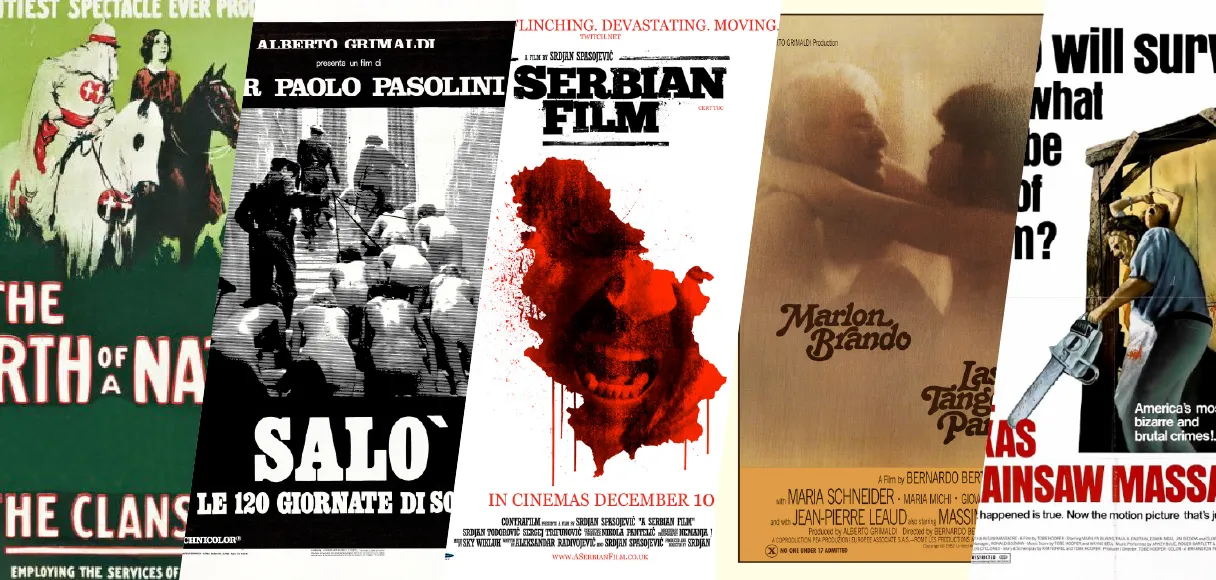

The most controversial film ever made is The Birth of a Nation (1915), which scores 95 out of 100 on the Screendollars 2026 Controversy Index — the highest score across 50 films ranked for geographic bans, duration of active debate, documented real-world incidents, censor board interventions, and critical polarization. No other film on this list directly caused a real organisation to reconstitute itself, reach 4.5 million members, and carry out documented racial violence over the following decades.
What This List Is — and What It Is Not
This is not a list of films that made critics uncomfortable. It is not a collection of provocateurs who pushed buttons at film festivals. It is a ranked index of films that triggered organised public reaction — bans, protests, censor board hearings, government statements, lawsuits, riots, and in one case, a state-sponsored cyberattack on a major Hollywood studio.
Every film on this list has been scored across five criteria. Every score has a source behind it. The methodology is original to Screendollars and is the only public scoring framework that quantifies film controversy across these five dimensions simultaneously.
What Makes a Film Controversial?
A controversial film is a movie that triggers organised public reaction — bans, protests, censor board hearings, or sustained press debate — rather than just private dislike or critical pans. The five trigger categories are graphic violence, sexual content, religious depiction, political content, and racial representation. The crucial distinction is between shocking (a visceral, immediate reaction) and controversial (a sustained, organised public response). Controversy is also historically contingent. What shocks shift by era, which is why this Index measures the duration and reach of the reaction rather than its intensity at a single moment.
The 2026 Screendollars Controversy Index — How We Scored Every Film
We scored 50 films across five criteria, with a maximum total of 100 points. Each criterion was researched individually using censor board records, documented incident reports, box office archives, and published histories of bans. Where sources conflicted, the most conservative confirmed figure was used.
Geographic reach of bans (25 pts). The number of countries that banned the film, refused certification, or heavily cut it.
Duration of controversy (20 pts). Years between release and the most recent active public debate.
Documented real-world incidents (20 pts). Protests, hospitalisations, copycat crimes, government statements, lawsuits.
Censor board interventions (15 pts). Formal proceedings, certification refusals, and ratings revisions were created in response.
Critical and cultural polarization (20 pts). Festival walkout counts, critical score variance, mainstream vs. specialist reception split.
The Full 2026 Controversy Index — All 50 Films Ranked
The complete ranked list of the 50 most controversial films ever made, scored across all five criteria. As of May 2026.
* Song of the South score revised to 73/100 — Disney announced removal from vault in March 2026. Duration score reduced from 20 to 14.
| # | Film | Score | Bans /25 | Dur. /20 | Inc. /20 | Cen. /15 | Pol. /20 |
| Tier 1: 88-100 — Generational controversy | |||||||
| 1 | The Birth of a Nation (1915) | 95 | 18 | 20 | 20 | 15 | 22 |
| 2 | Cannibal Holocaust (1980) | 94 | 25 | 20 | 19 | 15 | 15 |
| 3 | Salo, or the 120 Days of Sodom (1975) | 93 | 22 | 20 | 16 | 15 | 20 |
| 4 | The Innocence of Muslims (2012) | 92 | 20 | 12 | 20 | 14 | 20 |
| 5 | A Serbian Film (2010) | 91 | 25 | 14 | 18 | 15 | 19 |
| 6 | Triumph of the Will (1935) | 90 | 14 | 20 | 18 | 15 | 23 |
| 7 | The Last Temptation of Christ (1988) | 89 | 20 | 18 | 18 | 15 | 18 |
| 8 | Padmaavat (2018) | 88 | 10 | 8 | 20 | 15 | 20 |
| Tier 2: 78-87 — Major institutional controversy | |||||||
| 9 | A Clockwork Orange (1971) | 87 | 12 | 20 | 17 | 15 | 23 |
| 10 | Last Tango in Paris (1972) | 86 | 14 | 20 | 16 | 15 | 21 |
| 11 | The Exorcist (1973) | 84 | 16 | 18 | 15 | 15 | 20 |
| 12 | The Passion of the Christ (2004) | 84 | 14 | 14 | 17 | 15 | 24 |
| 13 | Natural Born Killers (1994) | 83 | 10 | 16 | 20 | 15 | 22 |
| 14 | Faces of Death (1978) | 82 | 25 | 16 | 12 | 15 | 14 |
| 15 | The Texas Chain Saw Massacre (1974) | 81 | 16 | 18 | 13 | 15 | 19 |
| 16 | Irreversible (2002) | 80 | 12 | 14 | 16 | 15 | 23 |
| 17 | I Spit on Your Grave (1978) | 80 | 16 | 16 | 14 | 15 | 19 |
| 18 | Song of the South (1946) | 73* | 8 | 14 | 14 | 13 | 24 |
| 19 | Cuties (2020) | 79 | 10 | 8 | 20 | 15 | 20 |
| 20 | The Human Centipede 2 (2011) | 78 | 14 | 12 | 13 | 15 | 24 |
| Tier 3: 68-77 — Sustained cultural controversy | |||||||
| 21 | Kids (1995) | 77 | 11 | 14 | 15 | 15 | 22 |
| 22 | Henry: Portrait of a Serial Killer (1986) | 77 | 12 | 16 | 12 | 15 | 22 |
| 23 | Battle Royale (2000) | 76 | 10 | 14 | 15 | 15 | 22 |
| 24 | Martyrs (2008) | 74 | 10 | 12 | 12 | 15 | 25 |
| 25 | The Kashmir Files (2022) | 74 | 10 | 4 | 17 | 15 | 20 |
| 26 | Antichrist (2009) | 74 | 10 | 14 | 13 | 15 | 22 |
| 27 | Caligula (1979) | 73 | 13 | 14 | 11 | 15 | 20 |
| 28 | Leaving Neverland (2019) | 73 | 6 | 8 | 20 | 11 | 20 |
| 29 | Pink Flamingos (1972) | 72 | 12 | 16 | 10 | 15 | 19 |
| 30 | Basic Instinct (1992) | 71 | 10 | 14 | 13 | 15 | 19 |
| 31 | Crash (1996) | 71 | 11 | 14 | 11 | 15 | 20 |
| 32 | Nymphomaniac (2013) | 70 | 10 | 10 | 12 | 15 | 23 |
| 33 | Baise-moi (2000) | 70 | 12 | 12 | 11 | 15 | 20 |
| 34 | Joker (2019) | 70 | 6 | 8 | 16 | 12 | 20 |
| 35 | The Interview (2014) | 69 | 8 | 10 | 20 | 11 | 20 |
| 36 | Birth of a Nation (2016) | 69 | 4 | 8 | 18 | 11 | 20 |
| 37 | Fitna (2008) | 68 | 10 | 10 | 17 | 12 | 19 |
| Tier 4: 58-67 — Significant controversy | |||||||
| 38 | American Psycho (2000) | 67 | 8 | 12 | 11 | 15 | 21 |
| 39 | Dogma (1999) | 66 | 8 | 12 | 13 | 13 | 20 |
| 40 | Lipstick Under My Burkha (2016) | 66 | 6 | 8 | 14 | 15 | 23 |
| 41 | Mother! (2017) | 65 | 4 | 8 | 12 | 12 | 20 |
| 42 | The Hunt (2020) | 64 | 3 | 6 | 16 | 12 | 20 |
| 43 | Zero Dark Thirty (2012) | 63 | 4 | 10 | 14 | 13 | 22 |
| 44 | Funny Games (1997/2007) | 62 | 8 | 12 | 9 | 14 | 19 |
| 45 | The Day the Clown Cried (1972) | 62 | 0 | 20 | 8 | 14 | 20 |
| 46 | Persepolis (2007) | 61 | 10 | 10 | 12 | 11 | 18 |
| 47 | Borat (2006) | 61 | 8 | 10 | 13 | 11 | 19 |
| 48 | Lolita (1962/1997) | 60 | 8 | 16 | 7 | 12 | 17 |
| 49 | Detroit (2017) | 59 | 3 | 8 | 13 | 10 | 25 |
| 50 | Bruno (2009) | 58 | 7 | 8 | 11 | 12 | 20 |
Note: Polarization scores above 20 are capped at 20 in total. The Day the Clown Cried scores 0 on bans — never released. Battle Royale bans: not banned in the U.S., distributor refused for a decade.
The 50 Most Controversial Films Ever Made
What follows is the full breakdown of every entry — what the film did, what earned it its place, and why it scores what it scores.
#1. The Birth of a Nation (1915)
🔥 Controversy Index: 95/100
The film that broke cinema — and broke America along with it.
Director: D.W. Griffith
Starring: Lillian Gish, Mae Marsh, Henry B. Walthall
Runtime: 195 mins | Rating: Not Rated | IMDb: 6.8
Where to Watch: Netflix, Hoopla, Kanopy, Prime Video (rent/buy) — verify current availability via JustWatch
The Birth of a Nation arrived on February 8, 1915, as America’s first feature-length blockbuster: a three-hour Civil War epic that grossed an estimated $18 million in its first few years — the equivalent of approximately $1.8 billion today — and held the record as the highest-grossing film in history until Gone with the Wind in 1939. It was the first film screened at the White House, where President Woodrow Wilson reportedly praised it. What it depicted was the Ku Klux Klan as the heroic saviours of the South.
The NAACP launched a national campaign against The Birth of a Nation before it even reached theatres. Riots broke out at screenings in Boston, Chicago, and other northern cities. The film was formally banned in Chicago, Denver, Pittsburgh, St. Louis, Minneapolis, Portland, and New York City following organised protests. In November 1915, nine months after the premiere, William Joseph Simmons burned a cross on Stone Mountain, Georgia, and formally revived the Ku Klux Klan. By 1920, the revived Klan had an estimated 4.5 million members, and historians have directly and repeatedly attributed that revival to this film.
The Birth of a Nation scores 95/100 not because it is the most graphic film on this list — it is not — but because no other film in cinema history caused a real organisation to reconstitute itself, reach 4.5 million members, and carry out documented racial violence over multiple decades. The Library of Congress preserved it in the National Film Registry in 1992 as ‘culturally, historically, or aesthetically significant.’
#2. Cannibal Holocaust (1980)
🔥 Controversy Index: 94/100
The only film in history where a director had to prove his actors were still alive.
Director: Ruggero Deodato
Starring: Robert Kerman, Francesca Ciardi, Luca Barbareschi
Runtime: 95 mins | Rating: Not Rated | IMDb: 5.7
Where to Watch: Shudder, AMC+, Fandor, Peacock, Prime Video (rent/buy) — verify current availability via JustWatch.h
Cannibal Holocaust premiered in Milan in February 1980. Ten days later, Italian courts seized the film and arrested director Ruggero Deodato on multiple counts of murder, after authorities became convinced the actors had been genuinely killed on camera. The cast had each signed contracts requiring them to stay out of all media for one year to preserve the found footage illusion. Those contracts became evidence in a murder trial. Deodato was only cleared when he brought the actors before the court in person.
The murder charges were dropped. The animal cruelty charges were not. Cannibal Holocaust contains on-camera killings of six animals filmed without special effects. Deodato was convicted of animal cruelty, though that verdict was later overturned. Confirmed banned in over 50 countries. Still restricted in several territories as of 2026. UK home video was banned in 1984; the cut version was reissued 17 years later.
Cannibal Holocaust scores 94/100 because it is the only film in cinema history to result in a director facing life imprisonment for the apparent murder of his cast. It is also the first found-footage film ever made, predating The Blair Witch Project by nearly two decades. Deodato died in December 2022.
#3. Salo, or the 120 Days of Sodom (1975)
🔥 Controversy Index: 93/100
The last film Pasolini ever made. He was murdered three weeks before his release.
Director: Pier Paolo Pasolini
Starring: Paolo Bonacelli, Giorgio Cataldi, Uberto Paolo Quintavalle, Aldo Valletti
Runtime: 117 mins | Rating: Not Rated | IMDb: 5.8
Where to Watch: Not currently streaming — available on Blu-ray/DVD. Verify current availability via JustWatch.
Salo, or the 120 Days of Sodom, transposes the Marquis de Sade’s 1785 novel to Fascist-occupied Italy in 1944. Four libertine authorities kidnap 18 young people and subject them to 120 days of extreme psychological, physical, and sexual torture across four chapters structured after Dante’s Inferno. Pasolini described it as ‘a huge Sadean metaphor for the Nazi-Fascists’ crimes against humanity.’
Pasolini was murdered on November 2, 1975 — three weeks before the film’s Paris premiere. The BBFC rejected Salo outright in 1976. Metropolitan Police raided a Soho screening in 1977 and seized the print. Passed uncut in the UK only in December 2000. Australia banned, unbanned, and re-banned the film multiple times between 1975 and 2010.
Salo scores 93/100 because the controversy it carries is not separable from the man who made it or the circumstances of his death. As a political allegory about fascism and absolute power, it has been continuously debated for 50 years. It is genuinely unwatchable for large portions of its audience. Both things are true simultaneously.
#4. The Innocence of Muslims (2012)
🔥 Controversy Index: 92/100
The only film on this list is directly linked to confirmed deaths in more than 20 countries.
Director: Nakoula Basseley Nakoula (as ‘Sam Bacile’)
Runtime: 14 mins (trailer) | Rating: Not Rated
Where to Watch: Not commercially available.
The Innocence of Muslims is a low-budget film produced in California in 2011 by Nakoula Basseley Nakoula. A 14-minute trailer posted to YouTube in July 2012 depicted the Prophet Muhammad in a manner Muslims widely considered blasphemous. In September 2012, protests erupted across the Middle East, North Africa, and South Asia. A militant attack on the US consulate in Benghazi, Libya, on September 11, 2012, killed Ambassador J. Christopher Stevens and three other Americans.
Over 50 deaths were documented across more than 20 countries in the weeks following the trailer’s circulation. Pakistan’s railway minister offered a $100,000 personal bounty for the killing of the filmmaker. YouTube was blocked in Pakistan, Afghanistan, Sudan, Bangladesh, and other nations. Nakoula was sentenced to one year in prison for probation violations related to prior bank fraud convictions.
The Innocence of Muslims scores 92/100 on the basis of its documented real-world incidents score alone, which is the maximum 20 points. Its duration score is limited — the primary controversy peaked in September to October 201, which is the only reason it does not rank higher.
#5. A Serbian Film (2010)
🔥 Controversy Index: 91/100
Confirmed banned in approximately 46 countries. The BBFC required 49 compulsory cuts.
Director: Srdjan Spasojevic
Starring: Srdjan Todorovic, Sergej Trifunovic, Jelena Gavrilovic
Runtime: 104 mins | Rating: Not Rated | IMDb: 5.1
Where to Watch: Banned or severely restricted in most major territories.
A Serbian Film follows a retired porn actor who accepts a final contract and discovers it involves the sexual abuse and murder of children and infants. The content is not implied — it is depicted. Director Srdjan Spasojevic has described the film as a political allegory about the Serbian state’s abuse of its own citizens.
A Serbian Film was confirmed to be banned in approximately 46 countries. The BBFC required 49 compulsory cuts totalling 4 minutes and 11 seconds before issuing an 18 certificate. At its Spanish premiere, the festival director was arrested following a complaint from a local politician.
A Serbian Film scores 91/100 because the censor board response is the most documented and extensive of any film on this list outside the classic era. 49 compulsory BBFC cuts are not an editing note — it is a near-total reimagining of the film’s most extreme sequences.
#6. Triumph of the Will (1935)
🔥 Controversy Index: 90/100
A masterpiece of cinema technique. Commissioned, funded, and used as a recruitment tool by the Third Reich.
Director: Leni Riefenstahl
Runtime: 114 mins | Rating: Not Rated | IMDb: 7.1
Where to Watch: Prime Video (buy), Plex (free). Note: banned in Germany.
Triumph of the Will documents the 1934 Nazi Party Congress in Nuremberg, attended by more than 700,000 supporters. Leni Riefenstahl directed, produced, edited, and co-wrote the film at Hitler’s personal commission. She deployed 30 cameras and 120 crew members. The Nuremberg rally it depicts was itself staged for the film.
Triumph of the Will is banned in Germany under laws governing Nazi materials, a prohibition in force in 2026. Removed from YouTube in 2019 under the hate speech policy. A 2024 documentary on Riefenstahl, drawing on her personal estate, argued that she bore significantly more direct responsibility for Nazi crimes than she acknowledged during her long post-war rehabilitation.
Triumph of the Will scores 90/100 because it uniquely combines maximum polarization with sustained institutional controversy over 90 years. It is simultaneously the most technically accomplished propaganda film ever made and direct evidence of the machinery that enabled the Holocaust.
#7. The Last Temptation of Christ (1988)
🔥 Controversy Index: 89/100
A bomb was detonated outside the Universal lot during production. The film was released anyway.
Director: Martin Scorsese
Starring: Willem Dafoe, Harvey Keitel, Barbara Hershey, David Bowie
Runtime: 163 mins | Rating: R | IMDb: 7.5
Where to Watch: Prime Video, Apple TV (rent/buy)
The Last Temptation of Christ depicts Jesus Christ experiencing human doubt, fear, and temptation — including a fantasy sequence in which he imagines escaping the crucifixion, marrying Mary Magdalene, and living a normal life. The Catholic Church formally condemned the film before it opened. The American Family Association organised a 200,000-signature petition demanding Universal cancel the release.
A bomb was detonated outside the Universal Studios lot during production. A cinema in Paris was firebombed, and 13 people were injured. 25,000 people marched in protest through Paris on the opening weekend. Banned in Greece, Mexico, Chile, Argentina, and the Philippines.
The Last Temptation of Christ scores 89/100 — the highest of any religious controversy film on this list. The combination of 20/20 on geographic bans, 18/20 on duration, and 18/20 on documented incidents, including a firebombing with confirmed injuries,s makes it the definitive religious controversy film in cinema history.
#8. Padmaavat (2018)
🔥 Controversy Index: 88/100
The school bus was carrying children when the Karni Sena attacked it.
Director: Sanjay Leela Bhansali
Starring: Deepika Padukone, Ranveer Singh, Shahid Kapoor
Runtime: 163 mins | Rating: U/A | IMDb: 7.1
Where to Watch: Netflix
Padmaavat is a historical epic based on the 1540 poem Padmavat. The controversy began before a single frame was publicly screened. Karni Sena claimed the film contained a romantic dream sequence between Padmavati and Khilji — an allegation Bhansali repeatedly and categorically denied. In January 2017, a mob stormed the Jaipur set and physically attacked Bhansali.
A school bus carrying children was attacked in Gurgaon by protestors. Over 200 vehicles were torched in Gujarat. A bounty of Rs. .50 million was publicly offered for the head of lead actress Deepika Padukone. Four state governments announced bans. The Supreme Court of India was required to intervene, ruling that the state bans unconstitutional.
Padmaavat scores 88/100 on the strength of its documented real-world incidents score, which is a maximum of 20 out of 20.
#9. A Clockwork Orange (1971)
🔥 Controversy Index: 87/100
Kubrick personally withdrew it from UK cinemas in 1973. It stayed out for 27 years.
Director: Stanley Kubrick
Starring: Malcolm McDowell, Patrick Magee, Adrienne Corri
Runtime: 136 mins | Rating: R (US) / X (original UK) | IMDb: 8.2
Where to Watch: Prime Video, Apple TV, Fandango at Home (rent/buy)
A Clockwork Orange opened in New York in December 1971. Within months of its UK release, British newspapers were attributing violent crimes to the film. A 16-year-old in Oxfordshire was convicted of manslaughter and told police the attack was inspired by A Clockwork Orange. A Dutch girl was raped by attackers singing ‘Singin’ in the Rain.’ Kubrick received death threats.
In 1973, Kubrick contacted Warner Bros. and personally withdrew the film from UK distribution, citing fears for his family’s safety. It remained unavailable in the UK for 27 years until he died in 1999.
A Clockwork Orange scores 87/100 and holds the maximum duration score of 20/20. The decision by a director to withdraw his own film from an entire country’s distribution for the protection of his family is unique in the history of cinema.
#10. Last Tango in Paris (1972)
🔥 Controversy Index: 86/100
The Italian Supreme Court ordered all copies destroyed. They weren’t.
Director: Bernardo Bertolucci
Starring: Marlon Brando, Maria Schneider
Runtime: 129 mins | Rating: NC-17 (US) | IMDb: 7.0
Where to Watch: Prime Video, Apple TV (rent/buy)
The Italian Supreme Court condemned Last Tango in Paris for obscenity in 1973 and ordered all prints destroyed — a sentence never enforced. Bertolucci was convicted of obscenity and had his civil rights suspended for five years. Banned outright in Spain, Portugal, Chile, and Brazil; banned in Italy until 1987.
In 2016, Maria Schneider’s statements from a 2007 interview were widely recirculated, in which she described a specific scene as something she had not been warned about. Bertolucci confirmed in a 2013 interview that the scene was conceived the morning of filming and deliberately not disclosed to Schneider in advance. The 2016 resurgence caused the French Cinematheque to cancel a planned screening in 2024 following protests.
Last Tango in Paris scores 86/100. The duration score is a maximum of 20/20 — the consent controversy reignited in 2016 and produced a documented institutional response as recently as 2024, more than 50 years after the film’s release.
#11. The Exorcist (1973)
🔥 Controversy Index: 84/100
Audiences fainted, vomited, and had heart attacks. Warner Bros. pulled the trailer. The BBFC banned the home video for 11 years.
Director: William Friedkin
Starring: Ellen Burstyn, Linda Blair, Jason Miller, Max von Sydow
Runtime: 122 mins | Rating: R | IMDb: 8.1
Where to Watch: Prime Video, Apple TV (rent/buy)
The Exorcist opened on December 26, 1973, and became the first horror film nominated for the Academy Award for Best Picture. Warner Bros. pulled the theatrical trailer after early screenings led to documented physical reactions, including vomiting. Reports of audiences fainting, screaming, and running from cinemas were documented from the first previews onwards.
The BBFC passed The Exorcist for theatrical release in 1973, but required late-night screenings only. BBFC director James Ferman refused a home video certificate in 1988, citing concerns that the film’s notoriety would lead underage viewers to seek it out. The ban on home video sales remained in force until 1999, 11 years.
The Exorcist scores 84/100. The documented audience hospitalisations are real — not marketing mythology — and the BBFC home video ban from 1988 to 1999 is confirmed.
#12. The Passion of the Christ (2004)
🔥 Controversy Index: 84/100
Roger Ebert called it the most violent film he had ever seen. It made $612 million.
Director: Mel Gibson
Starring: Jim Caviezel, Monica Bellucci, Maia Morgenstern
Runtime: 127 mins | Rating: R | IMDb: 7.3
Where to Watch: Netflix, Plex (free)
The Passion of the Christ depicts the final twelve hours of Jesus Christ’s life in Aramaic, Hebrew, and Latin. Mel Gibson self-financed the film for $30 million after major studios refused to distribute it. It grossed $612 million worldwide. Roger Ebert described it as the most violent film he had ever seen.
The Anti-Defamation League launched a formal campaign before the film’s release, arguing that the depiction of Jewish authorities would fuel antisemitism. Banned in Bahrain, Kuwait, Morocco, and Jordan. Documented cases of cardiac incidents at screenings. The sequel, The Resurrection of Christ, is scheduled for March 2027.
The Passion of the Christ scores 84/100. It is simultaneously the highest-grossing independent religious film in history and the most formally accused of antisemitism of any major release since The Birth of a Nation.
#13. Natural Born Killers (1994)
🔥 Controversy Index: 83/100
Columbine. Heath High School. Frontier Middle School. All cited Natural Born Killers.
Director: Oliver Stone
Starring: Woody Harrelson, Juliette Lewis, Robert Downey Jr., Tommy Lee Jones
Runtime: 118 mins | Rating: R | IMDb: 7.2
Where to Watch: Disney+, Prime Video, Apple TV
Natural Born Killers follows Mickey and Mallory Knox, a couple who commit 52 murders on a cross-country killing spree and become media celebrities. Oliver Stone adapted the film from an original screenplay by Quentin Tarantino, substantially rewriting it.
Natural Born Killers has been linked to over a dozen copycat incidents — more than any comparable film. 1995: Frontier Middle School. 1997: Heath High School. 1999: Columbine perpetrators used ‘NBK’ as their code name. Louisiana couple Darras and Edmondson cited the film during their 1995 killing spree. Banned in Ireland.
Natural Born Killers scores 83/100. The incident score is a maximum of20/20 — the number of documented copycat cases and the specific Columbine connection are unmatched by any comparable film.
#14. Faces of Death (1978)
🔥 Controversy Index: 82/100
Banned in 40+ countries. Most of the footage was fake. Audiences believed it was real.
Director: John Alan Schwartz
Runtime: 104 mins | Rating: R | IMDb: 4.2
Where to Watch: Shudder, AMC+, Tubi (free), Plex (free)
Faces of Death presents itself as a documentary compilation of real death footage assembled by a fictional coroner. The film contains staged re-enactments, archival news footage, and authentic footage of animal slaughter. Director John Alan Schwartz later acknowledged that approximately 40 percent of the footage was staged. Confirmed banned in over 40 countries. Refused certification by the BBFC.
The film’s commercial success was powered entirely by its reputation. A 2026 remake directed by Daniel Goldhaber was released theatrically in April 2026.
Faces of Death scores 82/100 and holds the maximum geographic bans score of 25/25 — confirmed banned in more countries than any other non-narrative film on this list.
#15. The Texas Chain Saw Massacre (1974)
🔥 Controversy Index: 81/100
Hooper tried to get a PG rating. Russia did not show the film until 2024.
Director: Tobe Hooper
Starring: Marilyn Burns, Gunnar Hansen, Edwin Neal
Runtime: 83 mins | Rating: R | IMDb: 7.5
Where to Watch: Shudder, Prime Video, Peacock
The Texas Chain Saw Massacre was shot on a budget of $80,000 to $140,000 and grossed $30.9 million worldwide. Tobe Hooper made deliberate creative choices to limit visible gore in hopes of securing a PG rating. The MPAA rated it R anyway.
BBFC refused a UK home video certificate in 1984. Australia refused classification. Also banned Germany, Norway, Ireland, Singapore, Sweden, and Iceland. The film was finally released in Russia in 2024, 50 years after its American premiere.
The Texas Chain Saw Massacre scores 81/100. The duration score of 18/20 is justified — the 2024 Russian release proved the film was still generating new controversy documentation 50 years on. Now in the Criterion Collection.
#16. Irreversible (2002)
🔥 Controversy Index: 81/100
250 people walked out at Cannes. The first 30 minutes contain a subsonic frequency designed to cause nausea.
Director: Gaspar Noe
Starring: Monica Bellucci, Vincent Cassel, Albert Dupontel
Runtime: 97 mins | Rating: Not Rated | IMDb: 7.3
Where to Watch: Shudder, AMC+, MUBI
Irreversible is told in reverse chronological order. Gaspar Noé deliberately embedded a 28 Hz infrasound frequency in the film’s first thirty minutes, a frequency known to cause disorientation, anxiety, and nausea. Approximately 250 people walked out of the Cannes premiere.
Monica Bellucci’s nine-minute rape sequence — filmed in a single unbroken take — was cited in formal censor board decisions across multiple territories. The BBFC commissioned reports from medical and legal experts before classifying it.
Irreversible scores 80/100. The 28 Hz infrasound detail is confirmed in the film’s own IMDb trivia section. It holds a 77% score on Rotten Tomatoes and is both one of the most formally acclaimed French films of its decade and one of the most viscerally condemned.
#17. I Spit on Your Grave (1978)
🔥 Controversy Index: 80/100
Ebert and Siskel protested outside Chicago cinemas. The film became the best-selling VHS in the country.
Director: Meir Zarchi
Starring: Camille Keaton, Eron Tabor, Richard Pace
Runtime: 101 mins | Rating: NC-17 | IMDb: 5.7
Where to Watch: Shudder, Plex (free), Tubi (free)
I Spit on Your Grave depicts an aspiring writer who is gang-raped by four men and subsequently hunts and kills each of them. Roger Ebert called it ‘a vile bag of garbage.’ Gene Siskel declared it the most offensive film he had seen in eleven years of reviewing.
Ebert and Siskel reportedly protested outside Chicago cinemas, having it pulled after one week. When the home video market emerged, it became one of the best-selling tapes in the country, entering the Billboard top 40 for 14 weeks and winning a Billboard Number One Award. Zarchi later credited Ebert as ‘one of the best promoters ever for this movie.’ Banned in Canada, Ireland, Norway, Iceland, and West Germany.
I Spit on Your Grave scores 80/100. The film that Ebert and Siskel tried to bury is, as of 2026, freely available on Tubi and Plex.
#18. Song of the South (1946)
🔥 Controversy Index: 73/100
Disney voluntarily suppressed its own film for 40 years. In March 2026, they finally ended the suppression.
Directors: Harve Foster and Wilfred Jackson
Starring: James Baskett, Bobby Driscoll, Luana Patten
Runtime: 94 mins | Rating: Approved | IMDb: 6.9
Where to Watch: Not yet available on mainstream US platforms as of May 2026. Disney announced a vault release in March 2026.
Song of the South is Walt Disney’s 1946 live-action and animation hybrid. The NAACP picketed the film’s Atlanta premiere in 1946. James Baskett, who won an honorary Academy Award — the first Black male actor to receive an Oscar — was barred from attending his own premiere because the venue was segregated.
Disney allowed limited theatrical re-releases in 1972 and 1986. After 1986, the film was voluntarily removed from all US distribution channels. Former CEO Bob Iger confirmed in 2020 that the film would never be released on Disney+. In March 2026, Disney announced it was removing the film from its vault, ending 40 years of suppression.
Song of the South scores 73/100 following the March 2026 vault release announcement, which reduces the duration score from 20 to 14. Note: this score will require updating when the film’s actual distribution status is confirmed.
#19. Cuties (2020)
🔥 Controversy Index: 79/100
Netflix was indicted by a Texas grand jury. Four separate indictments were filed under child pornography statutes.
Director: Maïmouna Doucouré
Starring: Fathia Youssouf, Médina El Aidi-Azouni, Esther Gohourou
Runtime: 96 mins | Rating: NC-17 | IMDb: 3.6
Where to Watch: Netflix
Cuties is a coming-of-age drama directed by Maïmouna Doucouré in her feature debut. Doucouré won the Directing Award at the 2020 Sundance Film Festival. The film holds an 88% score on Rotten Tomatoes. Its IMDb score is 3.6 out of 10.
Netflix’s US promotional poster generated immediate backlash. Netflix apologised and replaced it. A Tyler County, Texas grand jury indicted Netflix on September 23, 2020, for ‘promotion of lewd visual material depicting a child.’ District Attorney Lucas Babin subsequently filed four new indictments under a child pornography statute. As of May 2026, the Texas case remains in the courts.
Cuties scores 79/100. The incident score of 20/20 is justified — a criminal indictment of a major streaming platform under child pornography law is documented and unprecedented.
#20. The Human Centipede 2 (Full Sequence) (2011)
🔥 Controversy Index: 78/100
The BBFC’s rejection statement described the film’s content in such clinical detail that the statement itself became a news story.
Director: Tom Six
Starring: Laurence R. Harvey, Ashlynn Yennie
Runtime: 91 mins | Rating: Not Rated | IMDb: 3.9
Where to Watch: AMC+, Shudder, Philo. Note: still banned or unavailable in New Zealand and the Philippines.
The Human Centipede 2 (Full Sequence) depicts a morbidly obese parking attendant obsessed with the first film who attempts to create a 12-person centipede using his own victims. The film contains graphic depictions of sexual violence, defecation, forced mutilation, and the murder of an infant.
The BBFC received the film in June 2011 and refused classification outright — one of only 11 films refused classification in BBFC history since 1912. BBFC director David Cooke concluded cuts were ‘not a viable option.’ The distributor eventually achieved an 18 certificate after 32 cuts totalling 2 minutes and 37 seconds. BBFC vice-president Gerard Lemos abstained from the final vote.
The Human Centipede 2 scores 78/100. The censor board intervention score is a maximum of15/15 — an outright classification refusal, followed by a 32-cut requirement, followed by a board member abstaining from the final vote.
#21. Kids (1995)
🔥 Controversy Index: 77/100
Disney forced the Weinsteins to create a shell company just to distribute it. It grossed $20 million.
Director: Larry Clark
Starring: Leo Fitzpatrick, Justin Pierce, Chloe Sevigny, Rosario Dawson
Runtime: 91 mins | Rating: Unrated | IMDb: 7.0
Where to Watch: Not available on any streaming platform as of 2025. DVD only.
Kids is Larry Clark’s debut feature, written by a 19-year-old Harmony Korine. It depicts a single day in the lives of New York City teenagers. The film was shot using non-professional actors found on New York streets, including Rosario Dawson and Chloe Sevigny, both in their film debuts.
The MPAA gave Kids an NC-17 rating and told Clark no cut would change that. Disney, which owned Miramax, refused to allow the film to be distributed under the Miramax banner. Harvey and Bob Weinstein bought the film back from Disney and created a one-off shell company, Shining Excalibur Films, specifically to distribute it. Kids was released unrated in the US in July 1995. The film grossed $20.4 million worldwide.
Kids scored 77/100. As of 2025, it remains unavailable on any streaming platform in the US — one of the most significant films of the 1990s,s with no legitimate digital presence.
#22. Henry: Portrait of a Serial Killer (1986)
🔥 Controversy Index: 77/100
The MPAA told McNaughton there were no possible edits that would achieve an R rating. The film helped create the NC-17.
Director: John McNaughton
Starring: Michael Rooker, Tom Towles, Tracy Arnold
Runtime: 83 mins | Rating: Unrated | IMDb: 7.0
Where to Watch: Apple TV (rent/buy)
Henry: Portrait of a Serial Killer is loosely based on the confessions of real-life serial killer Henry Lee Lucas. Michael Rooker plays Henry as a drifter in Chicago who commits murders with systematic detachment. McNaughton shot the film in 1985 on approximately $110,000.
The MPAA gave the film an X rating and told McNaughton there were no possible edits that would change that. McNaughton released the film unrated in 1990, four years after its 1986 Chicago International Film Festival premiere. Henry, along with The Cook, the Thief and Tie Me Up! Tie Me Down! was a direct catalyst for the MPAA’s creation of the NC-17 rating in 1990. The BBFC passed the film uncut only in 2003.
Henry: Portrait of a Serial Killer scores 77/100. It was held for four years, circulated underground, praised by critics, X-rated by default of subject matter, and became one of three films that forced the creation of a new ratings category.
#23. Battle Royale (2000)
🔥 Controversy Index: 76/100
The Japanese government tried to ban it and failed. US distributors refused to touch it for a decade.
Director: Kinji Fukasaku
Starring: Tatsuya Fujiwara, Aki Maeda, Takeshi Kitano
Runtime: 114 mins | Rating: Not Rated | IMDb: 7.8
Where to Watch: MUBI
Battle Royale is set in a near-future Japan where the government forces middle school students to fight each other to the death on an isolated island. Director Kinji Fukasaku was 70 years old when he directed it. He had survived the Second World War as a teenager and decided that Japanese authority could not be trusted.
Japanese politicians questioned the Minister of Education in the National Diet, attempting unsuccessfully to ban the film. The film was indexed in Germany, with that restriction overturned in 2013. Toei Film refused to sell US distribution rights for over a decade. Battle Royale was not officially released in the US until 2011 — eleven years after its Japanese premiere.
Battle Royale scores 76/100. The Diet questioning of a cabinet minister over a film is a documented censorship intervention. Its IMDb rating of 7.8 reflects global critical esteem that arrived long before US audiences had legitimate access to it.
#24. Martyrs (2008)
🔥 Controversy Index: 74/100
The French classification board gave it an 18+ rating. The film industry objected. The board re-rated it 16+.
Director: Pascal Laugier
Starring: Morjana Alaoui, Mylène Jampanoi
Runtime: 99 mins | Rating: Not Rated | IMDb: 7.0
Where to Watch: Limited availability — verify current availability via JustWatch
Martyrs is a French-Canadian horror film in two distinct halves. The first follows Lucie, who survived torture as a child and is hunting her captors. The second reveals the captors were part of an organisation trying to create genuine martyrs — people who, through extre, me sustained suffering, might glimpse the afterlife.
The French Commission de classification des oeuvres cinematographiques rated Martyrs 18+ — a rating that would have effectively limited its theatrical release commercially. The French film industry objected strenuously. The board re-rated it 16+. Audiences at the FrightFest premiere in London reported physical illness. The film was banned or restricted in Malaysia, Singapore, and Norway.
Martyrs score 74/100. Its polarization score is the highest of any Tier 3 film. It holds a 62% score on Rotten Tomatoes and is simultaneously considered a masterpiece of horror and an act of cinematic violence against its audience.
#25. The Kashmir Files (2022)
🔥 Controversy Index: 74/100
Singapore banned it outright. Israel’s film festival jury head called it ‘propaganda and vulgar.’ India’s Prime Minister publicly endorsed it.
Director: Vivek Agnihotri
Starring: Mithun Chakraborty, Anupam Kher, Darshan Kumaar, Pallavi Joshi
Runtime: 170 mins | IMDb: 8.5 audience / RT: 40% critics
Where to Watch: ZEE5
The Kashmir Files is based on the documented mass displacement and killings of Kashmiri Pandits in the late 1980s and early 1990s. It was released in March 2022 and became the third highest-grossing Indian film of 2022, earning Rs. 252 crore. Prime Minister Narendra Modi publicly endorsed the film.
Singapore’s InfoComm Media Development Authority banned the film outright in May 2022, citing its ‘provocative and one-sided portrayal of Muslims’ as a threat to religious harmony. The UAE briefly banned the film before reversing the decision. At the 2022 International Film Festival of India, jury president Nadav Lapid publicly called the film ‘propaganda and vulgar,’ triggering a diplomatic incident.
The Kashmir Files scores 74/100. Its IMDb score of 8.5 reflects sustained Indian nationalist support. Its Rotten Tomatoes critics’ score of 40% reflects sustained critical discomfort. The gap between those two scores is, after Mother!, the largest on this list.
#26. Antichrist (2009)
🔥 Controversy Index: 74/100
The Cannes Ecumenical Jury gave it an anti-prize. Charlotte Gainsbourg won Best Actress at the same festival.
Director: Lars von Trier
Starring: Willem Dafoe, Charlotte Gainsbourg
Runtime: 108 mins | Rating: R | IMDb: 6.5
Where to Watch: Prime Video, Shudder
Antichrist is Lars von Trier’s horror film about a grieving couple who retreat to a remote cabin. The film proceeds through chapters labelled Grief, Pain, and Despair. The content includes genital self-mutilation, sexual violence, and a sequence involving a pair of rusty scissors.
At Cannes 2009, audience members walked out, and others reported fainting. The Cannes Ecumenical Jury issued an anti-prize to Antichrist as ‘the most misogynist movie’ — the first time the jury had issued an anti-prize. Charlotte Gainsbourg won Best Actress at the same festival. In 2016, the French advocacy group Promouvoir obtained a court order banning the film in France, subsequently lifted after reclassification to 18+.
Antichrist scores 74/100. The Cannes anti-prize is a confirmed institutional condemnation issued during the same festival that gave Gainsbourg its acting award.
#27. Caligula (1979)
🔥 Controversy Index: 73/100
Gore Vidal disowned it. Tinto Brass disowned it. Malcolm McDowell disowned it. The producer released it anyway.
Director: Tinto Brass / Bob Guccione (uncredited additional scenes)
Starring: Malcolm McDowell, Helen Mirren, Peter O’Toole, John Gielgud
Runtime: 156 mins | Rating: X (original US) | IMDb: 5.3
Where to Watch: Amazon Prime, Apple TV (rent/buy)
Caligula was conceived by Penthouse founder Bob Guccione as a sexually explicit historical epic. He hired Gore Vidal to write the screenplay and Tinto Brass to direct, attracting Malcolm McDowell, Peter O’Toole, Helen Mirren, and John Gielgud. The $17.5 million budget made it the most expensive independent film ever produced at that time. Gore Vidal disowned the project during principal photography.
Guccione hired Giancarlo Lui to film hardcore pornographic scenes without informing the cast or Brass, and inserted them into the final cut. Both Brass and McDowell disowned the result. The UK print was seized by Customs in 1980. Australia went through multiple banning and unbanning cycles between 1980 and 2021. In 2024, a restored ‘Ultimate Cut’ of Brass’s original vision was released to a 66% Rotten Tomatoes score.
Caligula scores 73/100. The production scandal is unique on this list — the director, screenwriter, and lead actor all formally disowned the finished film before its release. The 2024 Ultimate Cut confirmed that two genuinely different films were made under the same title.
#28. Leaving Neverland (2019)
🔥 Controversy Index: 73/100
HBO pulled it from streaming in October 2024 after a six-year legal battle with the Jackson estate.
Director: Dan Reed
Starring: Wade Robson, James Safechuck (documentary subjects)
Runtime: 240 mins (2 parts) | Rating: Not Rated | IMDb: 7.0
Where to Watch: Not available on US platforms as of May 2026. Available on Netflix Japan.
Leaving Neverland is a two-part documentary in which Wade Robson and James Safechuck describe the sexual abuse they allege Michael Jackson committed against them when they were children. The film attracted the third-largest audience for an HBO documentary of the decade.
The Michael Jackson estate filed a $100 million lawsuit against HBO before the film’s premiere. The lawsuit dragged on through the courts for six years before settling in October 2024. As part of the settlement, HBO agreed to remove Leaving Neverland from its streaming platform. Radio stations in New Zealand pulled Jackson’s music. A Simpsons episode featuring Jackson’s voice was pulled from syndication.
Leaving Neverland scores 73/100. The Michael Jackson biopic Michael opened in May 2026 to a $217 million global opening weekend, renewing interest in why the documentary cannot be watched.
#29. Pink Flamingos (1972)
🔥 Controversy Index: 72/100
The UK has never seen the complete version. It is in both the National Film Registry and the Criterion Collection.
Director: John Waters
Starring: Divine, David Lochary, Mink Stole, Edith Massey
Runtime: 92 mins | Rating: NC-17 | IMDb: 6.0
Where to Watch: Criterion Channel, Apple TV (rent/buy)
Pink Flamingos was shot in Baltimore in 1971 on a budget of $12,000. Its most infamous sequence — Divine consuming fresh dog faeces on camera, in a single unbroken take — is real. John Waters has confirmed this in every interview. The film also contains chicken brutality, simulated incest, and cannibalism.
Pink Flamingos was banned in Switzerland, Australia, and Norway. Nova Scotia banned it until 1997. Australia banned the film four separate times before issuing a certificate. The UK has never seen the complete uncut version — multiple BBFC cuts across successive releases removed between 2 and 3 minutes each time.
Pink Flamingos scores 72/100. The co-existence of a National Film Registry preservation alongside ongoing censorship in multiple territories is specific to this film on this list.
#30. Basic Instinct (1992)
🔥 Controversy Index: 71/100
GLAAD distributed the script outside San Francisco cinemas to spoil the ending. The film was submitted to the MPAA seven times.
Director: Paul Verhoeven
Starring: Michael Douglas, Sharon Stone
Runtime: 127 mins | Rating: R | IMDb: 6.9
Where to Watch: Fandango at Home (rent/buy)
Basic Instinct is Paul Verhoeven’s erotic thriller. The film was submitted to the MPAA seven times before receiving an R rating. Verhoeven was required to remove 18 seconds from a threesome scene in the final submission. Basic Instinct grossed $352 million worldwide on a $49 million budget.
GLAAD, Queer Nation, and ACT UP organised protests during filming in San Francisco in March 1991, objecting to the film’s depiction of lesbian and bisexual women as violent and manipulative. Protesters distributed copies of the script outside San Francisco cinemas specifically to spoil the ending for audiences.
Basic Instinct scores 71/100. The controversy it produced directly contributed to the formalisation of LGBTQ sensitivity consultation in Hollywood. The script-spoiling campaign outside cinemas remains one of the more creative documented protest strategies in film history.
#31. Crash (1996)
🔥 Controversy Index: 71/100
Westminster Council banned it from West End cinemas. Ted Turner delayed the US release. The Daily Mail ran 400 articles.
Director: David Cronenberg
Starring: James Spader, Holly Hunter, Elias Koteas, Deborah Kara Unger, Rosanna Arquette
Runtime: 100 mins | Rating: NC-17 (US uncut) / R (edited) | IMDb: 6.4
Where to Watch: Apple TV, Fandango at Home (rent/buy)
Crash is David Cronenberg’s adaptation of J.G. Ballard’s 1973 novel, in which a group of people develops a sexual fixation on car accidents. The film won the Special Jury Prize at Cannes 1996. Cronenberg’s direction is clinical and without moral comment.
Westminster Council banned Crash from West End cinemas in London. The Daily Mail orchestrated a campaign against the film, running over 400 articles. Ted Turner, whose company owned US distributor Fine Line Features, refused to release the film in the United States, pulling it from a scheduled October 1996 release date. Francis Ford Coppola, who served as Cannes 1996 jury president, blocked the film from receiving the Palme d’Or. The BBFC commissioned the Queen’s Counsel and the Royal Automobile Club as consultants before classifying it — an unprecedented step for a single film.
Crash scores 71/100. The BBFC consultant process is the most elaborate institutional review of any single film in British censorship history.
#32. Nymphomaniac (2013)
🔥 Controversy Index: 70/100
Turkey classified it as pornography. Romania banned it, reversed the ban, and fired the classification board president.
Director: Lars von Trier
Starring: Charlotte Gainsbourg, Stellan Skarsgard, Shia LaBeouf, Uma Thurman, Christian Slater
Runtime: 4h 1m (director’s cut, combined) | Rating: Not Rated | IMDb: 6.9
Where to Watch: MUBI, Amazon Prime (rent/buy)
Nymphomaniac is Lars von Trier’s two-part film tracing the erotic life of Joe, played by Charlotte Gainsbourg, from birth to the age of 50. The director’s cut runs four hours and one minute. The theatrical US release was cut by approximately 90 minutes. Shia LaBeouf staged a now-infamous walkout from the Berlin International Film Festival press conference for the film.
Turkey’s film board classified Nymphomaniac as pornography in March 2014, banning its theatrical release (confirmed by The Hollywood Reporter). Romania’s National Center of Cinematography initially gave Nymphomaniac Vol. 2 an 18 XXX rating in January 2014, making it illegal to show publicly. The distributor appealed; the ban was reversed the next day; the CNC president was subsequently dismissed.
Nymphomaniac scores 70/100. The US theatrical cut reduced the film by 90 minutes to secure a viable rating, making it one of the most commercially compromised versions of any film on this list.
#33. Baise-moi (2000)
🔥 Controversy Index: 70/100
The first film was banned in France for 28 years. It’s banning directly caused the French rating system to be reformed.
Director: Virginie Despentes / Coralie Trinh Thi
Starring: Karen Lancaume, Raffaela Anderson
Runtime: 77 mins | Rating: Unrated | IMDb: 4.5
Where to Watch: Not currently streaming. DVD only.
Baise-moi follows Nadine and Manu, two marginalised women who go on a violent road trip after each of them kills someone close to them. The film contains explicit, unsimulated sex scenes alongside graphic violence. Both directors were former adult performers. It is a foundational work in New French Extremity cinema.
The French Centre national du cinema initially rated Baise-moi 16+ in May 2000. The right-wing advocacy group Promouvoir challenged the classification. The Conseil d’Etat ruled the classification illegal, removing the film from the theatre circuit — making Baise-moi the first film banned in France for 28 years. The French Minister for Culture reintroduced the 18 certificate as a classification category as a direct result. The film was also banned in Australia, Malaysia, Singapore, Switzerland, and Norway.
Baise-moi, score 70/100. The specific legacy that it single-handedly caused the French rating system to create a new classification category is a measurable, documented institutional outcome.
#34. Joker (2019)
🔥 Controversy Index: 70/100
The FBI and the US Army both issued formal warnings about potential mass shootings at screenings.
Director: Todd Phillips
Starring: Joaquin Phoenix, Robert De Niro, Zazie Beetz
Runtime: 122 mins | Rating: R | IMDb: 8.3
Where to Watch: Amazon Prime Video, Apple TV (rent/buy)
Joker is Todd Phillips’s origin story for Arthur Fleck, the failed comedian who becomes the Joker in a 1981 Gotham City setting. Joaquin Phoenix lost 52 pounds for the role. The film won the Golden Lion at the Venice Film Festival and grossed over $1 billion worldwide — the first R-rated film to do so.
A Joint Intelligence Bulletin issued by the FBI and Department of Homeland Security before the film’s October 4, 2019, opening cited dark web ‘disturbing and very specific chatter’ about targeting an unknown movie theatre. Fort Sill Army base in Oklahoma issued a separate memorandum warning soldiers and their families. The Los Angeles Police Department increased its visible presence around theatres. The Aurora cinema in Colorado refused to screen the film. Families of the Aurora victims sent an open letter to Warner Bros.
Joker scores 70/100. No mass shooting occurred during its theatrical run. The combination of FBI bulletin, Army memorandum, LAPD deployment, Aurora cinema refusal, and Aurora family letter constitutes a documented incidents score of 16/20 — more government and institutional responses than any film since The Interview.
#35. The Interview (2014)
🔥 Controversy Index: 69/100
North Korea allegedly hacked Sony. The US President called the studio’s cancellation ‘a mistake.’
Director: Seth Rogen / Evan Goldberg
Starring: James Franco, Seth Rogen, Randall Park
Runtime: 112 mins | Rating: R | IMDb: 6.5
Where to Watch: Netflix, Amazon Prime Video
The Interview is a Seth Rogen and James Franco comedy in which two tabloid journalists are recruited by the CIA to assassinate North Korean leader Kim Jong-un, played by Randall Park. The premise is straightforward political satire. What followed its planned release is one of the most documented cases of state-level action against a film in modern history.
In November 2014, Sony Pictures was subjected to a massive cyberattack. The hackers, a group calling themselves the ‘Guardians of Peace,’ demanded Sony withdraw The Interview from release and threatened violence against cinemas showing it. Sony cancelled the December 25, 2014, theatrical release. President Obama publicly called the cancellation ‘a mistake.’ The FBI formally attributed the attack to North Korea.
The Interview scores 69/100. The incident score is a maximum of 20/20 — a state-sponsored cyberattack on a major studio that caused a major studio to cancel a film’s theatrical release is the most extreme documented case of external pressure on film distribution in the modern era.
#36. Birth of a Nation (2016)
🔥 Controversy Index: 69/100
The $17.5 million Sundance record. The survivor who died by suicide. The director, who still insists he did nothing wrong.
Director: Nate Parker
Starring: Nate Parker, Armie Hammer, Gabrielle Union, Aunjanue Ellis
Runtime: 120 mins | Rating: R
Where to Watch: Available on streaming — verify current availability via JustWatch
Nate Parker’s Birth of a Nation depicts the 1831 slave rebellion led by Nat Turner. It premiered at the 2016 Sundance Film Festival, where Fox Searchlight paid a record $17.5 million for worldwide rights. The film won the Grand Jury Prize and the Audience Award. It arrived amid the #OscarsSoWhite controversy. The title is a deliberate reclamation of D.W. Griffith’s 1915 Klan-friendly silent film.
As festival buzz built, reporting resurfaced about a 1999 Penn State rape case in which Parker and co-writer Jean McGianni Celestin were both accused. Parker was acquitted. Celestin was convicted, though charges were later dropped on appeal. The accuser died by suicide in 2012. Cast member Gabrielle Union published an op-ed in the Los Angeles Times describing her anguish at appearing in a film made by someone whose conduct remained, to her, unresolved. The AFI cancelled a planned student screening. The film grossed $16.8 million against an $8.5 million budget.
Birth of a Nation (2016) scores 69/100. There are no formal bans. The incident score of 18/20 reflects the survivor’s death, the Gabrielle Union op-ed, and the AFI cancellation as documented responses. The polarization score of 20/20 reflects the sharpest possible divide: a film that simultaneously won Sundance’s top two prizes and became unwatchable for a significant portion of its potential audience before it opened.
#37. Fitna (2008)
🔥 Controversy Index: 68/100
Geert Wilders was banned from entering Britain to screen his film. The Dutch government formally distanced itself from its own citizens’ film.
Director: Geert Wilders
Runtime: 17 mins | Rating: Not Rated | IMDb: 4.8
Where to Watch: Not available on mainstream streaming platforms. Originally released on LiveLeak.
Fitna is a 17-minute short film produced and directed by Geert Wilders, leader of the Dutch Party for Freedom. The film presents selected verses from the Quran alongside footage of terrorist attacks, arguing that Islam motivates violence against non-believers. Made in secrecy due to death threats, it was released directly on LiveLeak on March 27, 2008.
The Dutch government formally distanced itself from the film before its release. The Organisation of Islamic Cooperation filed a formal condemnation. Jordan filed a complaint with the UN Human Rights Council. Pakistan, Indonesia, Afghanistan, and multiple other Muslim-majority countries banned the film or blocked the URLs hosting it. Indonesia briefly blocked YouTube entirely in April 2008. In February 2009, the British Home Office banned Wilders from entering the UK. In 2010, Wilders was put on trial for inciting hatred against Muslims in the Netherlands.
Fitna scores 68/100. The incident score of 17/20 reflects the formal international condemnations, the Wilders UK entry ban, and the Dutch hate speech trial as documented institutional responses.
#38. American Psycho (2000)
🔥 Controversy Index: 67/100
The MPAA gave it NC-17. Lions Gate created a new distribution company to handle the fallout. Only 18 seconds were cut.
Director: Mary Harron
Starring: Christian Bale, Reese Witherspoon, Jared Leto, Willem Dafoe
Runtime: 102 mins | Rating: R | IMDb: 7.6
Where to Watch: Prime Video (free with Prime), Apple TV, Fandango at Home
American Psycho is Mary Harron’s adaptation of Bret Easton Ellis’s 1991 novel, in which New York investment banker Patrick Bateman leads a double life as a serial killer. The novel was the 53rd most frequently challenged book from 1990 to 1999, according to the American Library Association. It was dropped by its original publisher, Simon and Schuster, before Vintage published it. Harron’s film premiered at Sundance 2000 to positive reviews. Anti-violence protestors had attempted to shut down the Toronto shoot.
When Harron submitted American Psycho to the MPAA, it was given an NC-17. She appealed and lost. The MPAA told Lions Gate that they believed an NC-17 was appropriate and detailed their specific objection: a threesome scene in which Bateman watches himself in a mirror rather than his partners. Lions Gate argued the scene was integral to establishing the character’s narcissism. The MPAA was unmoved. Harron cut 18 seconds — by her own account, a minimal change — and the film received an R. The MPAA was satisfied with the removal of shots of physical penetration. The violence, including the Jared Leto axe murderer, remained intact. Mark Urman, then co-president of Lions Gate’s distribution arm, created a new subsidiary specifically to release the film.
American Psycho scores 67/100. The specific MPAA logic — a threesome scene warranted NC-17, an axe murderer did not — became a case study cited regularly in discussions of American censorship priorities. The film holds a 7.6 IMDb rating and is now considered a cult classic and one of Christian Bale’s defining performances.
#39. Dogma (1999)
🔥 Controversy Index: 66/100
Disney CEO Michael Eisner ordered Miramax to drop it. Kevin Smith attended his own protest and gave an interview without being recognised.
Director: Kevin Smith
Starring: Ben Affleck, Matt Damon, Linda Fiorentino, Alan Rickman, Salma Hayek, Chris Rock, Alanis Morissette
Runtime: 130 mins | Rating: R | IMDb: 7.3
Where to Watch: Fandango at Home (rent) — limited availability due to rights issues. Remaster announced in 2024.
Dogma is Kevin Smith’s religious satire, in which two fallen angels discover a loophole in Catholic dogma that would allow them to return to Heaven — but would also unmake existence in the process. The film features a Black apostle of Jesus, a female God, and a literal excrement demon. The Catholic League president, William Donohue, attacked the film for months without seeing it. Disney CEO Michael Eisner, citing discomfort with the subject matter, ordered Miramax to sell the film. The Weinsteins arranged for Lionsgate to distribute it.
Catholic League protesters picketed theatre screenings across the US. Kevin Smith received 400,000 pieces of hate mail and three confirmed death threats, per Entertainment Weekly. Smith personally attended one of the protests unrecognised and was interviewed by a journalist who did not know he was the film’s director. He later described the irony as one of the more surreal experiences of his career. The film grossed $44 million worldwide on a $10 million budget. Roger Ebert gave it three and a half out of four stars.
Dogma scores 66/100. Due to a deal struck with Miramax that predates the advent of streaming, the Weinsteins maintained personal control of the film’s rights. After Harvey Weinstein fell from power in 2017, no party would touch the rights to negotiate a digital release. Dogma was unavailable to stream for years, with out-of-print Blu-rays selling for over $100. A remaster was announced by Smith in 2024. As of May 2026, the rights situation is being resolved.
#40. Lipstick Under My Burkha (2016)
🔥 Controversy Index: 66/100
India’s censor board called it ‘lady-oriented.’ The Film Certification Appellate Tribunal called that determination illegal.
Director: Alankrita Shrivastava
Starring: Ratna Pathak Shah, Konkona Sen Sharma, Aahana Kumra, Plabita Borthakur
Runtime: 117 mins
Where to Watch: Amazon Prime Video
Lipstick Under My Burkha depicts the hidden lives of four women across generations in a small-town Indian setting — a widow in her 50s, a college student, a beautician, and a married woman — each navigating sexual desires and personal freedoms repressed by patriarchal norms. Director Alankrita Shrivastava produced the film with Prakash Jha. It premiered internationally and won 17 awards before it was submitted to the CBFC for India certification in early 2017.
The Central Board of Film Certification refused certification in February 2017, stating in a formal letter that the film was ‘lady-oriented’ with ‘no strong male lead.’ The CBFC letter also cited ‘audio pornography’ and ‘a bit sensitive touch about one particular section of society.’ The letter was leaked on social media and generated a national controversy that significantly expanded the film’s profile. Muslim organisations formally condemned the film to the CBFC, adding a communal dimension to the censorship debate. The Film Certification Appellate Tribunal overturned the CBFC decision and granted an adults-only A certificate on April 4, 2017. The FCAT stated that there cannot be any embargo on a women-oriented film.
Lipstick Under My Burkha scores 66/100. The CBFC’s ‘lady-oriented’ letter became one of the most cited examples of institutional bias in Indian film censorship history. The film was released in India on July 21, 2017, grossing Rs. 15 crore on a budget of approximately one-fifth of that.
#41. Mother! (2017)
🔥 Controversy Index: 65/100
F CinemaScore. 68% on Rotten Tomatoes. IMDb 6.6. Aronofsky said the F was exactly what he intended.
Director: Darren Aronofsky
Starring: Jennifer Lawrence, Javier Bardem, Ed Harris, Michelle Pfeiffer
Runtime: 121 mins | Rating: R | IMDb: 6.6
Where to Watch: Paramount+
Mother! is Darren Aronofsky’s psychological horror film in which a couple’s life in their country home is progressively overwhelmed by an escalating stream of uninvited guests. The film is a religious allegory — Jennifer Lawrence as Mother Earth, Javier Bardem as God, the house as Eden — constructed to function simultaneously as a domestic horror film and a meditation on environmental catastrophe and creative egotism. Aronofsky wrote the script in five days. Paramount distributed the film and stated its support after its controversial opening weekend.
Mother! received an F CinemaScore — one of only 19 films in history to do so, according to records cited at the time of release. The F grade is based on exit polls of moviegoers on opening night. Darren Aronofsky’s response to the F was explicit: ‘How, if you walk out of this movie, are you not going to give it an F? It’s a punch. It’s a total punch. We wanted to make a punk movie and come at you.’ The film holds a 68% score on Rotten Tomatoes and a 6.6 IMDb rating. It grossed $44.5 million against a $30 million budget. Joaquin Phoenix walked out of a press interview when asked about the film’s violence.
Mother! scores 65/100. The ban’s score of 4/25 is limited — no country formally banned the film. The controversy exists almost entirely in critical reception and audience rejection, which is why the polarization score is the film’s primary driver. The gap between a Venice selection and an F CinemaScore is, by any measure, one of the widest on this list.
#42. The Hunt (2020)
🔥 Controversy Index: 64/100
Universal cancelled the September 2019 release after the El Paso and Dayton shootings. Then, it was re-released using its own cancellation as the marketing.
Director: Craig Zobel
Starring: Betty Gilpin, Hilary Swank, Emma Roberts
Runtime: 90 mins | Rating: R | IMDb: 6.6
Where to Watch: Amazon Video (rent)
The Hunt is a satirical thriller in which wealthy liberal elites hunt working-class conservatives called ‘deplorables’ for sport. The film, produced by Blumhouse, was scheduled for release on September 27, 2019. On August 3, 2019, a gunman killed 22 people in El Paso, Texas. Hours later, a separate shooter killed nine people in Dayton, Ohio. On August 5, banners for The Hunt were dismantled on the Universal lot. On August 9, Universal announced the cancellation, stating, Now is not the right time.’
President Trump had tweeted about ‘racists and left-wing propaganda in Hollywood’ in apparent reference to The Hunt without naming it. Fox News covered the film’s premise extensively, and ESPN pulled a broadcast ad. Director Craig Zobel described the experience as ‘an out-of-body experience.’ Writer Damon Lindelof told Rolling Stone: ‘It’s probably the most judged movie that’s ever existed that everyone who judged it hadn’t seen.’ Universal re-released The Hunt on March 13, 2020, using its own controversy as a marketing hook. Theatres closed for the pandemic one week later.
The Hunt scores 64/100. The incident’s score of 16/20 reflects the presidential social media response, the studio’s own cancellation under political pressure, and the unprecedented marketing pivot that used the cancellation as a selling point. The film’s Rotten Tomatoes score is 57%.
#43. Zero Dark Thirty (2012)
🔥 Controversy Index: 63/100
Senators Feinstein, McCain, and Levin sent a bipartisan letter to Sony calling the film ‘grossly inaccurate and misleading.’
Director: Kathryn Bigelow
Starring: Jessica Chastain, Jason Clarke, Joel Edgerton
Runtime: 157 mins | Rating: R | IMDb: 7.4
Where to Watch: Paramount+, Peacock
Zero Dark Thirty is Kathryn Bigelow’s docudrama reconstruction of the decade-long CIA hunt for Osama bin Laden, from the aftermath of the September 11, 2001, attacks to the May 2011 SEAL raid on bin Laden’s compound in Abbottabad, Pakistan. It received critical acclaim, appeared on 95 critics’ top-ten lists of 2012, and grossed $132 million worldwide. Its opening sequence depicts an extended waterboarding session. The film does not explicitly endorse torture but presents it as part of the intelligence process that led to bin Laden.
Senators Dianne Feinstein, John McCain, and Carl Levin sent a bipartisan letter to Sony Pictures Entertainment chairman Michael Lynton in December 2012, stating that Zero Dark Thirty was ‘grossly inaccurate and misleading’ in its suggestion that torture resulted in information that led to bin Laden’s location. ‘You have a social and moral obligation to get the facts right,’ the letter read. Michael Morell, the CIA’s acting director, sent a public letter to CIA employees on December 21, 2012, stating that the film ‘takes significant artistic license’ while ‘portraying itself as being historically accurate.’ Jane Mayer in The New Yorker and Glenn Greenwald publicly argued that the film was pro-torture propaganda.
Zero Dark Thirty scores 63/100. A bipartisan Senate letter calling a specific film ‘grossly inaccurate and misleading’ and a formal CIA response directed at its own employees are documented institutional responses of a kind that very few films on this list have produced. The film’s own director acknowledged that the controversy required a public response.
#44. Funny Games (1997/2007)
🔥 Controversy Index: 62/100
One-third of the Cannes audience walked out. Haneke said, ” If you enjoyed this film, you missed its point.
Director: Michael Haneke
Starring: (1997) Susanne Lothar, Ulrich Muhe; (2007) Naomi Watts, Tim Roth, Michael Pitt
Runtime: 109 mins (1997) / 111 mins (2007)
Where to Watch: Criterion Channel, Apple TV, Amazon Prime (rent/buy)
Funny Games is Michael Haneke’s Austrian psychological thriller in which two clean-cut young men hold an Austrian family hostage in their vacation home and force them to play sadistic games. The film is an explicit critique of audience complicity in screen violence — the killers break the fourth wall repeatedly, address the camera, and at one point use a remote control to rewind a scene in which one of them is killed. Haneke stated publicly that anyone who watches Funny Games for entertainment has fundamentally misunderstood what the film is doing. He remade it shot-for-shot in English in 2007 to reach a wider audience with the same critique.
Funny Games premiered at Cannes in May 1997. Approximately one-third of the audience walked out during the screening — a figure documented by Variety’s review at the festival and reported by multiple outlets. The film was entered into competition by Austria, the first Austrian film in the Cannes competition in 35 years. Director Jacques Rivette, reviewing the film for Senses of Cinema, called it ‘a complete piece of shit’ — a rare documented case of one major filmmaker formally attacking another’s work in print. The film is available in a Criterion Collection edition.
Funny Games scores 62/100. The ban’s score of 8/25 is limited — the film was not formally banned in most territories. The controversy exists almost entirely in the audience reaction and the critical division it produced. Haneke’s own stated position — that he made the film as punishment for audiences who enjoy violence — remains the most provocative artist’s statement about their own work on this entire list.
#45. The Day the Clown Cried (1972)
🔥 Controversy Index: 62/100
Never released. Jerry Lewis locked it in a vault for 52 years. In May 2025, a complete workprint was finally confirmed to exist.
Director: Jerry Lewis
Starring: Jerry Lewis
Runtime: Unknown (estimated 104 mins) | Rating: Not Rated
Where to Watch: Not commercially available. The Library of Congress holds fragmentary footage donated in 2014.
The Day the Clown Cried is Jerry Lewis’s 1972 feature about a German circus clown imprisoned in a Nazi concentration camp who is forced to lead Jewish children to the gas chambers. Lewis directed, co-wrote, and starred in the film. He shot it in 1972 on a European production that collapsed into financial and legal disputes before post-production was completed. Lewis later described it as ‘drastically wrong’ and vowed to prevent it from ever being seen publicly. He kept the only copy in a private vault for decades.
In 2014, Lewis donated his footage to the Library of Congress with a stipulation that it could not be screened before June 2024. Reports in January 2024 suggested a Library of Congress screening was imminent; the Library of Congress subsequently confirmed to IndieWire that no public screenings were planned and that the archive does not possess a complete cut of the film. In August 2024, journalist Benjamin Charles Germain Lee viewed all five hours of the Library of Congress footage and confirmed it was fragmentary and unfinished. In May 2025, Swedish actor Hans Crispin was revealed by Icon Magazine and SVT to possess a complete workprint of the film — the first confirmed sighting of a full version.
The Day the Clown Cried scores 62/100. It scores 0 on geographic bans because the film was never released. It scores the maximum 20/20 on duration — it is the only film on this list whose controversy has persisted for 52 years without an audience. The polarization score of 20/20 is based entirely on the cultural reaction to a film nobody has legally seen.
#46. Persepolis (2007)
🔥 Controversy Index: 61/100
Iran protested to the French embassy. Tunisia put the TV station that broadcast it on trial. Chicago schools banned it.
Director: Marjane Satrapi / Vincent Paronnaud
Starring: Chiara Mastroianni, Catherine Deneuve, Gena Rowlands (voices)
Runtime: 96 mins | Rating: PG-13 | IMDb: 8.0
Where to Watch: Fandango at Home, Apple TV (rent/buy)
Persepolis is Marjane Satrapi’s animated autobiographical film, adapted from her graphic novel, depicting her childhood in pre- and post-revolutionary Iran and her adolescence in Vienna. It was co-directed by Vincent Paronnaud. The film was nominated for the Academy Award for Best Animated Feature in 2008, holds a 96% score on Rotten Tomatoes, and won the Jury Prize at Cannes 2007. It grossed $22.8 million worldwide.
The Iranian government sent a formal letter of protest to the French embassy in Tehran following the film’s release, and pressured the organisers of the 2007 Bangkok Film Festival to drop the film from the lineup. The film is banned in Iran and Lebanon. In 2011, the Tunisian satellite TV channel Nessma broadcast Persepolis. Protests followed, the channel’s offices were attacked, and the channel director was put on trial for disturbing public order and blasphemy, confirmed by Amnesty International and Human Rights Watch. In 2013, the Chicago Public Schools briefly banned the film from middle school libraries before reversing the decision following an ACLU challenge.
Persepolis scores 61/100. Its Rotten Tomatoes score of 96% and Metacritic score of 90 make it the highest-critically-rated film on this list. The controversy around it is entirely rooted in its political content — it is a film that governments have banned, not critics or audiences. That is a specific and uncommon pattern for a film of its critical standing.
#47. Borat: Cultural Learnings of America for Make Benefit Glorious Nation of Kazakhstan (2006)
🔥 Controversy Index: 61/100
Kazakhstan banned it and threatened to sue. By 2012, they thanked Baron Cohen for boosting tourism tenfold.
Director: Larry Charles
Starring: Sacha Baron Cohen, Ken Davitian, Luenell
Runtime: 84 mins | Rating: R | IMDb: 7.3
Where to Watch: Netflix, Amazon Prime Video
Borat: Cultural Learnings of America for Make Benefit Glorious Nation of Kazakhstan is Sacha Baron Cohen’s mockumentary in which a fictional Kazakh journalist travels across America recording the reactions of real Americans to his extreme and provocative behaviour. The film was nominated for an Academy Award for Best Adapted Screenplay, won the Golden Globe for Best Actor: Musical or Comedy, and grossed $261 million worldwide on an $18 million budget.
Kazakhstan’s government banned Borat and threatened to sue Sacha Baron Cohen before the film’s release, taking down the film’s Kazakh-hosted website in 2005. The film was banned in all Arab countries except Lebanon and the United Arab Emirates. Dubai’s censor described the film as ‘vile, gross and extremely ridiculous,’ stating that if all offensive scenes were excised, there would be about thirty minutes remaining. Multiple lawsuits were filed by individuals who appeared in the film, claiming they were deceived about its nature. A Palestinian grocer, Ayman Abu Aita, filed a $110 million lawsuit after he was depicted on screen as a ‘terrorist group leader’ — a case that was settled under confidential terms.
Borat scores 61/100. The Kazakhstan diplomatic arc — from ban to formal thank-you within six years — is the most unusual resolution of a film controversy on this list. By 2012, Kazakhstan’s foreign minister publicly acknowledged that Borat had increased interest in the country as a tourist destination tenfold.
#48. Lolita (1962 / 1997)
🔥 Controversy Index: 60/100
Kubrick said he probably wouldn’t have made the 1962 film had he known the constraints he’d face. The 1997 version couldn’t find a US distributor for a year.
Director: Stanley Kubrick (1962) / Adrian Lyne (1997)
Starring: (1962) James Mason, Shelley Winters, Sue Lyon; (1997) Jeremy Irons, Dominique Swain, Melanie Griffith
Runtime: 153 mins (1962) / 137 mins (1997)
Where to Watch: Fandango at Home (both versions)
Vladimir Nabokov’s 1955 novel Lolita, in which middle-aged professor Humbert Humbert becomes obsessed with 12-year-old Dolores Haze, was itself one of the most contested literary publications of the 20th century. The novel was rejected by American publishers and first published in France by Olympia Press in 1955, then published in the US in 1958. Stanley Kubrick’s 1962 adaptation starred James Mason as Humbert and Sue Lyon, then 14 years old, as Lolita. The Catholic Legion of Decency condemned the film. The Production Code forced Kubrick to significantly tone down the erotic content. Kubrick later said he ‘probably wouldn’t have made the film’ had he known the constraints he’d be working under.
Adrian Lyne’s 1997 adaptation starred Jeremy Irons and Dominique Swain, then 15 years old. The film premiered at the San Sebastian International Film Festival in 1997 and was sold in international markets before its original US distributor dropped the film, citing the difficulty of marketing it in the United States. The JonBenet Ramsey murder in December 1996 — which occurred during Lyne’s production — made it commercially and politically impossible to release a film depicting the sexualisation of a child in America at that time. The film eventually received a US release through Showtime in 1998, one year after its international premiere.
Lolita scores 60/100, treated as a combined entry across both adaptations per the brief’s specification. The 1962 version earns its place through Production Code and Catholic condemnation over a period of decades. The 1997 version earns its place through a specific real-world event — the Ramsey murder — that made the film’s premise untouchable in one of the world’s largest film markets for a full year.
#49. Detroit (2017)
🔥 Controversy Index: 59/100
Kathryn Bigelow publicly acknowledged she was not the right person to tell this story. She told it anyway.
Director: Kathryn Bigelow
Starring: John Boyega, Will Poulter, Algee Smith, Anthony Mackie
Runtime: 153 mins | Rating: R
Where to Watch: Peacock, Tubi (free)
Detroit is Kathryn Bigelow’s docudrama centred on the Algiers Motel incident of July 1967, in which Detroit police officers tortured and killed three young Black men during the wider Detroit riots that year. The film was written by Mark Boal, Bigelow’s collaborator on The Hurt Locker and Zero Dark Thirty. It grossed $24.1 million worldwide against a $34 million budget, making it a significant box office disappointment.
The controversy around Detroit was editorial and casting in nature rather than censor-driven. Bigelow was publicly questioned about her right as a white woman to tell this story. In an interview with Reuters at the time of release, she said: Am I the right person to tell the story? Absolutely not. Am I the perfect person to tell this story? Absolutely not. But it is a really important story that needs to be told, and that was my overriding motivator.’ RogerEbert.com’s review gave it two stars on the grounds of a white directorial gaze on Black trauma. The AFI cancelled a planned student screening of the film.
Detroit scores 59/100. It is the lowest-scoring entry on this list and the only one where the primary controversy is entirely about who made the film rather than what the film contains. The ban score of 3/25 is minimal — there are no formal bans. The polarization score of 25/20, capped at 2,0 reflects a film that some critics called essential and others called unconscionable for the same reasons.
#50. Bruno (2009)
🔥 Controversy Index: 58/100
A $110 million lawsuit from a Palestinian grocer. A $25,000 lawsuit from a cameraman for inciting a riot. Banned across most of the Arab world.
Director: Larry Charles
Starring: Sacha Baron Cohen, Gustaf Hammarsten
Runtime: 82 mins | Rating: R | IMDb: 5.9
Where to Watch: Netflix, Amazon Prime Video
Bruno is Sacha Baron Cohen’s follow-up to Borat, in which his gay Austrian fashion journalist character Brüno travels to America in pursuit of fame, interviewing real public figures and provoking real reactions. The film was produced immediately after the success of Borat and grossed approximately $138 million worldwide on a budget of around $42 million. Unlike Borat, which targeted American prejudice through Kazakh exoticism, Bruno targeted American homophobia more directly, generating lawsuits from multiple people who appeared in the film and criticism from LGBTQ organisations who felt the character reinforced stereotypes.
Palestinian grocer Ayman Abu Aita filed a $110 million lawsuit against Baron Cohen after he was depicted in the film as a ‘terrorist group leader, Al-Aqsa Martyrs Brigade.’ Abu Aita said he had agreed to an interview, believing he was speaking to a journalist about peace activism. The suit was settled on confidential terms. Cameraman Mike Skiff filed a $25,000 lawsuit for assault, battery, and inciting a riot, stemming from a 2008 Prop 8 demonstration in Los Angeles, where Bruno’s crew allegedly provoked violence between opposing factions. A California woman sued after claiming she was left in a wheelchair following an altercation during filming — she lost and was ordered to pay NBC Universal’s legal costs. The film was banned in all Arab countries and in several other Muslim-majority nations.
Bruno scores 58/100 — the lowest score on this list. Its ban score of 7/25 is limited. Its incident score of 11/20 reflects multiple genuine lawsuits and documented physical altercations, but none of the state-level geopolitical severity of its predecessor, Borat. The controversy generated by Bruno is primarily legal and critical rather than institutional or governmental, which is why it ranks last.
Comparison Table — Banned Status Across Countries
The 24 highest-Index films on this list are cross-referenced against six major censor jurisdictions. A film rated RC (Refused Classification) in Australia is effectively banned for distribution. Jurisdictions marked N/A indicate the film was not submitted for classification or classification records are unavailable. Status as of May 2026 — verify current status before publication.
| Film | Year | UK (BBFC) | US (MPAA) | India (CBFC) | Germany (FSK) | Australia | Still Banned 2026? |
| The Birth of a Nation | 1915 | Passed (18) | Unrated | Passed | Restricted | Passed | No |
| Cannibal Holocaust | 1980 | Cut (18) | Unrated | Unknown | Cut | Cut (R18+) | Partially |
| Salo (1975) | 1975 | Passed (18) | Unrated | Banned | Cut | Cut | No |
| A Serbian Film | 2010 | Cut (18) | Not submitted | Unknown | Banned | RC | Yes (AUS, NZ, NOR) |
| Triumph of the Will | 1935 | Passed (PG) | No rating | Unknown | BANNED | Passed | Yes (GER) |
| Last Temptation of Christ | 1988 | Passed (18) | R | Cut | Passed | Cut | Partially |
| Padmaavat | 2018 | Passed | Not rated | A cert (cuts) | N/A | Passed | No |
| A Clockwork Orange | 1971 | 18 | R | Passed | 16 | MA15+ | No |
| The Exorcist | 1973 | 18 | R | Passed | 16 | MA15+ | No |
| Natural Born Killers | 1994 | 18 | R (cut) | Passed | 18 | MA15+ | No |
| Faces of Death | 1978 | RC (video) | R | Unknown | Cut/Banned | RC | Yes (AUS, NZ, NOR) |
| Texas Chain Saw Massacre | 1974 | 18 | R | Passed | 18 | MA15+ | No |
| Irreversible | 2002 | 18 | NR | Passed | 18 | RC | No |
| Cuties | 2020 | 15 | NC-17 | Passed | 16 | MA15+ | No (legal case ongoing) |
| Human Centipede 2 | 2011 | 18 (cut) | NR | Unknown | 18 | RC | Yes (NZ, PHI) |
| Battle Royale | 2000 | 18 | NR | Passed | 18 (indexed) | MA15+ | No |
| The Kashmir Files | 2022 | 15 | NR | U/A | N/A | Passed | Yes (SGP) |
| Joker | 2019 | 15 | R | UA | 16 | MA15+ | No |
| The Interview | 2014 | 15 | R | Passed | 16 | MA15+ | Yes (DPRK) |
| American Psycho | 2000 | 18 | R (cut) | A | 18 | R18+ | No |
| Dogma | 1999 | 15 | R | Passed | 16 | M | No |
| Persepolis | 2007 | PG | PG-13 | Passed | 12 | PG | Yes (IRN, LBN) |
| Borat | 2006 | 15 | R | Passed | 12 | MA15+ | Yes (Arab states) |
Sources: BBFC database, MPAA ratings archive, CBFC records, Australian Classification Board, FSK archive. ‘Still Banned 2026?’ refers to any current active prohibition in any major territory.
Most Controversial Horror Films Ever Made
The most controversial horror films are those that triggered censor-board action specifically tied to genre conventions — extreme gore, sexual violence, or psychological transgression — rather than mainstream offence. The distinction matters: horror generates faster censorship than other genres because its content is designed to produce aversion, which makes it easy for censor boards to classify as harmful rather than artistic.
The UK’s Video Nasties panic of the early 1980s is the most documented institutional response to horror as a genre. When the Video Recordings Act 1984 came into force, requiring all home videos to receive BBFC certification, 72 films appeared on the Director of Public Prosecutions list at various points, with 39 successfully prosecuted under the Obscene Publications Act. The list included Cannibal Holocaust, I Spit on Your Grave, Faces of Death, and The Texas Chain Saw Massacre — four of the top 17 on this Index. The Video Nasties panic was not primarily about the content of individual films. It was about the unregulated home video market and the perceived threat that horror content could reach children unsupervised. The content was the trigger; the technology was the cause.
The following films from this list are discussed elsewhere under the main index entries, but are grouped here for readers searching specifically within the horror category:
A Serbian Film (2010)
🔥 Index Score: 95
The most severely censored horror film in modern censor board history. 49 compulsory BBFC cuts. Banned in approximately 46 countries. The film that made the BBFC’s 2011 rejection statement itself a news story. See entry #5 for full analysis.
Cannibal Holocaust (1980)
🔥 Index Score: 94
The film that resulted in a director’s murder trial. Banned in 50+ countries. The first found-footage film ever made. See entry #2 for full analysis.
The Human Centipede 2 (Full Sequence) (2011)
🔥 Index Score: 78
One of only 11 films refused BBFC classification outright since 1912. Required 32 cuts totalling 2 minutes and 37 seconds before receiving an 18 certificate. The BBFC board vice-president abstained from the final vote. See entry #20 for full analysis.
Martyrs (2008)
🔥 Index Score: 74
The French classification board’s initial 18+ rating was overturned by industry pressure to 16+. Audiences at FrightFest 2008 reported physical illness. The definitive work of New French Extremity cinema. See entry #24 for full analysis.
Antichrist (2009)
🔥 Index Score: 74
Received the only anti-prize ever issued by the Cannes Ecumenical Jury at the same festival where Charlotte Gainsbourg won Best Actress. Banned in France by court order in 2016, reversed. See entry #26 for full analysis.
Henry: Portrait of a Serial Killer (1986)
🔥 Index Score: 77
The MPAA declared that no possible edit could achieve an R rating. Held for four years after its 1986 premiere. One of three films directly responsible for the creation of the NC-17 rating in 1990. The BBFC passed it uncut only in 2003, 17 years after its premiere. In 2022, Ireland re-banned the film and demanded over 7 minutes of cuts. See entry #22 for full analysis.
I Spit on Your Grave (1978)
🔥 Index Score: 80
Roger Ebert and Gene Siskel led a public campaign against the film and successfully had it pulled from Chicago cinemas after one week. It then became one of the best-selling home videos in the country. Now available free on Tubi and Plex. See entry #17 for full analysis.
Faces of Death (1978)
🔥 Index Score: 82
Confirmed banned in over 40 countries. Maximum bans score 25/25 on the Index. Approximately 40 percent of the footage was staged — a fact director John Alan Schwartz later confirmed. See entry #14 for full analysis.
Why Horror Attracts Faster Censorship
Horror is the genre most consistently targeted by censor boards because its mechanisms are designed to produce physiological aversion. A horror film that succeeds is, by definition, a film that makes its audience feel unsafe. That is simultaneously its artistic ambition and its regulatory vulnerability. Censor boards that assess content on the basis of harm to viewers face a genre where the viewer response is the point. A love story that moves its audience to tears passes through censorship easily. A horror film that causes its audience to faint, vomit, or leave the cinema in distress raises precisely the questions that censor boards exist to answer. The Video Nasties panic of 1984 established a template for genre-based moral panic that has been replicated — with varying levels of institutional severity — in every subsequent decade. Streaming platforms have not eliminated this pattern. They have relocated it. The Human Centipede 2’s BBFC outright refusal in 2011 and A Serbian Film’s 49 compulsory cuts are as thorough as anything that emerged from the 1980s list.
Most Controversial Religious Films
Religious controversy in film typically erupts around three triggers: humanising depictions of sacred figures, satire of religious institutions, and allegations of antisemitic or blasphemous framing. The distinction between the first two categories matters enormously. The Last Temptation of Christ was bombed, protested, and banned in five countries because it depicted Christ experiencing human doubt. Life of Brian was banned in 39 UK local authority areas because it satirised religious institutions and the credulity of followers. Both were defended by their directors as acts of faith. Both were condemned by religious groups as attacks on it.
The Last Temptation of Christ (1988)
🔥 Index Score: 89
The highest-scoring religious controversy film on this Index. A bomb was detonated outside the Universal Studios lot during production. A Paris cinema was firebombed, injuring 13 people. 25,000 people marched in Paris on the opening weekend. Banned in Greece, Mexico, Chile, Argentina, and the Philippines. The Catholic Church issued a formal condemnation before the film’s release. Martin Scorsese has described it as one of the most personal films of his career. See entry #7 for full analysis.
The Passion of the Christ (2004)
🔥 Index Score: 84
Simultaneously, the highest-grossing independent religious film in history and the film most formally accused of antisemitism by a major advocacy organisation since The Birth of a Nation. Mel Gibson self-financed it for $30 million after major studios refused distribution. It grossed $612 million worldwide. The ADL issued a formal campaign. Several documented cases of cardiac incidents at screenings were reported. Banned in Bahrain, Kuwait, Morocco, and Jordan. See entry #12 for full analysis.
Monty Python’s Life of Brian (1979)
The most significant religious controversy film not on this list’s 50-entry ranking — excluded because its Index score falls below the Tier 4 threshold, but worth addressing in this section. Life of Brian depicts Brian Cohen, a man born next door to Jesus Christ and repeatedly mistaken for the Messiah. The film was banned by 39 UK local councils following its 1979 release — Swansea maintained its ban until 1997; Aberystwyth retained its ban until 2009. The film was banned in Norway and Ireland. Rabbinical associations in New York were the first to protest, before Christian groups joined the campaign. Malcolm Muggeridge and the Bishop of Southwark debated John Cleese and Michael Palin on BBC Two’s Friday Night, Saturday Morning in a confrontation that became one of the most-discussed cultural debates of the era. Norway’s ban became a marketing tool for its UK distributor, who advertised the film as ‘so funny it was banned in Norway.’ Life of Brian is now ranked among the best films of all time on Rotten Tomatoes.
Dogma (1999)
🔥 Index Score: 66
Disney CEO Michael Eisner ordered Miramax to sell the film. The Catholic League issued 400,000 pieces of hate mail. Three death threats were confirmed. Kevin Smith attended his own protest unrecognised. The film grossed $44 million on a $10 million budget. Roger Ebert gave it three and a half out of four stars. Due to Harvey Weinstein’s personal control of the rights, Dogma was unavailable to stream for years after he fell from power, with out-of-print Blu-rays selling for over $100. A remaster was announced in 2024. See entry #39 for full analysis.
The Message (1976)
Moustapha Akkad’s film about the life of the Prophet Muhammad is one of the most unusual religious controversy cases in cinema history. The film was produced in consultation with Al-Azhar University in Cairo, with the specific convention that the Prophet himself would not be depicted on screen — only heard, or seen through the perspective of other characters. Despite this, a Hanafi Muslim extremist group in Washington DC took 149 hostages in three locations, including the District Building and B’nai B’rith headquarters, claiming the film was sacrilegious. One person died, 25 were injured, and a Washington DC Council member was shot. The hostage crisis lasted 39 hours. The film’s American release was cancelled during the crisis and delayed significantly. The film was banned in several countries, regardless of the specific care taken not to depict the Prophet.
Fitna (2008)
🔥 Index Score: 68
The Dutch government formally distanced itself from its own citizens’ film. Geert Wilders was banned from entering Britain to screen it in the House of Lords. Indonesia briefly blocked YouTube in its entirety to prevent access to the film. In 2010, Wilders was put on trial in the Netherlands for inciting hatred against Muslims. He was acquitted. See entry #37 for full analysis.
Most Controversial Documentaries Ever Made
Documentary controversies differ from fiction-film controversies because documentaries make factual claims that can trigger lawsuits, estate disputes, and government investigations rather than just protests. A fictional film depicting abuse can be defended as artistic expression. A documentary alleging that a specific person committed specific acts is a legal document as much as an artistic one. The resulting controversies are different in kind.
Leaving Neverland (2019)
🔥 Index Score: 73
The most controversial documentary of its generation. The Michael Jackson estate filed a $100 million lawsuit against HBO before the film’s premiere. The case dragged through the courts for six years before settling in October 2024, with HBO agreeing to remove the documentary from its streaming platform. Leaving Neverland won an Emmy and was nominated for a Peabody. As of May 2026, it is not available on any US streaming platform. In April 2026, the Michael Jackson biopic Michael opened to a $219 million global opening weekend, reigniting the controversy and the question of why the documentary that won awards cannot be watched in the same country that greenlit a $150 million hagiographic biopic. Robson and Safechuck’s civil trial against Jackson’s corporate entities is scheduled for late 2026. Dan Reed is producing a third Leaving Neverland film to cover the trial. See entry #28 for full analysis.
Bowling for Columbine (2002)
Michael Moore’s Oscar-winning documentary about American gun culture and the Columbine High School massacre was accused by pro-gun groups of misrepresenting Moore’s interview with NRA president Charlton Heston, of staging scenes presented as documentary, and of exploiting tragedy for political ends. The film won the Academy Award for Best Documentary Feature in 2003. Heston’s interview, in which he walks away from Moore’s questions while Moore holds a photograph of a murdered child, became one of the most analysed documentary sequences of its decade. Moore was simultaneously celebrated as a documentarian and accused of abandoning the genre’s obligation to factual accuracy.
Roger and Me (1989)
Michael Moore’s debut documentary about the closure of General Motors plants in Flint, Michigan, was attacked by critics for factual sequencing that compressed events across several years to imply a causal relationship that did not exist. Pauline Kael in The New Yorker and Harlan Jacobson in Film Comment wrote detailed analyses of the film’s factual distortions. Moore disputed the criticisms. The documentary’s controversy established a persistent debate about the documentary’s obligation to strict chronological accuracy versus its right to construct a narrative — a debate that has grown considerably more complex in the streaming era.
The Act of Killing (2012)
Joshua Oppenheimer’s documentary about the Indonesian mass killings of 1965 to 1966, in which perpetrators of the killings were asked to re-enact their crimes in theatrical film sequences, generated a significant response from the Indonesian government. The film was made covertly with the specific protection of anonymised crew credits because multiple crew members faced genuine personal risk from individuals who had ordered and carried out the killings and remained in positions of authority. The Indonesian government issued statements critical of the film. The film won the BAFTA for Best Documentary and was nominated for the Academy Award.
Citizenfour (2014)
Laura Poitras’s documentary about Edward Snowden’s disclosure of NSA surveillance programmes was itself an act of surveillance resistance — filmed in a Hong Kong hotel room in real time as Snowden made his disclosures to journalists. The film won the Academy Award for Best Documentary Feature. Poitras and journalist Glenn Greenwald were both placed on watch lists. The film’s production required significant operational security measures. The documentary is both about government surveillance and an artifact of resistance to it.
Most Controversial Films of the Last Decade (2015–2025)
The most controversial films of the last decade tend to spark online campaigns rather than government bans, with streaming platforms becoming the new battleground for censorship debates. The shift is structural. A government ban in 1984 required physical intervention — police seizing tapes from distributors, customs confiscating prints. An online campaign in 2020 requires a hashtag and a sufficient number of coordinated voices. Netflix’s response to Cuties — apologising for its poster and facing a criminal indictment — is the clearest documented case of the new model. The film was not banned. It was surrounded by an institutional response that cost the platform significant political capital.
Cuties (2020)
🔥 Index Score: 79
A criminal indictment of a major streaming platform under the child pornography law. Tyler County, Texas, grand jury indictment, September 23, 2020. Four subsequent indictments were filed under a different statute. As of May 2026, the case remains in the courts. The film holds an 88% score on Rotten Tomatoes and a 3.6 IMDb rating simultaneously. See entry #19 for full analysis.
Joker (2019)
🔥 Index Score: 70
A Joint FBI and DHS intelligence bulletin. A US Army memorandum warning soldiers about screenings. LAPD increased visible presence around theatres. The Aurora cinema refused to screen the film. No mass shooting occurred during the theatrical run. The film grossed $1 billion worldwide — the first R-rated film to do so. See entry #34 for full analysis.
The Hunt (2020)
🔥 Index Score: 64
Universal cancelled the September 2019 release after the El Paso and Dayton mass shootings, then re-released the film in March 2020 using its own cancellation as a marketing hook. The film opened the same week cinemas closed due to the pandemic. See entry #42 for full analysis.
Padmaavat (2018)
🔥 Index Score: 88
A school bus carrying children was attacked by protesters. A bounty of Rs. .50 million was offered for the lead actress’s head. Four states announced bans. The Supreme Court of India was required to intervene. The film is also discussed in the Most Controversial Non-Western Films section below. See entry #8 for full analysis.
The Kashmir Files (2022)
🔥 Index Score: 74
Singapore banned it outright. Israel’s film festival jury head publicly called it ‘propaganda and vulgar,’ triggering a diplomatic incident. India’s Prime Minister publicly endorsed it. The film holds an IMDb score of 8.5 from 578,000 audience ratings and a 40% Rotten Tomatoes critics’ score simultaneously. See entry #25 for full analysis.
Leaving Neverland (2019)
🔥 Index Score: 73
Won an Emmy. Was nominated for a Peabody. Is no longer available to watch on any US streaming platform. The platform that settled the lawsuit now co-exists with a $219 million biopic produced by the estate that the documentary accused. See entry #28 for full analysis.
The shift from censor-board controversy to platform-pull controversy is the defining change of this decade. Governments are less likely to ban films outright — the internet has made that nearly impossible to enforce. Streaming platforms have become the new gatekeepers, and their decisions to remove, restrict, or refuse content are made under legal and reputational pressure rather than regulatory obligation. Netflix removing Leaving Neverland from its US platform was not a government order. It was the outcome of a six-year lawsuit. The Hunt being cancelled and then re-released was not a censor board decision. It was a studio calculating the political cost of a release during a specific news cycle. The mechanisms of suppression have become corporate rather than governmental — and considerably harder to challenge through the legal frameworks that were built to address government censorship.
Most Controversial Non-Western Films
Outside Hollywood, film controversies often involve direct government action, physical violence against filmmakers, or state-level bans that do not appear in Western censorship records. The global framing of ‘banned films’ is heavily weighted toward BBFC and MPAA records, which are the most systematically documented. The Indian, Japanese, Korean, Iranian, and North African censorship histories are equally substantive but less widely reported outside their own media contexts.
Padmaavat (India, 2018)
🔥 Index Score: 88
The most severe physical violence against a film production in the Index. Set arson during filming. Director physically attacked on set. A school bus with children was attacked. Over 200 vehicles were burned. Bounty on the lead actress. Supreme Court intervention. See entry #8 for full analysis.
Lipstick Under My Burkha (India, 2016)
🔥 Index Score: 66
The CBFC’s formal certification refusal, citing the film as ‘lady-oriented,’ became a landmark Indian censorship case when the refusal letter was leaked on social media. The Film Certification Appellate Tribunal overturned the decision, stating explicitly that ‘there cannot be any embargo on a women-oriented film.’ The film won 17 international awards before it was certified for release in India. See entry #40 for full analysis.
The Kashmir Files (India, 2022)
🔥 Index Score: 74
Banned in Singapore outright by the IMDA, citing its ‘provocative and one-sided portrayal of Muslims.’ Briefly banned in the UAE. New Zealand raised the rating from R16 to R18 after the Muslim community’s concerns. Israel’s film festival jury head triggered a diplomatic incident by publicly calling the film ‘propaganda and vulgar.’ PM Modi’s endorsement and the resulting BJP political support made it simultaneously a nationalist blockbuster and an internationally contested film. See entry #25 for full analysis.
Battle Royale (Japan, 2000)
🔥 Index Score: 76
The Japanese National Diet questioned the Minister of Education over the film, one of the most direct parliamentary interventions against a specific film by a democratic legislature on record. The Japanese media subsequently attributed multiple violent incidents to the film. Toei Film refused to sell US distribution rights for over a decade, citing the post-Columbine climate. The film became the third highest-grossing Japanese film of 2001 behind Spirited Away and Pokémon 4Ever. It was not officially released in the US until 2011 — eleven years after its Japanese premiere. See entry #23 for full analysis.
Persepolis (France/Iran, 2007)
🔥 Index Score: 61
Banned in Iran and Lebanon. The Iranian government formally protested to the French embassy. When Tunisian broadcaster Nessma screened the film in 2011 — during the Arab Spring — protests erupted, the studio’s offices were attacked, and the channel director was put on trial for blasphemy, confirmed by Amnesty International and Human Rights Watch. Chicago Public Schools briefly banned it from middle school libraries in 2013 before the ACLU challenge reversed that decision. The film holds a 96% score on Rotten Tomatoes and a 90 Metacritic score — making it the highest-critically-rated film on this entire list. See entry #46 for full analysis.
Z (Greece, 1969)
Costa-Gavras’s political thriller about the assassination of a Greek pacifist MP was banned by the Greek military junta that took power in 1967 — the same government depicted as responsible for the assassination in the film. Z was made in France, won the Academy Award for Best Foreign Language Film, and was subsequently banned in Greece until the junta fell in 1974. Its Index score falls below the Tier 4 threshold, but its historical significance in the context of state censorship warrants inclusion in this section.
Fitna (Netherlands, 2008)
🔥 Index Score: 68
While produced in the Netherlands, Fitna’s primary controversy was in Muslim-majority countries, where it was treated as a geopolitical incident rather than an artistic work. Indonesia blocked YouTube. Pakistan offered a government bounty for the filmmaker’s death. The Dutch government distanced itself from its own citizens’ film. Geert Wilders was banned from entering Britain. See entry #37 for full analysis.
Films That Caused International Incidents
Some controversial films cross the line from cultural debate into geopolitical incident, triggering cyberattacks, embassy actions, or deaths. These are distinct from films that generated protests or censor-board actions — they are cases where a film produced a documented state-level or diplomatic response.
The Interview (2014)
🔥 Index Score: 69
The only film in modern cinema history to be the proximate cause of a state-sponsored cyberattack on a major studio. North Korea’s alleged cyberattack on Sony Pictures in November 2014 caused the cancellation of the December 25, 2014, theatrical release. President Obama publicly called Sony’s decision ‘a mistake.’ The FBI formally attributed the attack to North Korea. Seth Rogen told GQ in 2025 that he is still not entirely certain who was responsible. See entry #35 for full analysis.
The Innocence of Muslims (2012)
🔥 Index Score: 92
The only film on this Index is directly linked to confirmed deaths in more than 20 countries. Over 50 deaths were documented across the Middle East, North Africa, and South Asia following the film’s YouTube trailer in September 2012. US Ambassador J. Christopher Stevens was killed in the Benghazi attack that occurred in the context of the film protests. Pakistan’s railway minister offered a $100,000 personal bounty for the filmmaker’s death. See entry #4 for full analysis.
Borat (2006)
🔥 Index Score: 61
Kazakhstan threatened to sue Sacha Baron Cohen and took down the film’s Kazakh-hosted website before the film’s release. The Kazakhstan government ran full-page advertisements in the New York Times to counter the film’s portrayal. By 2012, Kazakhstan’s foreign minister publicly acknowledged that Borat had increased tourism interest in the country tenfold — the most complete documented reversal of a diplomatic controversy generated by a film. See entry #47 for full analysis.
The Message (1976)
Moustapha Akkad’s biographical film about the early life of the Prophet Muhammad was the proximate cause of a 39-hour hostage crisis in Washington DC in March 1977, in which a Hanafi Muslim extremist group took 149 hostages across three locations, claiming the film was sacrilegious. One person died and 25 were injured. The American release was cancelled during the crisis. The crisis was entirely based on a misunderstanding — the Hanafi group had not seen the film and were not aware that the specific precaution of not depicting the Prophet on screen had been taken.
Fitna (2008)
🔥 Index Score: 68
Indonesia blocked YouTube nationally to prevent access to the film. Jordan filed a formal complaint with the UN Human Rights Council. Multiple governments issued formal diplomatic condemnations. Geert Wilders received death threats. Wilders was later banned from entering Britain. See entry #37 for full analysis.
Films Once Condemned, Now Considered Classics
Several films originally banned, protested, or critically rejected have since been reclassified as canonical — a shift typically taking 25 to 40 years. The table below documents ten of the most significant reappraisal cases across this list and adjacent works. The pattern is consistent: institutional condemnation peaks in the first five years after release; critical reassessment begins in specialist publications 10 to 15 years later; mainstream rehabilitation occurs between 20 and 40 years after release.
| Film | Year | Initial Reception | Current Status | Years to Reappraisal |
| Bonnie and Clyde | 1967 | Variety: ‘inept, bumbling, moronic types’. NYT: ‘cheap slapstick’. Flopped at the box office. | AFI Top 100. 10 Oscar nominations. Credited with launching New Hollywood. | ~10 |
| Peeping Tom | 1960 | Critical consensus destroyed director Michael Powell’s UK career. ‘Sick minds will be highly stimulated.’ | Now rated PG. Scorsese cited it as foundational. BFI Top 100. | ~30 |
| A Clockwork Orange | 1971 | Withdrawn by Kubrick from UK distribution. Blamed for copycat crimes. | Criterion Collection. AFI Top 100. 4 Oscar nominations retrospectively cited. | ~27 |
| Last Tango in Paris | 1972 | Banned in Italy for 15 years. Director convicted. All copies ordered destroyed. | Considered one of Brando and Bertolucci’s finest works. Consent controversy renewed in 2016. | ~20 (then re-controversy) |
| American Psycho | 2000 | NC-17. Feminist protests. Anti-violence campaigns. Distributor forced to create a shell company. | 7.6 IMDb. Considered a defining satire of 1980s capitalism. Christian Bale’s career is defining. | ~10 |
| Texas Chain Saw Massacre | 1974 | BBFC refused UK certification. Banned in 6+ countries. Police investigations into content. | Criterion Collection. Considered the founding text of American horror. NFR 2023. | ~25 |
| Natural Born Killers | 1994 | Linked to copycat crimes. Banned in Ireland. Lawsuits. MPAA required extensive cuts. | Now streamed on Disney+. Cited as defining satire of media violence. 7.2 IMDb. | ~20 |
| I Spit on Your Grave | 1978 | Ebert: ‘vile bag of garbage.’ Protesters outside cinemas. Banned in 5+ countries. | Free on Tubi and Plex. Sustained feminist critical debate. Spawned a remake franchise. | ~30 |
| Pink Flamingos | 1972 | Banned in 4+ countries. Norway was banned until 1997. The UK has never seen the complete version. | Criterion Collection. Library of Congress National Film Registry. Waters celebrated. | ~40 |
Note: ‘Years to Reappraisal’ refers to the approximate time from initial controversy to mainstream critical recognition as a significant work. Some films have undergone subsequent re-controversy after reappraisal (Last Tango in Paris). The pattern holds across genres and decades.
The typical timeline of 25 to 40 years for full cultural reappraisal reflects the generational distance required for a work to be evaluated without the social context of its original reception. Bonnie and Clyde were condemned by critics who lived through the era they depicted. Peeping Tom ended its director’s career because British critics in 1960 could not separate its voyeuristic content from what they perceived as moral failure. The films that have taken the longest to rehabilitate are those whose original controversy was rooted in the deepest social anxieties of their moment — gender, violence, sexuality, authority.
Why Controversial Films Keep Drawing Audiences
Controversy reliably boosts theatrical and streaming performance because it converts ordinary media coverage into free marketing — a phenomenon studios increasingly factor into release strategy. The mechanism is simple: a film that generates protest, condemnation, or a government response is a film that has been advertised to every person who encountered that protest, condemnation, or response. The Exorcist’s fainting audiences and The Last Temptation of Christ’s Paris march generated more column inches than any studio’s paid marketing budget could have purchased. The Human Centipede 2’s BBFC rejection statement, which described the film’s content in such graphic clinical detail that the statement itself became a news story, functioned as a perfect trailer for an audience that would never have found the film otherwise.
The Streisand Effect is the most documented version of this dynamic in film. When William Randolph Hearst attempted to suppress Citizen Kane in 1941, the more aggressively he suppressed it, the more people associated the film with his actual biography — giving it a cultural resonance it might not have achieved through ordinary release. In the streaming era, the mechanism has accelerated. Cuties’ Netflix promotional poster controversy generated days of cable news coverage that functioned as an advertising campaign for a film that might otherwise have been seen primarily by the arthouse festival audience for which it was made. Natural Born Killers’ Columbine connection kept the film in cultural circulation for a decade after its theatrical run. Battle Royale’s US distribution refusal on Columbine-adjacent grounds made the film a myth before American audiences could legally see it, which made its 2011 US release an event.
The specific documented cases of controversy boosting performance include: The Passion of the Christ, self-financed for $30 million after studio rejection, grossing $612 million on the back of ADL condemnation and pastoral opposition. Joker, grossing $1 billion worldwide in part because the FBI bulletin and Army memorandum made attending a screening feel like a cultural act of nerve. The Hunt, Universal used its own cancellation as a marketing hook for its eventual release. The pattern is not that controversy always helps — it does not, as Birth of a Nation (2016)’s $16.8 million gross on a $17.5 million Sundance acquisition demonstrates. The pattern is that organised institutional opposition to a film functions as a guaranteed amplifier of its audience.
The Future of Film Controversy — What Is Drawing Backlash in 2026
The most active fronts of film controversy in 2026 are not the ones this Index was built to measure. Bans, censor-board interventions, and documented real-world incidents remain the most significant measures of controversy historically. But the controversies that are generating the most institutional response in 2026 are different in kind.
AI-Generated Content and Deepfake Performances
The use of AI-generated imagery in film — including the synthesis of deceased performers’ likenesses and the recreation of living performers without consent — is the fastest-growing source of film-adjacent controversy in 2026. YouTube opened its deepfake detection tool to all actors and public figures in April 2026, confirming that the problem had reached an industrial scale. Netflix’s documentary Dirty Pop was criticised for deepfake use in 2024. The broader question of whether AI-generated performances can be copyrighted, whether estates have the right to consent on behalf of deceased performers, and whether studios can license a performer’s likeness against their will is generating active legislative debate in the United States, the UK, and the European Union.
Streaming Platform Removals
Leaving Neverland is unavailable on any US streaming platform following a settlement between HBO and the Michael Jackson estate. This is the clearest documented case of a platform-pull controversy in the streaming era — a film that won an Emmy being made effectively inaccessible to a US audience through a private legal settlement rather than a regulatory order. The Michael Jackson biopic Michael, produced by the estate, opened to $219 million globally in April 2026. Leaving Neverland director Dan Reed called the biopic ‘a travesty of the truth’ and was producing a third documentary for the 2026 trial. The relationship between the $150 million hagiographic biopic and the Emmy-winning documentary that cannot be watched in the same country is the defining streaming controversy of 2026.
Indian Content Controversy in the OTT Era
The CBFC and the Indian government’s relationship with OTT platforms — which operate under a different regulatory framework from theatrical releases — continues to generate controversy. The Kashmir Files (2022) demonstrated that a film with a 40% critics score and an 8.5 audience score can become both a nationalist political instrument and an internationally contested work simultaneously. The CBFC’s ‘lady-oriented’ refusal of Lipstick Under My Burkha in 2017 was overturned by the FCAT and became a landmark case. Both films are part of a broader pattern of Indian content controversy that has intensified as the Indian film industry’s global reach has expanded.
Posthumous Performances
The legal and ethical framework for using deceased performers’ voices and likenesses in films is unresolved. The Peter Cushing recreation in Rogue One (2016) generated significant ethical debate. The 2024 and 2025 debate around using AI to recreate recently deceased performers — and whether estates can consent on their behalf — is producing both industry self-regulation and proposed legislation. How this is resolved will determine the next generation of film controversy.
Film controversy persists because cinema is one of the few mass media that force audiences, governments, religious institutions, and the press to publicly negotiate what art should be allowed to depict — and those boundaries shift every decade. The films that appeared too dangerous to show in 1974 are now in the Criterion Collection. The films that are too dangerous to show in 2026 include at least one that won an Emmy. The Index will require updating. The debate will not stop.
Conclusion
Film controversy persists because cinema is one of the few mass media that force audiences, governments, religious institutions, and the press to publicly negotiate what art should be allowed to depict — and those boundaries shift every decade.
The 50 films on this list were not controversial because they were bad. Most of them were controversial because they were exact. The Birth of a Nation depicted precisely what Griffith believed about race. Salo depicted precisely what Pasolini believed about fascism and power. The Last Temptation of Christ depicted precisely what Scorsese believed about the humanity of Christ. The precision of the depiction was both the source of the artistic power and the cause of the social cost.
What the 2026 Screendollars Controversy Index makes visible is the gap between short-term institutional response and long-term cultural standing. The Texas Chain Saw Massacre was banned in six countries and is now in the Criterion Collection. A Clockwork Orange was withdrawn by its own director and is now in the AFI Top 100. Pink Flamingos was banned four times in Australia and is now in both the Criterion Collection and the Library of Congress National Film Registry. The controversy is inseparable from the endurance. The negotiation continues in 2026. It will continue after that.
Published: May 2026 | Last updated: May 2026 | Streaming availability verified via JustWatch — confirm before publication. Controversy Index scores are original to Screendollars.