


Welcome to Moviegoing in 2026: Low-Budg BACKROOMS and OBSESSION Overwhelm Traditional Hollywood Fare

BACKROOMS, the viral internet horror film from A24, knocked STAR WARS out of first place to lead all films with $81.5M in its opening weekend. Focus Features’ OBSESSION, another internet-fueled horror flick, finished second with a weekend gross of $26.4M, an increase of 10% compared to last weekend’s box office. THE MANDALORIAN AND GROGU sunk to third in its second weekend with $25.0M. All movies in release this weekend earned $179.0M, compared to $147.0M from the same weekend in 2025, led by LILO & STITCH’s $61.8M in its second weekend.
After last weekend’s shortfall of 34% compared to Memorial Day of 2025, 2026’s immediate bounce back comes as a pleasant surprise. The driving force behind the turnaround is the combined $107.9M taken in by BACKROOMS and OBSESSION. Little was expected from these two low-budget horror films when they first appeared on the 2026 release schedule, and it was only in the last 30 days that their potential began to take shape. Both films were directed by young creators with strong followings on YouTube, with the potential to turn out to see their movies.
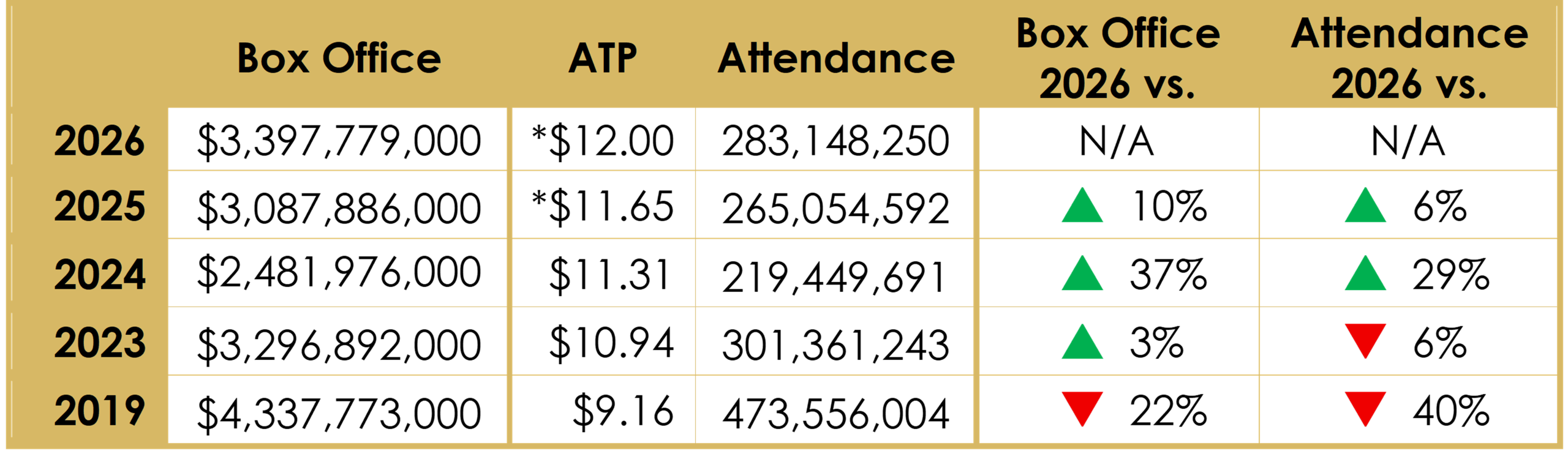
This unexpected boost has blunted the competitive deficit that 2026 appeared to have vis-à-vis 2025, when LILO & STITCH was driving crowds to the theatre, winding up as the second highest-grossing film of the year. With several of last year’s best earning weekends behind us, 2026 is well ahead of 2025 at this same point and it seems as if it has a chance to breach the $9B annual box office ceiling that has held sway since 2019.
Next weekend, three significant new releases will arrive: Paramount’s horror comedy SCARY MOVIE, Amazon MGM’s action adventure MASTERS OF THE UNIVERSE, and Fathom’s animated psychological horror film THE AMAZING DIGITAL CIRCUS from yet another YouTube sensation. We expect next weekend to come in higher than the $112.7M earned last year on this same frame, which was still led by Disney’s LILO & STITCH with $32.4M in its third weekend.
The Last 4 Weeks – 2026 vs. 2025

#1 – BACKROOMS
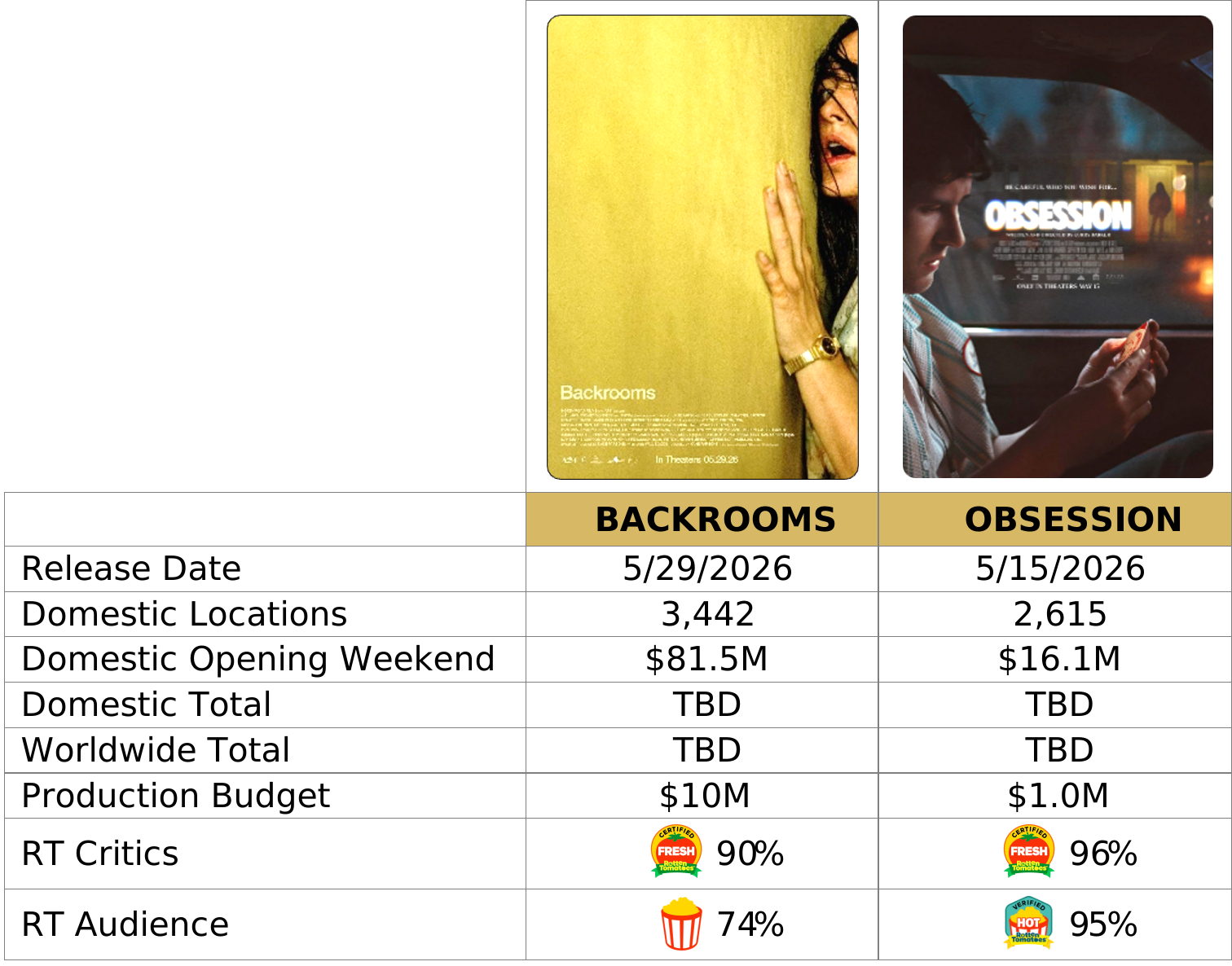
A24’s psychological horror film BACKROOMS took first place in its debut with a gross of $81.5M domestically and $118.0M globally. For the second time in the past three weekends, the box office was animated by new offerings from internet-born filmmakers, following OBSESSION’s surprise second-place finish last weekend.
BACKROOMS was directed by Kane Parsons, a 20-year-old filmmaker known by the online moniker “Kane Pixels.” Parsons broke through in 2022 with an ultra-low-budget YouTube web series “The Backrooms”, which has been viewed 79 million times as of May 2026. After proving his ability to direct feature films with the movies THE OLDEST VIEW and PEOPLE STILL LIVE HERE, A24 hired Parsons to direct a feature adaptation of “The Backrooms”, becoming the youngest-ever feature film director in A24’s history at only 19 years old. The success and visibility of “The Backrooms” on YouTube convinced A24 that the concept might work as a feature.
The movie stars Chiwetel Ejiofor (12 YEARS A SLAVE, DOCTOR STRANGE and CHILDREN OF MEN), Renate Reinsve (THE WORST PERSON IN THE WORLD), Mark Duplass, Finn Bennett and Lukita Maxwell. The story centers on a mysterious doorway hidden inside a furniture showroom that leads into an endless maze of eerie yellow rooms with distorted realities known as “the Backrooms.” The film blends psychological horror, analog horror, and science fiction with themes of isolation, memory and anxiety. The production reportedly built a massive 30,000-square-foot practical “Backrooms” set rather than relying on CGI. It is said that crew members occasionally became disoriented and lost while walking through the maze-like practical set. This reinforced the filmmaker’s vision of a feeling of frustration when people are lost.
Although the movie appears as if shot with a grainy 1990s-era camcorder, Parsons actually used modern cinema equipment to record the footage before then degrading it with digital effects. The inspiration for the BACKROOMS series and movie originated from a single unsettling image of an empty, yellow office-style room posted online in 2019. From that point, it has evolved into one of the internet’s best-known and notorious horror myths ever.
As with the other current horror hit OBSESSION, BACKROOMS has benefited from a viral online marketing campaign which embraced BACKROOMS’ internet roots. Rather than using a conventional Hollywood marketing approach, A24’s team tapped into Parsons’ YouTube fan following as the foundation of the campaign to promote their movie. The original Backrooms “found footage” video short had already been viewed by tens of millions online, which served as free advertising for the feature.
A24 also marketed the story of Parsons himself, an inspired 20-year-old filmmaker who went from creating Blender animations in his bedroom to directing a major theatrical release. That narrative helped generate extensive online coverage and interest from Gen-Z audiences. The teaser campaign revealed very little about the plot, instead emphasizing liminal spaces, analog distortion and unsettling imagery. Fans immediately began creating and posting theory videos and online breakdowns. The studio further fueled interest through fake in-universe commercials for the fictional furniture store “Cap’n Clark’s Ottoman Empire,” complete with hidden clues and references tied to older Kane Pixels videos.
The campaign targeted analog-horror fans first rather than mainstream horror audiences. Instead of traditional jump-scare marketing, A24 leaned into VHS aesthetics, cryptic lore and online mystery. The studio even allowed Parsons to continue releasing Backrooms episodes on YouTube during the campaign, treating the web series as part of the larger ecosystem. Many industry observers are pointing to BACKROOMS as a blueprint for future Gen-Z horror marketing because fans themselves became part of the promotional campaign, similar to the dynamics supporting OBSESSION.
Critics have lined up strongly behind the film, giving it an 89% rating on Rotten Tomatoes. Audiences have been less enthusiastic, with a middling 74% popcornmeter. The Los Angeles Times said, “Describing ‘Backrooms’ as a horror film doesn’t feel exactly right. It’s a surrealist painting in motion, the equivalent of staring at Salvador Dali’s wasteland of melting clocks until it makes gut-sense.” Variety felt, “As an atmospheric freakout, ‘Backrooms’ is extraordinarily effective. You sit back and settle into the enigmas and the grunge textures, knowing that the movie is going to keep raising your eyebrows.” The Film Verdict put forward, “With connective tissue linking it to both Skinamarink and Synecdoche, New York, Backrooms is a chillingly ambitious debut that finds the terror in enclosed spaces and echoing silences.”
The film was created on a modest budget $10M, and after its opening weekend take of $81.5M it has already gone far past the $25M in worldwide gross necessary for it to be profitable. For a comparison movie, we have chosen the very recent OBSESSION. In addition to both films being horror movies, they share other common features. Both were directed by new-to-theatrical, former internet directors and were marketed with a heavy emphasis on using social media to reach their audiences.
BACKROOMS vs. OBSESSION
#2 – OBSESSION
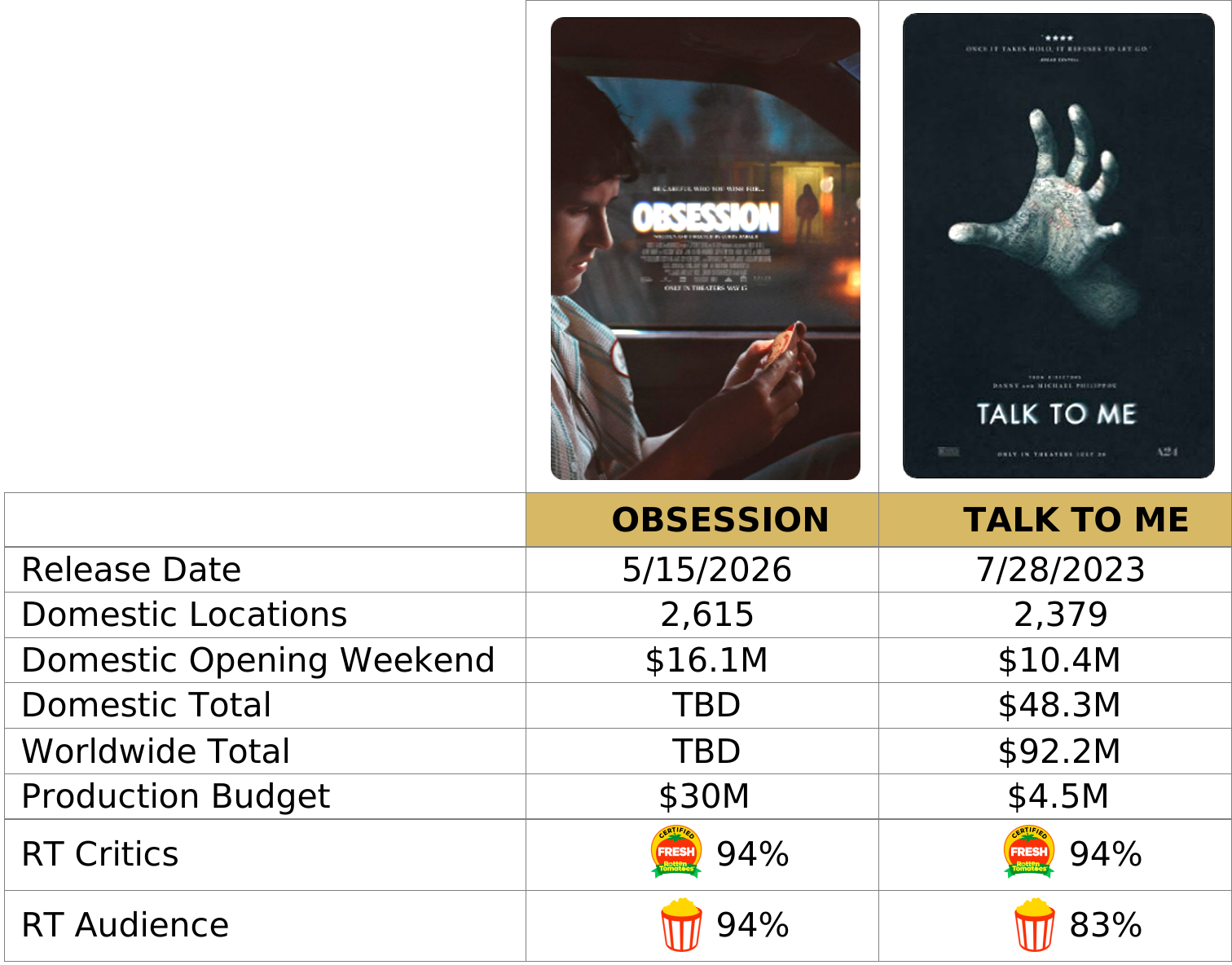
Focus Features’ horror film OBSESSION finished second in its third weekend, bringing in $26.4M, an increase of 10% compared to last weekend. After 17 days, the film has now generated $104.8M domestically and $148.0M globally. Its success has drawn intense attention, with talk of it representing a new business model for theatrical releases. It was produced for a mere $1M, and tapped into a passionate online audience of YouTube watchers. It featured the major debut of young filmmaker Curry Barker, who offered a fresh perspective and appeal to young audiences. The results are speaking for themselves, with rising weekend grosses from the first weekend to the second, and again from the second weekend to the third.
It’s also important to note that virtually all of these ticket sales have been outside of the Premium Large Format screens, which the major studios’ action-focused and animated films have relied on for a large portion of their grosses. Cinemark President and CEO Sean Gamble stated on a recent investor presentation that, “On just 5% of our screens, our XD premium large format generated 13% of our global box office.”
The audience coming out to see OBSESSION is drawn to the film’s story rather than the wow-factor of a big-screen format. Showtimes are selling out in mostly mid-sized and smaller auditoriums, leading to a more intimate environment that brings the audience closer together and adds to the shared horror experience. OBSESSION has turned into an exhibitor-friendly title alongside the PLF-centric STAR WARS: THE MANDALORIAN AND GROGU.
OBSESSION vs. TALK TO ME after 17 Days
#3 – THE MANDALORIAN AND GROGU
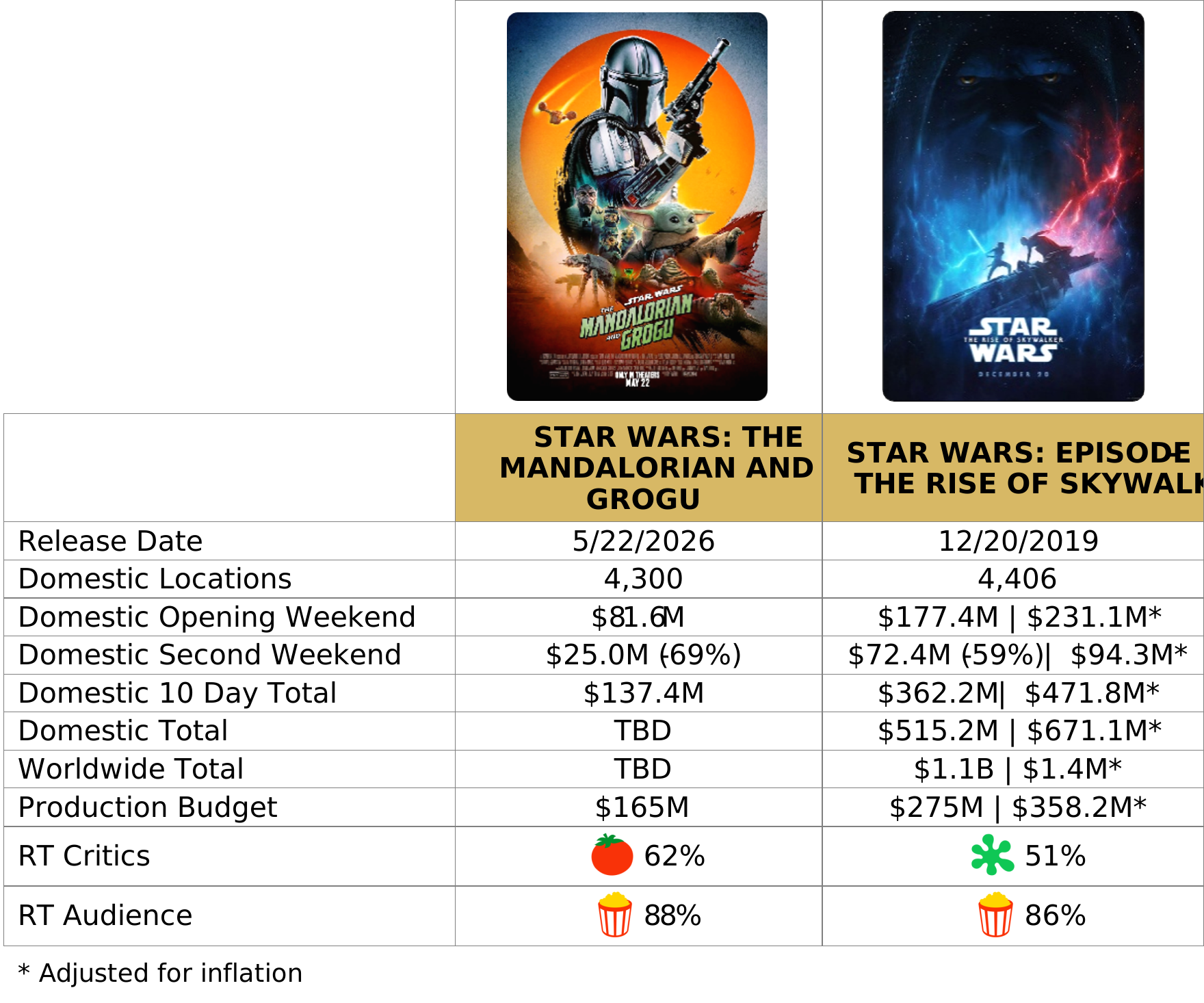
STAR WARS: THE MANDALORIAN AND GROGU from Disney and Lucasfilm finished third in its second weekend, grossing $25.0M and dropping 69% from its opening. Its 10-day totals are now $137.6M in the US and Canada and $246.6M worldwide. The immediate drop from first to third place has to be seen as a disappointment. Disney targeted a Memorial Day release with the expectation that the film would open as the top movie for the holiday weekend and remain there for at least another week or two to follow. For an iconic STAR WARS title to lose its second weekend crown to an upstart, low-budget release like BACKROOMS and also underperform OBSESSION in its third weekend is telling about the long-term financial health of the franchise.
Last weekend’s $81.6M debut for THE MANDALORIAN AND GROGU fell below the $84.4M opening of SOLO: A STAR WARS STORY on the Memorial Day weekend of 2018. This makes the current release the lowest opening weekend for any STAR WARS film since Disney acquired Lucasfilm in 2012. To find a lower franchise opening, you have to go all the way back to STAR WARS: EPISODE II – ATTACK OF THE CLONES, which launched to $80M on May 16, 2002. Adjusted for inflation, that opening would equal approximately $148.1M in current dollars. Perhaps most concerning, THE MANDALORIAN AND GROGU opened to just 46% of the $177.4M debut generated by the most recent film in the franchise, STAR WARS: EPISODE IX – THE RISE OF SKYWALKER in December 2019.
After 10 days in release, THE MANDALORIAN AND GROGU has slipped even further behind the pace of THE RISE OF SKYWALKER, reaching only 38% of that film’s comparable total. One concern raised by industry observers before release was whether THE MANDALORIAN’s enormous success on Disney+ would wind up limiting the theatrical potential of a feature-film adaptation. When Disney+ launched in November 2019, THE MANDALORIAN became the service’s breakout hit, with Grogu emerging as a cultural phenomenon that fueled social media engagement, merchandise sales, and subscriber growth. Disney+ attracted 10 million subscribers on the film’s first day and surpassed 100 million subscribers within 16 months. The final new episode of The Mandalorian and Grogu Disney+ series aired on May 4, 2024.
Disney did not stop there. The company aggressively expanded STAR WARS on streaming with THE BOOK OF BOBA FETT, OBI-WAN KENOBI, ANDOR, AHSOKA, SKELETON CREW, and multiple animated series. The strategy successfully transformed STAR WARS from a franchise that generated revenue primarily through its theatrical releases into one capable of driving year-round streaming engagement. A side effect appears to have been a dilution of the urgency once associated with STAR WARS theatrical events.
Disney’s next test arrives in 2027 with STAR WARS: STARFIGHTER. This time, the studio is leaning on the star power of Ryan Gosling to help reignite excitement around the franchise’s big-screen future. Disney used STAR WARS masterfully to launch and grow Disney+, but the company now faces a difficult balancing act. The franchise’s abundance of streaming content has been a boon for subscriber growth, yet it may also have reduced the exclusivity and event status that once powered blockbuster theatrical openings. With STAR WARS: STARFIGHTER, Disney will be looking to prove that audiences still view STAR WARS as a special theatrical experience. Fortunately for Disney, Gosling arrives with considerable momentum after leading PROJECT HAIL MARY to become one of 2026’s biggest theatrical success stories.
STAR WARS: THE MANDALORIAN AND GROGU vs. STAR WARS: EPISODE IX – THE RISE OF SKYWALKER After 10 Days
#4 – MICHAEL
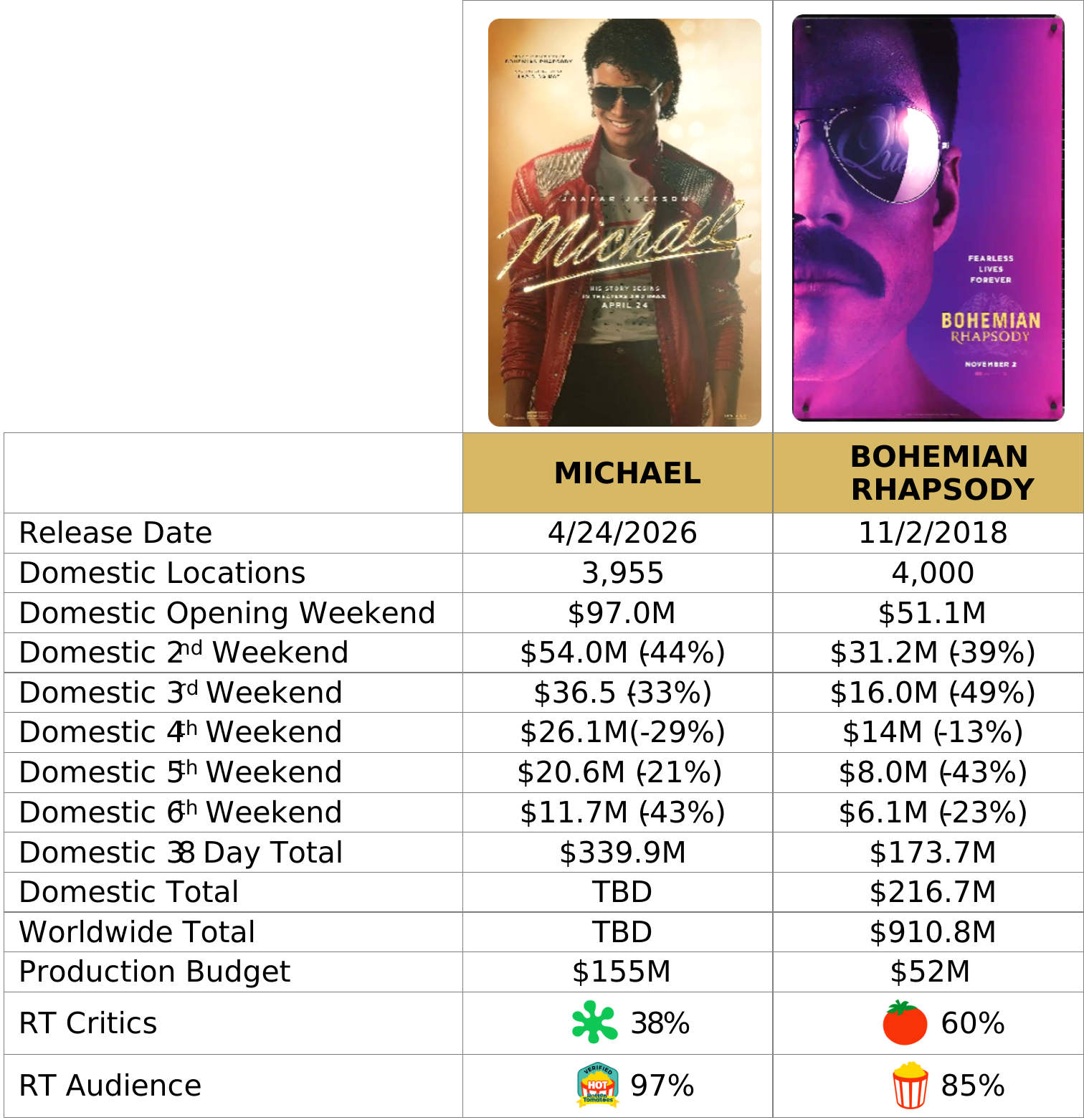
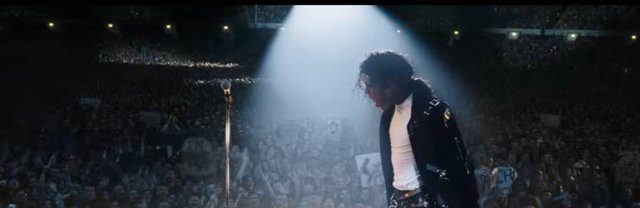
Lionsgate’s MICHAEL continued its run of top five finishes by landing fourth place in its sixth weekend, selling an additional $11.7M in tickets, a drop of 43%. This brings its 38-day totals to $339.9M domestically and $851.3M globally. The film continues to climb higher in the Lionsgate record books, currently placed as the studio’s their third highest domestic grossing movie of all time behind HUNGER GAMES: CATCHING FIRE which earned $424.7M in 2013 and the original HUNGER GAMES which earned $408.0M in from 2012. It also ranks as Lionsgate’s third-highest-grossing worldwide grossing film, trailing only TWILIGHT SAGA: BREAKING DAWN PART 2 from 2012 at $868.6M and HUNGER GAMES: CATCHING FIRE at $865.0M from 2013. Among musical biographies, it ranks first in the domestic market and second globally, after BOHEMIAN RHAPSODY’s 2018 run of $910.8M worldwide. Among 2026 movies, MICHAEL has moved into second place for the entire year, trailing THE SUPER MARIO GALAXY MOVIE’s $425M. The “Gloved One” has certainly left its mark on the 2026 box office.
MICHAEL vs. BOHEMIAN RHAPSODY after 38 Days
#5 – THE BREADWINNER
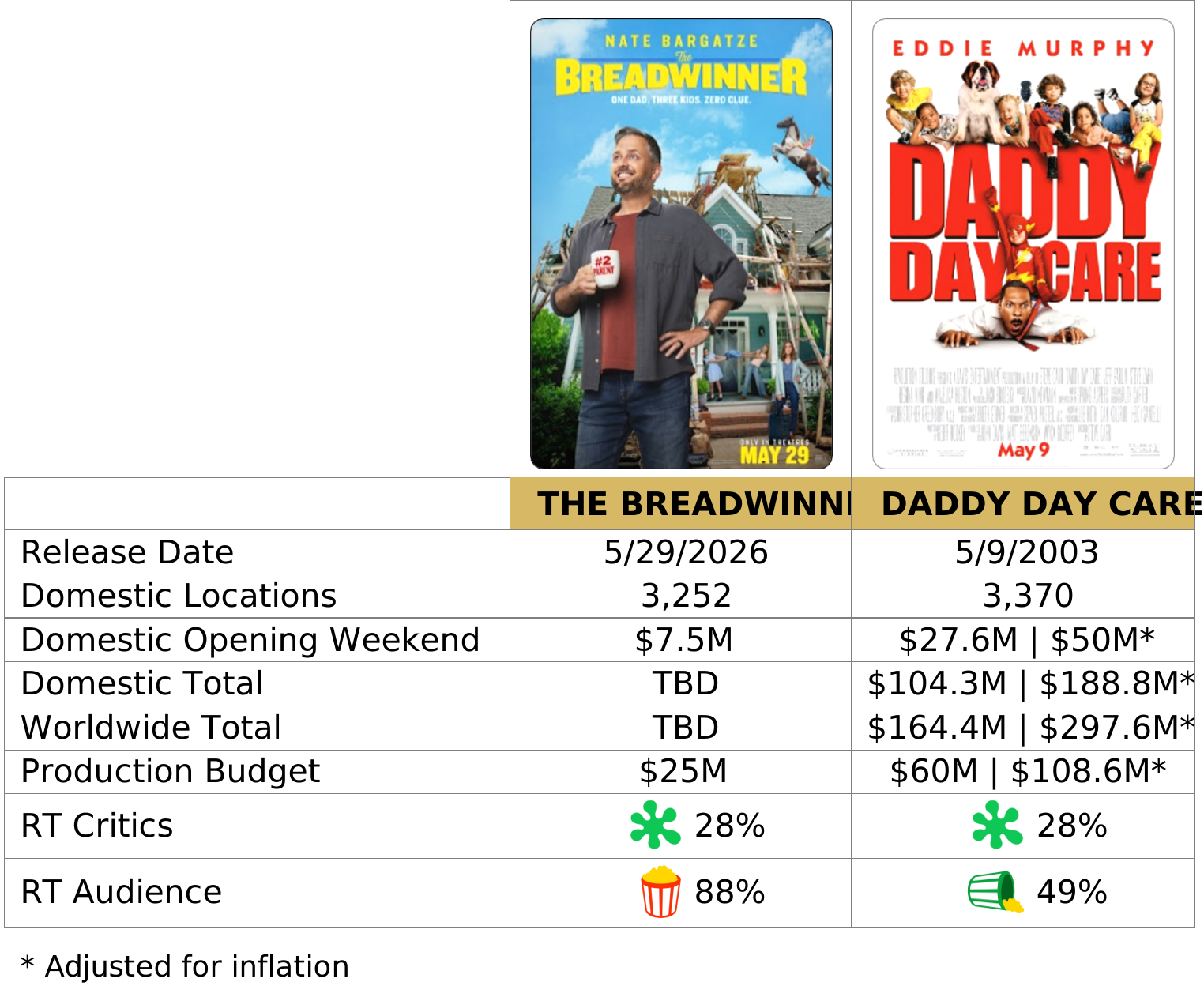
Sony’s family comedy THE BREADWINNER finished in fifth place in its opening weekend with $7.5M. The film is directed by Eric Appel, a filmmaker best known for directing the Roku original movie WEIRD: THE AL YANKOVIC STORY starring Daniel Radcliffe, and for his extensive television comedy work including episodes of Brooklyn Nine-Nine, New Girl and Silicon Valley. The film was developed as the feature-film acting debut of stand-up superstar Nate Bargatze, who also co-wrote the screenplay. Bargatze has become one of the most successful stand-up comedians in America today, beloved for his clean, observational, family-friendly humor delivered with a dry, deadpan Southern affect. His breakthrough came in 2017 with Netflix’s The Standups, which introduced him to a national audience. He followed that success with stand-up specials including The Tennessee Kid, The Greatest Average American, and Hello World, establishing Bargatze as one of comedy’s biggest touring draws. His popularity surged even further after hosting Saturday Night Live, where his “George Washington” sketches became viral sensations. By 2024, he was the highest-grossing stand-up comedian in the world, selling more than a million tickets and generating over $82 million in tour revenue. The film represents one of the more notable recent attempts to convert an arena-level stand-up comedian into a mainstream comic acting star, following a path previously taken by performers such as Richard Pryor, Eddie Murphy, Adam Sandler, Kevin Hart and Dane Cook.
THE BREADWINNER centers on salesman Nate Wilcox, played by Bargatze, whose seemingly perfect family life is turned upside down when his wife Katie, played by Mandy Moore, lands a lucrative Shark Tank-inspired business deal and leaves on an extended work trip. Forced into the role of primary caregiver for their three daughters, Nate discovers that running the household is far more difficult than he imagined.
The cast combines established comedy and television talent. While Bargatze is in the lead, he is assisted ably by Moore, who is best known for her work on the television drama This Is Us and the Disney animated feature film TANGLED. Supporting players include Saturday Night Live’s Colin Jost and Zach Cherry from SEVERANCE and SHANG-CHI AND THE LEGEND OF THE TEN RINGS.
Professional reviewers have been unkind to the film, which sports a not-so-fresh 28% critics’ rating on Rotten Tomatoes. The audience, however, seems to enjoy it with a solid 87% grade. This dramatic point differential between the critics and audience reminds us of another current film that has overcome a similar discrepancy, MICHAEL. While the team behind THE BREADWINNER could hope to achieve similar success to that of MICHAEL for their movie, Nate Bargatze does not have the universal appeal of Michael Jackson.
Here is a sampling of what some of the critics are saying. Rolling Stone reports, “You start to feel like you’re a consumer being sold a bill of goods, and this is just one more product meant for you to buy, consume, and forget. The first two options are up to you. The last one couldn’t be more easy.” The Hollywood Reporter weighed in by saying, “The Breadwinner is so lazy and laid-back that it practically recedes into itself. This is a film that makes television shows like Father Knows Best and My Three Sons seem edgy.” Variety feels, “Select moments may land a laugh, but zoom out a little, and the real joke is that this movie was made in 2026.” To be fair, not everyone hated the film. The New York Times was complimentary and saying, “Bargatze proves himself a savvy writer and performer here; he doesn’t hog all the laugh lines for himself, but instead often plays straight man to his three daughters… It’s the girls who ultimately make this comedy sing.’
The film was made for $25M, a reasonably tight budget considering the cast. With this investment, the film need to bring in $63M worldwide to become profitable. With its opening weekend of $7.5M and limited prospects in foreign markets, we think that it will not get there. However, its PG rating and family friendly storyline could serve it well in its afterlife on streaming, as parents seem to have an insatiable appetite for movies to entertain their kids at home. The comparison film we have chosen is DADDY DAY CARE from 2003 starring Eddie Murphy. That movie seems quite similar to THE BREADWINNER because they both are comedies centered on fathers who are forced into primary childcare roles and discover that raising children is far more demanding than expected. In both films, the humor comes from overwhelmed dads struggling with daily parenting responsibilities, household chaos, and the challenge of earning their children’s respect.
THE BREADWINNER vs. DADDY DAY CARE
Where Are We as of 5/28/2026
RESULTS FOR THE FIRST 21 WEEKS OF THE YEAR
Related DICK WALSH's Industry Update

THE MANDALORIAN AND GROGU Shines in STAR WARS’ Return to the Big Screen
MICHAEL Moonwalks Past PRADA 2 into First Place
Mothers Keep THE DEVIL WEARS PRADA 2 on Top

THE DEVIL WEARS PRADA 2 Is Proving Worth the 20-Year Wait
Michael Jackson Biopic Tops Box Office $97M, Mario Galaxy #2