
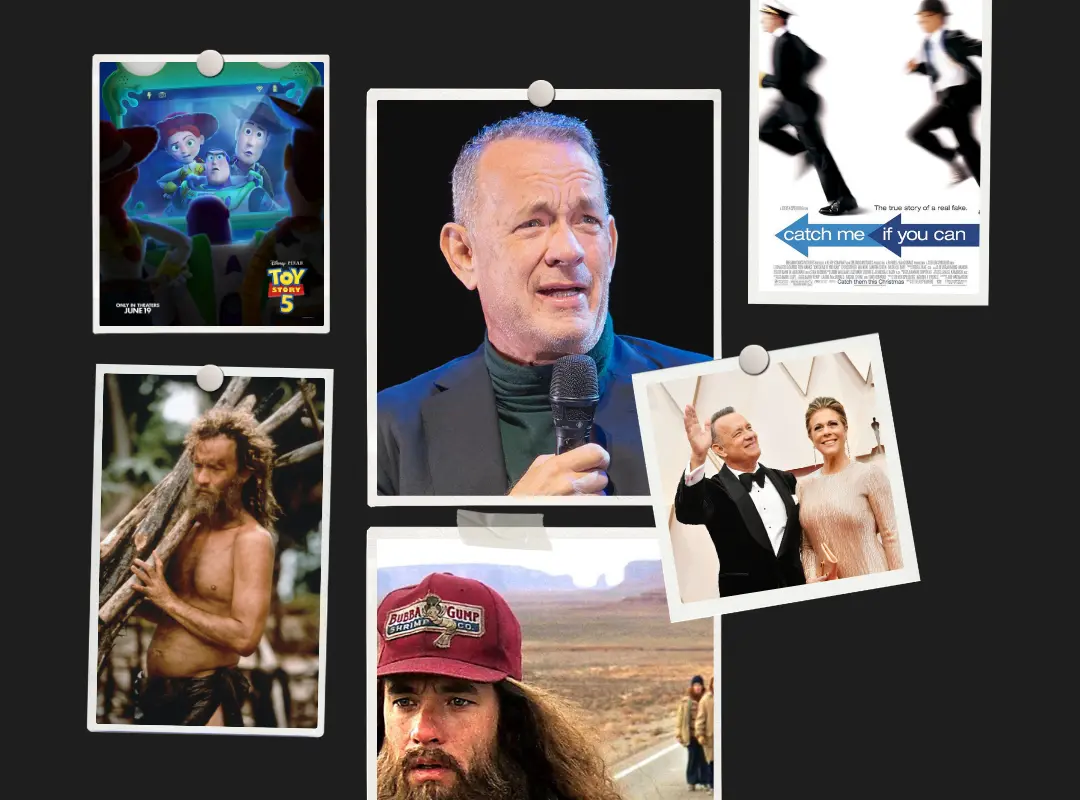

Thomas Jeffrey Hanks was born on July 9, 1956, in Concord, California. In the four decades since he first appeared on screen, he has become something rare in Hollywood: a genuine institution. He is not just a box office draw or an awards regular. He is the actor America trusts.
Two Oscar wins. Seven Emmy wins. A Presidential Medal of Freedom. A career spanning sitcoms, blockbusters, prestige television, and animated franchises that have outlasted entire generations of moviegoers.
What makes Hanks different is range, and it is the consistency. Film after film, role after role, he shows up as someone we believe. Known for both his comedic and dramatic roles, Hanks is one of the most popular and recognizable film stars worldwide and is widely regarded as an American cultural icon.
In 2026, with a landmark WWII documentary series premiering on Memorial Day and Toy Story 5 arriving in June, he is as relevant as he has ever been. This is the story of how he got here.
Tom Hanks: Career Quick Facts (2026 Edition)
| Full Name | Thomas Jeffrey Hanks |
| Major Awards | 2 Academy Awards (Best Actor), 7 Primetime Emmys, 4 Golden Globes, Presidential Medal of Freedom |
| Key Franchises | Toy Story (Woody), Robert Langdon Trilogy, Band of Brothers (Producer) |
| Production Co. | Playtone (Co-founder with Gary Goetzman) |
| Highest Grossing | Toy Story 4 ($1.073 Billion), Forrest Gump ($678 Million) |
The Anatomy of a Legend
Few careers in Hollywood break as cleanly into chapters as Tom Hanks‘. There was the comedian who made audiences laugh so hard they forgot they were watching an actor. Then came the dramatic powerhouse who rewrote Oscar history. Then the producer, narrator, and custodian of American memory. Each era built on the last. Let’s look at it!
The Comedic Breakout (1980–1992)
#1. The Physical Comedy Era (Splash, Big, A League of Their Own)
Before the Oscars, before the speeches, before anyone called him “America’s Dad,” Tom Hanks was a guy in a dress on a network sitcom. His television days ran through sitcom roots Bosom Buddies (1980–1982), a short-lived ABC comedy in which he and Peter Scolari played men who disguised themselves as women to live in an affordable all-female residence. The show did not last long, but it got him noticed. It led to guest spots, including an appearance on Happy Days, where he crossed paths with writers who were developing a film for a Ron Howard project. That project was Splash (1984).
Splash was the turning point. Howard considered Hanks for the role of the main character’s wisecracking brother, which eventually went to John Candy. Instead, Hanks landed the lead role, and the film went on to become a surprise box office success, grossing more than $69 million. It was his first real leading role in a film, an early romantic lead, in a rom-com about a man who falls in love with a mermaid, and it established the template for what Hanks does better than almost anyone: be completely believable as an ordinary person in an extraordinary situation. The slapstick charm was there. The warmth was there. The watchability was off the charts.
Then came Big (1988), the film that made him a genuine star. Directed by Penny Marshall, it remains one of the cleanest examples of the boy-in-a-man ‘s-body concept ever committed to film. A 12-year-old wakes up in an adult’s body, gets a job at a toy company, and tries to navigate a world he is not remotely prepared for. The film’s most iconic sequence, “The Big Piano” scene at FAO Schwarz, in which Hanks and Robert Loggia play “Heart and Soul” and “Chopsticks” by dancing on a giant floor piano, requires no dialogue and no drama. It is physical comedy at its purest. For his performance in the film, Hanks earned his first nomination for the Academy Award for Best Actor. The word “nomination” undersells it. He was 31 years old, playing 12, and making it look easy. Co-star Elizabeth Perkins brought grounding to the film’s romantic subplot, and together they sold the odd tenderness at its center.
What followed was a mixed stretch. Box office misfires interrupted the momentum. But Hanks had something more durable than a hot streak. He had instinct. By 1992, he appeared in Penny Marshall‘s A League of Their Own, playing Jimmy Dugan, a washed-up baseball legend turned reluctant manager of a women’s professional baseball team during World War II. It was not a comedic star vehicle. It was ensemble work, supporting a cast that included Geena Davis, Lori Petty, Madonna, and Rosie O’Donnell. By 1992, Hanks flashed shades of dramatic work as the drunk baseball manager in A League of Their Own, one year before he completely shattered the perception of his acting chops by winning his first Oscar for Philadelphia. The line between comedy and drama was blurring. He was ready for the next phase.
Quote: “The actor who turned a 12-year-old’s wonder into a Hollywood powerhouse, proving that comedy is the hardest drama of all.”
The Golden Age of Drama (1993–2000)
#2. The Back-to-Back Oscar Milestone (Philadelphia, Forrest Gump)
In 1993, two things happened that permanently changed Tom Hanks’ place in film history. He starred in Philadelphia, and he won his first Academy Award. The year after, he starred in Forrest Gump, and he won his second. No actor had accomplished back-to-back Best Actor wins since Spencer Tracy did it in 1937 and 1938. He became the first actor since Spencer Tracy in 1938 to achieve this feat. This made him a cultural icon. That record has not been broken since.
Philadelphia (1993), directed by Jonathan Demme, was not an easy film to make or to sell. Hanks played Andrew Beckett, a gay lawyer with AIDS who is wrongfully dismissed from his firm and takes them to court. Hanks lost 35 pounds and thinned his hair to appear sickly for the role. He was cast opposite Denzel Washington, playing the initially homophobic lawyer who reluctantly takes Beckett’s case, and the tension between their performances is what drives the film. Philadelphia arrived at a moment when AIDS activism in film was both urgently needed and commercially risky. Hanks committed fully. The result was a performance so precise and so human that it brought mainstream audiences into genuine contact with a community and a crisis that had been largely ignored by Hollywood. In 2025, Philadelphia was selected for preservation in the U.S. National Film Registry for being “culturally, historically, or aesthetically significant.”
Forrest Gump (1994), directed by Robert Zemeckis, operated on an entirely different register. It was a work of historical fiction that threaded its title character through decades of American life, from the civil rights movement to Vietnam to the AIDS epidemic, all with an earnest wonder that could have been unbearable in lesser hands. Hanks made it work because he never played Forrest as a punchline. He played him as a person. The film grossed over $678 million worldwide and entered the cultural conversation permanently. Co-star Gary Sinise, who played Lieutenant Dan, earned his own Oscar nomination and delivered one of the most memorable supporting performances of the decade.
Together, Philadelphia and Forrest Gump did something beyond individual achievement. They established Hanks as the voice of a generation, an actor who could access the emotional and moral center of the American experience and hold it steady onscreen. Two films. Two Oscars. One stretch of consecutive years that Hollywood is still talking about thirty years later.
Quote: “One of only two actors in history to win consecutive Best Actor Oscars, cementing his status as the voice of a generation.”
The Modern Historian and Producer (2001–2026)
#3. Collaborative Legacy with Steven Spielberg
The collaboration between Tom Hanks and Steven Spielberg is one of the most significant partnerships in American cinema and television. Hanks collaborated with Steven Spielberg on five films: Saving Private Ryan (1998), Catch Me If You Can (2002), The Terminal (2004), Bridge of Spies (2015), and The Post (2017), as well as three World War II-themed miniseries: Band of Brothers (2001), The Pacific (2010) and Masters of the Air (2024).
Saving Private Ryan (1998) set the standard for historical accuracy in war filmmaking. The 27-minute Omaha Beach opening sequence remains a benchmark for combat cinematography. Hanks played Captain John Miller with the kind of quiet authority that keeps chaos coherent. The film was both a critical and commercial landmark, earning five Academy Awards and a fourth Oscar nomination for Hanks.
Off the back of that film, Hanks and Spielberg moved into prestige television. Band of Brothers (2001), co-produced with Spielberg through Hanks’ production company Playtone, which he co-founded with Gary Goetzman, followed the men of Easy Company, 506th Parachute Infantry Regiment, from training through the end of World War II in Europe. The series earned seven Primetime Emmys and remains the definitive WWII retelling on television. It is the project that revealed the full scope of what Hanks could do as a producer, not just a performer. It also cemented his identity as a committed, meticulous advocate for veteran advocacy and correct historical representation on screen.
That commitment has only deepened. Masters of the Air (2024), produced by Hanks and Spielberg for Apple TV+, told the story of the 100th Bombardment Group during World War II, starring Austin Butler and Callum Turner. And now, in 2026, Hanks returns as narrator and executive producer of World War II with Tom Hanks, a 20-episode documentary series premiering on the History Channel on Memorial Day, May 25, 2026. Told over 20 hours and guided by Hanks, whose lifelong passion for this history has shaped some of the most profound screen portrayals of the era, the series captures the full arc of the war from the rise of fascism in Europe to the fall of Berlin, from Pearl Harbor to Hiroshima, and the uneasy peace that follows. The series is produced in association with Playtone and Gary Goetzman, and is being broadcast in 200 territories and 40 languages simultaneously. Hanks has said of the project: “During my formative years, every single adult in my life would make references to two words: The War. The lasting effects of WWII on the world and my own family were not lost on me.”
Quote: “The man who has become the unofficial custodian of American history, narrating the past with a voice we trust implicitly.”
Future Projects and “America’s Dad” Reputation
The Return of a Legend: Toy Story 5 (2026)
There is a reason people talk about Sheriff Woody the way they talk about characters from literature. He is stubborn, loyal, occasionally wrong, and deeply decent. And for three decades, the reason Woody has felt real is Tom Hanks.
Toy Story 5 is scheduled to be released in the United States on June 19, 2026. The Pixar production reunites Hanks with Tim Allen, who returns as Buzz Lightyear. The two voice actors have anchored every main installment in the franchise since the original film in 1995. After Hanks indicated in 2019 that Toy Story 4 might be the final chapter, in June 2023, Pixar’s chief creative officer Pete Docter confirmed that Woody would return in the film.
The premise, described by Docter as “Toy meets Tech,” sets the gang against a new kind of threat: electronics. Woody, Buzz, Jessie, and the rest of the gang’s jobs are challenged when they’re introduced to electronics, a new threat to playtime. The film is directed by Andrew Stanton, who co-wrote the first four Toy Story films and directed Finding Nemo and WALL-E. The full returning cast includes Joan Cusack as Jessie, Annie Potts as Bo Peep, Tony Hale as Forky, and John Ratzenberger as Hamm, joined by new additions including Greta Lee, Conan O’Brien, and Keanu Reeves.
The Toy Story franchise is the crown of animated cinema’s legacy. The first film, released in 1995, was the first fully computer-animated feature. Toy Story 4 crossed $1.073 billion worldwide. The billion-dollar franchise did not become that through spectacle alone. It became that because childhood nostalgia is a force, and because Hanks invested Woody with a voice acting performance across every installment that never phoned in a single line. Woody’s loyalty, his anxiety, his genuine love for a child he will eventually lose, all of it comes through in the voice. That is not incidental. That is craft.
The “America’s Dad” reputation extends well beyond the Toy Story universe. Hanks has played Fred Rogers in A Beautiful Day in the Neighborhood, Captain Chesley Sullenberger in Sully, and Captain Richard Phillips in Captain Phillips. Roles defined by protection, moral clarity, and the kind of calm that holds things together under pressure. His personal reputation, scandal-free across more than four decades in public life, reinforces every character he plays.
The actor and the archetype have merged in the public imagination in a way that happens for very few people.
Quote: “Woody remains the soul of Pixar because Tom Hanks gives him a heartbeat made of loyalty.”