

The Actor’s Actor in the Age of Franchises
Most actors have a lane. A type. A calling card. Chiwetel Ejiofor has defied all three for nearly thirty years.
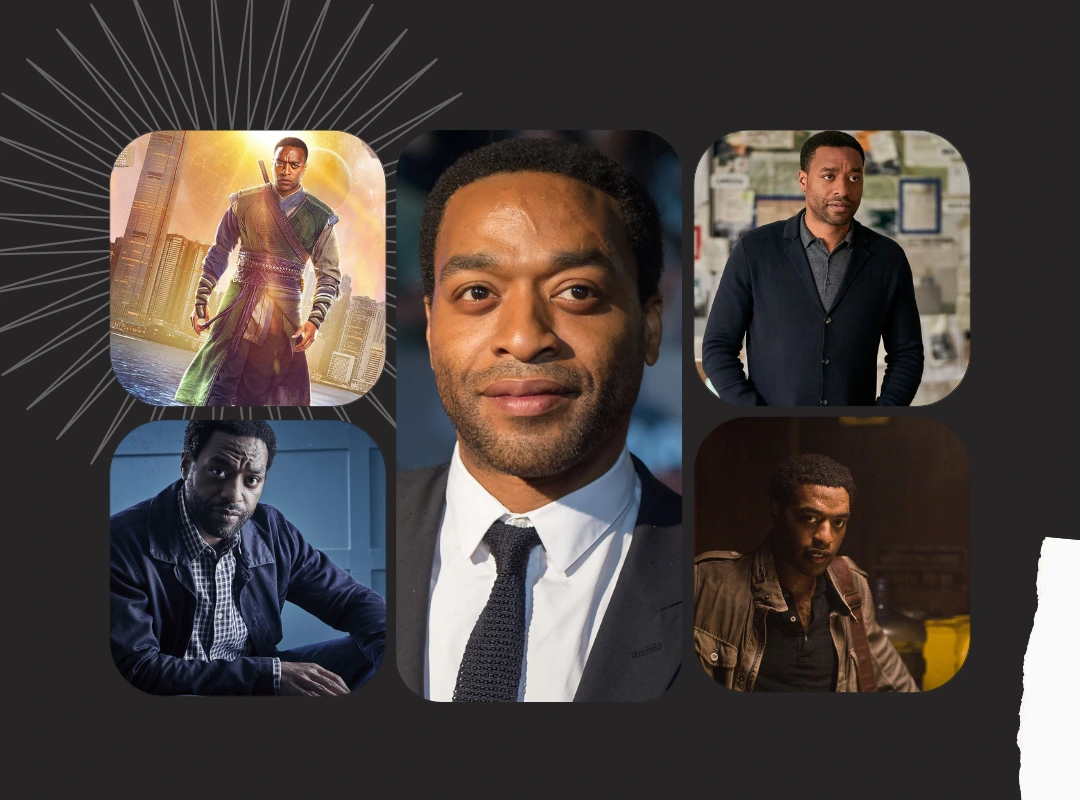
He is a British stage-trained actor, director, writer, and OBE/CBE honoree who somehow became both the conscience of prestige cinema and a reliable fixture inside blockbuster universes. He is an Oscar nominee for one of the most demanding roles in modern film, a Laurence Olivier Award winner for Shakespeare, and a Marvel villain who has shown up in multiple MCU films. He is an Emmy nominee for television, a voice actor who reinvented a Disney classic, and a filmmaker whose directorial work has been recognized at Sundance. He holds over 100 IMDb credits across a 29-year career and, as of 2025, a net worth estimated at $16 million.
The prevailing logic in Hollywood is that serious actors do franchise work to pay the bills and then return to real cinema when they can. Ejiofor never accepted that premise. His 2024-to-2027 slate is proof. A romantic comedy. A Netflix action sequel. A Stephen King adaptation. A prestige horror reboot. A Tomi Adeyemi fantasy epic. The range across that single window matches careers most actors build across entire decades.
The Spielberg Origin Story (1997–2002)
A. “Amistad” at 19
There is a version of Chiwetel Ejiofor’s story that begins at LAMDA. The actual version begins before he finished his first year there.
Steven Spielberg cast him in Amistad (1997) three months into his course at the London Academy of Music and Dramatic Art. Ejiofor was 19. He played Ensign James Covey, a real historical figure — a formerly enslaved man who had learned English and served in the U.S. Navy, brought aboard to act as interpreter for the Mende captives aboard the slave ship. Covey’s role in the film is the bridge between two worlds: the captives’ native language and the American courtroom that will decide their fate. It is a supporting part, but an essential one — without Covey, the Africans cannot tell their own story.
Getting the role meant leaving drama school permanently. He did, and never looked back. He later described the casting as a shock — an early lesson that a career in acting cannot be predicted or planned for. That instinct for responsiveness, rather than strategic self-positioning, would define his path.
B. Early Stage Dominance
Before the film career took hold, Ejiofor built a serious stage foundation. He played the title role in Othello at the Bloomsbury Theatre in September 1995, and again at the Theatre Royal, Glasgow, in 1996, opposite Rachael Stirling as Desdemona. He was a teenager doing Shakespeare’s most demanding lead role in professional repertory. It was not a tentative beginning.
In 2000, he appeared in Joe Penhall’s Blue/Orange at the Royal National Theatre’s Cottesloe stage, playing Christopher — a young Black man in a London psychiatric hospital whose identity and sanity are contested by the doctors around him. The production was directed by Roger Michell and also starred Bill Nighy and Andrew Lincoln. It was a three-person chamber piece, and Ejiofor held his own against both of them for the run. The production later transferred to the Duchess Theatre in the West End.
For that performance, he received the London Evening Standard Theatre Award for Outstanding Newcomer in 2000. He also received a nomination for the Laurence Olivier Award for Best Supporting Actor in 2001 and the Jack Tinker Award for Most Promising Newcomer at the Critics’ Circle Theatre Awards. The same year, his performance as Romeo in Tim Supple’s production of Romeo and Juliet earned an Ian Charleson Award nomination.
In the space of five years, he had done Spielberg, Shakespeare, and an Olivier Award-nominated West End debut. That is not a typical early career. That is someone who treats every job as if it might be his last.
C. Breakthrough: “Dirty Pretty Things” (2002)
Stephen Frears‘ thriller Dirty Pretty Things gave Ejiofor his first major lead role on screen. He played Okwe, a Nigerian doctor who has fled his home country and is surviving in London as a cab driver by day and a hotel night clerk by night. He is undocumented, exhausted, and carrying a history the film reveals slowly. He stumbles onto a criminal operation harvesting organs from desperate immigrants willing to trade body parts for false passports.
The role required Ejiofor to carry the moral weight of an entire film. Okwe does not make speeches. He watches, he thinks, he acts. The British Independent Film Award for Best Actor that year was a confirmation of something the stage world already knew: this was not an actor who needed volume to be heard. His trademark quality — a kind of controlled, interior intensity was visible from the beginning.
The Prestige Era: From Stage to Screen (2003–2013)
A. The “Kinky Boots” Pivot (2005)
No one who cast Ejiofor as a conflicted Nigerian exile expected him to follow it with a drag queen. That is precisely why it worked.
In Kinky Boots (2005), he played Lola — a larger-than-life cabaret performer who forms an unlikely alliance with a struggling shoe manufacturer in Northampton. The role required Ejiofor to sing, to perform, and to inhabit a character operating at a completely different emotional frequency from anything he had done before. He was physically transformed. He was performing in high heels. He was funny.
The result earned him a Golden Globe nomination for Best Actor in a Musical or Comedy and a British Independent Film Award nomination. More importantly, it proved to anyone paying attention that Ejiofor’s toolkit had no obvious limits. The “subtle intensity” of Dirty Pretty Things was not a ceiling. It was simply one setting.
B. Blockbuster Supporting Work
This period also established Ejiofor as a go-to actor for supporting roles that demanded more than the part usually required.
In Love Actually (2003), directed by Richard Curtis, he played Peter — the unsuspecting husband of Juliet (Keira Knightley), whose best friend Mark (Andrew Lincoln) harbors an undisclosed obsession with his new wife. The role is largely reactive. Peter is the person to whom nothing is being told, and Ejiofor found a warmth and specificity in the character that has kept people invested in Peter’s perspective for over two decades. In 2017, he reprised the role in the Red Nose Day short sequel, Red Nose Day Actually.
In Serenity (2005), director Joss Whedon’s continuation of the cult sci-fi series Firefly, Ejiofor played The Operative — an agent of a totalitarian government who is, importantly, fully aware that his cause is corrupt and continues serving it anyway. It became one of the film’s most discussed performances and expanded his cult following significantly.
Children of Men (2006), Alfonso Cuarón’s dystopian masterwork, cast him as Luke, a revolutionary leader in a collapsing Britain. The film’s political tension runs through every scene Ejiofor shares with Clive Owen, and he brings an edge to Luke that the character’s ideological certainty requires.
He also appeared in Inside Man (2006) and American Gangster (2007), both films working in the shadow of larger stars — Denzel Washington in both cases. In each, Ejiofor made his presence felt without competing for focus he was not asked to hold.
C. The Laurence Olivier Award (2008)
In 2007, Ejiofor returned to Othello — this time at the Donmar Warehouse in London, directed by Michael Grandage. Kelly Reilly played Desdemona. Ewan McGregor played Iago. The production received exceptional reviews, and Ejiofor’s performance was consistently cited as its centerpiece. He was awarded the Laurence Olivier Award for Best Actor for his work, the highest honor in British theatre.
His Othello was described, in a widely-circulated assessment, as one of the most memorable performances of the role in recent years. The production confirmed what the stage world had known since his Blue/Orange days: Ejiofor’s Shakespearean work was not decorative training. It was the core of his technique, and it showed.
The Oscar Nomination: “12 Years a Slave” (2013)
A. The Role of Solomon Northup
Steve McQueen‘s 12 Years a Slave is the most important film of Ejiofor’s career to date and one of the most demanding performances in contemporary cinema.
He played Solomon Northup, a free Black man from Saratoga Springs, New York, who was kidnapped in 1841, sold into slavery in Louisiana, and spent twelve years enslaved before being returned to freedom. The role required Ejiofor to inhabit a man who cannot reveal who he is, cannot react as he wishes, and must constantly calculate the cost of every expression on his face. McQueen, on casting, was unequivocal: Ejiofor was always going to be Solomon Northup. He was looking for someone who possessed a specific kind of gentleness and humanity that could be tested to its absolute limit without breaking.
Ejiofor prepared extensively. He learned to play the violin, which Northup was known for, and which features in several pivotal scenes. He maintained the grooming details of the period. He studied the conditions of plantation labor. The preparation was comprehensive, but what the performance communicates on screen is not effort — it is presence. Solomon endures through watchfulness. He survives by controlling what he shows, and Ejiofor made every held expression feel like a decision with consequences.
B. Critical Consensus
The film won the Academy Award for Best Picture at the 86th Academy Awards. Ejiofor received the BAFTA Award for Best Actor, his first major film acting award at that level, along with an Academy Award nomination for Best Actor. He also won the Boston Society of Film Critics Best Actor Award for 2013.
The critical consensus on his performance was consistent: he held a film of extraordinary brutality together through interior stillness. The Atlantic described him as the point of stillness and decency around which the madnesses of the film revolve.
C. Career Aftermath
12 Years a Slave shifted how the industry perceived Ejiofor. He had always been respected. After this, he was bankable.
His OBE, received in 2008 for services to the arts, was advanced to a CBE in 2015. He was appointed a UNHCR Goodwill Ambassador, working with the United Nations refugee agency. He received an honorary degree from the School of Advanced Study, University of London, in 2024. The film itself was selected for the National Film Registry by the Library of Congress as culturally, historically, and aesthetically significant — one of only a handful of films from the 2010s to receive that designation.
The Franchise Integration: Marvel, Disney, and Beyond (2016–2024)
A. Karl Mordo in the MCU
Ejiofor joined the Marvel Cinematic Universe in Doctor Strange (2016), playing Karl Mordo — a senior sorcerer of Kamar-Taj and early mentor to Stephen Strange (Benedict Cumberbatch). Mordo begins the film as an ally and ends it as something more complicated. His disillusionment with the Ancient One’s method, and his eventual rejection of what he sees as the corruption of sorcery, turns him toward an antagonist arc that continued in Doctor Strange in the Multiverse of Madness (2022), in which Ejiofor appeared as the Earth-838 variant of Mordo — a version who has taken control of that universe’s Sorcerer Supreme position.
The MCU casting brought Ejiofor to a global audience that might not have sought out Dirty Pretty Things or the Donmar Warehouse Othello. More importantly, the role gave him a multi-film character with genuine philosophical complexity — not a villain defined by malice, but by a coherent, rigidly held worldview. That’s a harder thing to play, and he played it well.
B. “The Lion King” (2019)
Jon Favreau‘s photorealistic reimagining of The Lion King cast Ejiofor as the voice of Scar — the calculating, power-hungry lion who murders his brother Mufasa to claim the Pride Lands. In the original animated film, Scar is operatic and theatrical. Ejiofor’s version is quieter and colder. He described playing Scar as knowing that at any moment the character can turn everything on its head with outrageous acts of violence — and that this capacity needs to be present even in the calmest scenes.
Favreau, on the casting, pointed specifically to Ejiofor’s Shakespearean background: he brings a mid-Atlantic cadence to the character and the sensibility of a classical villain — someone who has studied power and resentment at the deepest level. Ejiofor received the Black Reel Award for Outstanding Voice Performance in 2020 for the role.
C. “Maleficent: Mistress of Evil” (2019)
The same year, he appeared in Maleficent: Mistress of Evil alongside Angelina Jolie, playing Conall — a dark fey warrior and elder who exists in the hidden world of the Moors. The role is substantially different in register from Scar — warmer, principled, carrying an older sadness, and the fact that Ejiofor played both in the same year speaks to how efficiently he moves between tonal registers within the fantasy genre.
D. “Venom: The Last Dance” (2024)
Venom: The Last Dance, the third film in Sony’s Spider-Man Universe Venom franchise, cast Ejiofor as Rex Strickland — a military antagonist connected to the Venom symbiote’s history. The role placed him squarely in the Sony/Marvel adjacent universe and continued his pattern of taking on franchise work that connects across studio ecosystems.
The Director Emerges: Filmmaking Career (2019–2024)
A. “The Boy Who Harnessed the Wind” (2019)
Ejiofor’s feature directorial debut was not a safe bet. He wrote, directed, and starred in The Boy Who Harnessed the Wind — an adaptation of the memoir by Malawian inventor William Kamkwamba, who built a wind-powered water pump from scrap materials as a teenager to help his village survive a famine. The film is set in rural Malawi, shot largely in the Chichewa language, and centers on a young person of no particular fame doing something extraordinary in conditions of extreme hardship.
Ejiofor played Trywell Kamkwamba — William’s father, a farmer who struggles to hold his family together as the famine deepens. The relationship between Trywell and his son is the emotional spine of the film. It is a father who is proud and resistant in equal measure, a man watching his world fail while his child finds a solution he cannot fully understand.
The film screened at the 2019 Sundance Film Festival, where it won the Alfred P. Sloan Feature Film Prize. It was distributed globally by Netflix and earned the NAACP Image Award for Outstanding Directing in a Motion Picture in 2020. It was selected as the British entry for the Academy Award for Best International Feature Film. The critical consensus on Rotten Tomatoes recognized Ejiofor’s direction and the film’s performances as the basis of its quiet strength.
The film has since been adapted into a stage musical by the Royal Shakespeare Company, which debuted at Stratford-upon-Avon in February 2026 and is scheduled for a West End run at @sohoplace in 2026.
B. “Rob Peace” (2024)
Ejiofor’s second feature as writer and director, Rob Peace, is based on Jeff Hobbs’ 2014 biography The Short and Tragic Life of Robert Peace — a book about a young Black man from East Orange, New Jersey, who excelled at St. Benedict’s Prep, earned a molecular biophysics degree from Yale, and was killed in 2011 in circumstances connected to the drug trade he had entered partly to raise money for his father’s legal appeals.
Ejiofor cast himself as Robert “Skeet” Douglas — Rob’s father, convicted of a double murder he maintained he did not commit, spending the film largely behind prison glass as the magnetic force that pulls his son off course. Jay Will plays Rob Peace. Mary J. Blige plays Jackie, Rob’s mother. Camila Cabello plays his college girlfriend Naya.
The film had its world premiere at the 2024 Sundance Film Festival and was released theatrically by Republic Pictures in August 2024, before streaming on Netflix from November 2024. It holds a 75% rating on Rotten Tomatoes. Where his debut was measured and clear in its storytelling, Rob Peace is more formally ambitious — more willing to be political, more willing to sit with contradiction. Some critics found the structure uneven; most agreed that the performances, including Ejiofor’s own, were the film’s foundation.
Producer Antoine Fuqua, who approached Ejiofor about the project after seeing The Boy Who Harnessed the Wind, described his storytelling as humanist in the most specific sense — attentive to the actual weight of actual lives.
C. Directorial Style
Two features are too few to declare a fixed style, but a pattern is visible. Both films are built around real people from outside the Western cultural mainstream. Both center father-son or parent-child relationships are under extraordinary pressure. Both refuse easy emotional resolution. Ejiofor has spoken about the importance of bringing balance and tonality to biographical material — of not leaving an audience with bleakness as the only takeaway, even when the story is genuinely tragic. That is a specific craft ambition. It is also a hard one to execute.
The 2024–2027 Peak: Unmatched Range in Action
A. “Bridget Jones: Mad About the Boy” (2025)
The fourth film in the Bridget Jones franchise cast Ejiofor as Scott Walliker — a teacher who becomes a love interest for a widowed Bridget Jones (Renée Zellweger), set a decade after the events of the third film. The character is buttoned-up and professionally restrained but gradually revealed to be something warmer and more complicated.
It is a full-circle moment in a specific way. Ejiofor’s Peter in Love Actually (2003) was the husband in a love triangle he knew nothing about. Scott Walliker, he is finally the one who gets the girl, which he noted with some satisfaction in interviews. He specifically cited the echoes of the role in the film’s own lineage — and made clear that Scott Walliker was distinct from Mark Darcy territory. The film holds an 88% rating on Rotten Tomatoes.
B. “The Old Guard 2” (2025)
Netflix’s action sequel to The Old Guard (2020) reunites Ejiofor with director Victoria Mahoney. He returns as James Copley — a former CIA analyst who, in the first film, is hired to capture a group of immortal mercenaries led by Andy (Charlize Theron) and ultimately becomes an unlikely ally after understanding the scope of what they actually do. The sequel continues Copley’s role as the group’s chronicler and moral witness — the human record-keeper of people who outlive every record.
It is Ejiofor’s second collaboration with Prince-Bythewood, who would direct him again in Children of Blood and Bone.
C. “Eleanor the Great” (2025)
Scarlett Johansson‘s directorial debut, Eleanor the Great, features Ejiofor in a supporting role alongside June Squibb, who plays the film’s 94-year-old protagonist. The film is distributed by Sony Pictures Classics. Ejiofor plays Roger. It marks his first collaboration with Johansson as director — a working relationship that would continue immediately afterward on The Exorcist.
D. “The Exorcist” (2027) — The Flanagan Reunion
In February 2026, it was confirmed that Ejiofor had joined Mike Flanagan‘s new take on The Exorcist, the second collaboration between the two following Flanagan’s The Life of Chuck (2024), an adaptation of a Stephen King novella.
Flanagan’s Exorcist is an all-new story set within The Exorcist universe — not a sequel to the poorly received The Exorcist: Believer (2023), but a fully reimagined film produced by Blumhouse and Atomic Monster under Universal Pictures. The cast is extensive: Scarlett Johansson plays the mother of Jacobi Jupe’s character; Diane Lane, Laurence Fishburne, John Leguizamo, and Sasha Calle are among the ensemble, along with a significant number of Flanagan’s frequent collaborators, including Carla Gugino, Rahul Kohli, Kate Siegel, and Hamish Linklater.
Ejiofor plays an ex-convict turned priest — a character whose history of transgression and current vocation put him at the intersection of the human and spiritual stakes the film is built around. Principal photography began in New York City in March 2026. The film is scheduled for release on March 12, 2027. Flanagan has described it as a fresh and bold entry into the franchise.
E. “Children of Blood and Bone” (2027)
Gina Prince-Bythewood directs the film adaptation of Tomi Adeyemi‘s bestselling novel for Paramount Pictures. The film is set in the West African-inspired fantasy kingdom of Orïsha and follows a young woman named Zelie (Thuso Mbedu) on a quest to reclaim the magic that was violently taken from her people.
Ejiofor plays King Saran — the ruthless king who eradicated magic from Orïsha and whose continued rule the film’s protagonists seek to challenge. The cast surrounding him includes Viola Davis, Cynthia Erivo, Idris Elba, Lashana Lynch, Amandla Stenberg, Damson Idris, and Tosin Cole. The film is scheduled for release in IMAX on January 15, 2027. Production filmed in South Africa.
It is Ejiofor’s third collaboration with Prince-Bythewood, and his second time playing a major antagonist in a large-scale fantasy franchise — a genre footprint that, paired with his MCU presence, makes him one of the busiest villain actors of his generation.
F. “Backrooms” (2026)
Based on the viral internet horror phenomenon originally developed by Kane Parsons as a short film, Backrooms is currently in post-production. Few confirmed details about Ejiofor’s role are available at this time.
The Range Matrix: Genre Mastery Across Decades
| Genre | Representative Role | Year | Awards/Recognition |
| Historical drama | “Amistad” (Ensign James Covey) | 1997 | Spielberg debut |
| Neo-noir thriller | “Dirty Pretty Things” (Okwe) | 2002 | BIFA Best Actor |
| Romantic comedy | “Love Actually” (Peter) | 2003 | Ensemble classic |
| Musical/comedy | “Kinky Boots” (Lola) | 2005 | Golden Globe nom |
| Dystopian sci-fi | “Children of Men” (Luke) | 2006 | Critical darling |
| Biographical drama | “12 Years a Slave” (Solomon Northup) | 2013 | Oscar nom, BAFTA win |
| Superhero/blockbuster | “Doctor Strange” (Mordo) | 2016 | MCU multi-film arc |
| CGI fantasy | “The Lion King” (Scar) | 2019 | Black Reel Award |
| Action franchise | “The Old Guard” (Copley) | 2020/2025 | Netflix blockbuster |
| Horror | “The Exorcist” (Priest) | 2027 | Flanagan collaboration |
The Craft: What Makes Ejiofor Unmatched
A. Physical Transformation
Ejiofor’s preparation for roles consistently exceeds what the camera strictly requires. For 12 Years a Slave, he learned to play the violin to a performance level — a skill Northup actually possessed and which appears in several scenes demanding genuine musicianship rather than mimicry. For his action roles across the MCU and The Old Guard, he underwent combat and stunt preparation that made his physicality credible rather than choreographed-looking. For The Lion King, he made deliberate vocal choices that separated Scar’s register from both the animated original and from his own previous work, finding a particular coldness that was distinct from scenery-chewing villainy.
What is consistent across all of it is a resistance to shortcuts. He does not approximate. He acquires.
B. Accent and Linguistic Range
The breadth of Ejiofor’s linguistic and accent work across his career is rarely mentioned as a discrete skill, but it runs throughout his filmography.
He plays Nigerian accents convincingly (Okwe in Dirty Pretty Things, Solomon Northup’s internal life in Half of a Yellow Sun). His natural British voice carries his stage work and his romantic leads. He plays American characters across a range of registers — Karl Mordo in the MCU, James Copley in The Old Guard, Skeet Douglas in Rob Peace. For The Boy Who Harnessed the Wind, he prepared in Chichewa, the Malawian language spoken in the film. Jon Favreau specifically noted the “mid-Atlantic cadence” he brings — a flexibility that reads as culturally specific without ever reading as performed.
For a British actor with West African heritage, that range is not accidental. It reflects a technical discipline rooted in Shakespearean training that treats voice as the primary instrument.
C. Stage-to-Screen Translation
The Shakespearean foundation matters not just as biography but as method. The capacity to carry a scene with interiority — to let what the character is not saying be as present as what they are — is a stage skill. Film amplifies it. Ejiofor’s best screen performances work because the camera catches something that most actors would have externalized.
His Othello at the Donmar Warehouse, opposite Ewan McGregor’s Iago and Kelly Reilly’s Desdemona, demonstrated a specific quality: the ability to make a character’s destruction feel inevitable and still surprising. He brought that quality to Solomon Northup, who is also a man watching his world be taken from him and choosing, carefully, how to survive. The connection between those two performances is not incidental. The same technique is operating in both.
His other stage roles include Romeo, Macbeth’s Malcolm on a UK tour, and characters in productions by the Royal Court Theatre. Each expanded the vocabulary of what he could access on screen.
D. Collaborator Loyalty
Ejiofor works in relationships, not just in roles. His most significant on-screen and directorial partnerships recur across the filmography. Steve McQueen cast him in the role that changed his career. Mike Flanagan has now directed him twice, with The Exorcist representing a significant shared project. Gina Prince-Bythewood has directed him three times. Denzel Washington shared the screen with him across multiple films in the mid-2000s. Benedict Cumberbatch has appeared alongside him in both the MCU and The Man Who Fell to Earth (2022). Scarlett Johansson moved from co-star to director with him across a single year.
These are not just professional relationships. They are the infrastructure of a specific career — built on trust, repeat engagement, and mutual respect for craft. In an industry where most relationships are transactional, Ejiofor’s collaborator loyalty is part of what makes him distinctive.
Television and Streaming Dominance
A. “Dancing on the Edge” (2013)
In 2013, the same year 12 Years a Slave was released, Ejiofor starred in Dancing on the Edge — a BBC Two/Starz miniseries set in 1930s London. He played Louis Lester, the founder and leader of a jazz band navigating the social contradictions of interwar Britain, where Black musicians could be celebrated at the highest social levels and dismissed or endangered at the lowest. The role earned him a Primetime Emmy nomination for Outstanding Lead Actor in a Miniseries or a Movie, a Golden Globe nomination, and a Satellite Award nomination.
It is a performance that could easily have been overshadowed by the 12 Years a Slave moment happening simultaneously. Instead, it expanded the conversation about what Ejiofor was capable of across a sustained arc — the miniseries format requiring a different kind of sustained investment than a single film role.
B. “The Man Who Fell to Earth” (2022)
The Showtime sci-fi series The Man Who Fell to Earth — a continuation of the world established by the 1976 Nicolas Roeg film — cast Ejiofor as Faraday, an alien who arrives on Earth and must rapidly learn to navigate human behavior, emotion, and social codes in order to save his dying planet. It is a ten-episode arc that requires a specific kind of physicality: an alien who is acquiring humanity gesture by gesture, making choices that are slightly off in ways that communicate the absence of the thing being performed.
The show was produced by Alex Kurtzman — who would later produce Rob Peace — and ran for one season on Showtime.
C. “Star Trek: Starfleet Academy” (2026)
Ejiofor provides the voice of The Makers in Star Trek: Starfleet Academy, a live-action series for Paramount+. It extends his voice acting career, which includes his Black Reel-winning turn as Scar in The Lion King, and establishes a presence in the Star Trek universe that runs parallel to his other franchise commitments.
The Business of Ejiofor
A. Financial Trajectory
Ejiofor’s $16 million net worth (2025 estimate) reflects a career built on consistent work rather than a single large payday. He has never been the highest-paid actor in any of his major franchise films, but the diversity of his output — acting, directing, writing, voice work has created multiple income streams that accumulate differently than a performer who only acts.
B. Honors and Recognition
His OBE in 2008 and CBE in 2015 — both for services to the arts- reflect a consistent recognition by the British cultural establishment of a career that has been conducted with seriousness and without scandal. The honorary degree from the School of Advanced Study, University of London, in 2024 added an academic dimension to a list of distinctions that already spans theatre, film, and television.
With 100+ IMDb credits across 29 years, he is also simply one of the most consistently working actors of his generation — not resting between landmark performances, but working through them.
C. Selectivity Strategy
Ejiofor has spoken about his approach to roles in terms that resist the idea of a master plan. He does not claim to be building a deliberate oeuvre. He responds to what comes up, evaluates what it might require, and decides whether the work itself — the actual challenge of making it — is worth doing.
In practice, this produces something that looks like a strategy even if it is not calculated as one: no more than approximately one major blockbuster commitment per year, consistent alternation between prestige and genre work, directorial projects spaced at intervals that allow full attention, and a recurring return to theatre that keeps the instrument sharp. Whether intentional or not, it is a model that has produced unusual longevity and range without the burnout or overexposure that damages careers at this level.
Conclusion
Chiwetel Ejiofor was 19 when Steven Spielberg found him in a LAMDA classroom. He is 48 now — a multi-hyphenate with one of the most varied active slates in the industry. The distance between Ensign James Covey on the deck of the Amistad and King Saran in the fantasy kingdom of Orïsha is not just chronological. It represents a career-long refusal to accept that a Shakespearean actor cannot also be a Marvel villain, that a BAFTA winner cannot also headline a Netflix action franchise, or that serious filmmaking and commercial entertainment are mutually exclusive.
His range is about rigor — the same rigor applied to every project, regardless of scale. That’s what makes the range feel genuine rather than diluted. He does not do blockbuster work as a break from real acting. He does it in the same act.
Watch: Rob Peace (Netflix, 2024), 12 Years a Slave (2013), Dirty Pretty Things (2002), The Boy Who Harnessed the Wind (Netflix, 2019). Anticipate: The Exorcist (March 12, 2027), Children of Blood and Bone (January 15, 2027)